Calculate the cost of preferred stock from dividends, share price, par value, and flotation costs with options to solve for any missing input.
- All Business Calculators
- Cost of Debt Calculator
- Discount Factor Calculator
- Reverse Stock Split Calculator
- Dilution Factor Calculator (Dilutant to Stock Ratio)
- Equity Dilution Calculator
- Preferred Return Calculator
Cost of Preferred Stock Formula
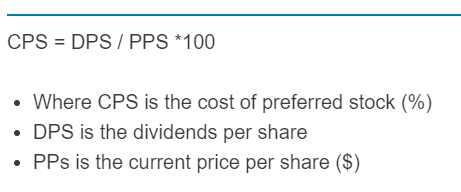
The following equation is used to calculate the cost of preferred stock.
- Where CPS is the cost of preferred stock (%)
- DPS is the fixed annual dividend per share ($)
- PPs is the current price per share ($)
For perpetual fixed-dividend preferred stock, divide the annual dividend per share by current share price, then multiply by 100. The rate-and-par option uses annual dividend = rate × par value. For a new issue with flotation costs, use net proceeds per share (issue price minus flotation cost per share) in the denominator.
Cost of Preferred Stock Definition
The cost of preferred stock is defined as the rate of return required by the holder of a company’s preferred stock.
Cost of Preferred Stock Example
How to calculate a cost of preferred stock?
- First, determine the dividends per share.
Calculate the dividends per share on an annual basis.
- Next, determine the current share price.
Calculate the current price per share.
- Finally, calculate the cost of preferred stock.
Calculate the percentage of return required on the preferred stock using the equation above.
FAQ
Preferred stock generally has dividend and liquidation priority over common stock, subject to its terms. Creditors rank ahead of shareholders, and preferred dividends may be omitted.