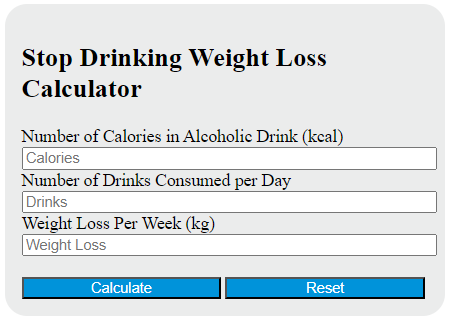
Calculate alcohol calories saved and estimated weight-change equivalents in lb or kg by day, week, month, or year, or solve for drinks and calories per serving.
Safety note: If you drink heavily, drink daily, or think you may have alcohol dependence, do not stop suddenly without medical advice—alcohol withdrawal can be life-threatening. Seek medical guidance; call emergency services right away for severe symptoms (e.g., confusion, seizures, hallucinations, trouble breathing). For reliable help and next steps, check national public-health resources (e.g., NIAAA/CDC) or a local alcohol support helpline.
Stop Drinking Weight Loss Formula
This calculator estimates the maximum theoretical weekly weight change from removing alcohol calories from your routine. It is most useful as a calorie-deficit estimate, not a guarantee of body-fat loss, because real-world results also depend on what you eat, drink, and burn during the week.
| Variable | Meaning | Typical Unit |
|---|---|---|
| C | Calories in one alcoholic drink | kcal per drink |
| D | Average number of drinks consumed per day | drinks per day |
| A | Alcohol calories removed per day | kcal per day |
| WLkg | Estimated weekly weight-change equivalent | kg per week |
| WLlb | Estimated weekly weight-change equivalent | lb per week |
How the Calculator Works
- Enter the calories in one drink you usually consume.
- Enter the average number of drinks you have per day.
- The calculator finds your daily alcohol calories removed.
- It multiplies that daily amount by 7 to estimate weekly calories removed.
- It converts that weekly calorie reduction into an estimated weekly weight-change equivalent.
The key assumption is simple: if alcohol calories are removed and not replaced elsewhere, your weekly calorie intake drops. If you replace those calories with snacks, desserts, sugary mixers, or larger meals, the actual result will be smaller.
Example
If one drink contains 150 kcal and you usually have 3 drinks per day:
In this scenario, the calculator estimates a weekly weight-change equivalent of about 0.41 kg or 0.90 lb, assuming those calories are truly removed from your diet.
Use the Right Drink Calories
Accuracy depends heavily on entering realistic calories for your actual serving size. “A drink” can vary a lot depending on alcohol type, pour size, alcohol percentage, and mixers.
| Beverage | Typical Serving | Approximate Calories | What Changes the Number |
|---|---|---|---|
| Light beer | 12 oz | 95-110 kcal | Brand and ABV |
| Regular beer | 12 oz | 140-180 kcal | ABV and carbohydrate content |
| Wine | 5 oz | 120-130 kcal | Poured size and sweetness |
| Spirits | 1.5 oz | 95-105 kcal | Proof and pour size |
| Cocktails | 1 mixed drink | 180-500+ kcal | Syrups, juice, soda, cream, liqueurs |
If you only drink on certain days, use your weekly average per day. For example, 14 drinks per week is an average of 2 drinks per day for calculator purposes.
Why Actual Results May Be Different
- Calorie replacement: many people unconsciously eat more when they stop drinking, especially late-night snacks or desserts.
- Water-weight changes: short-term scale movement may reflect hydration, sodium intake, glycogen, and digestion rather than fat loss.
- Mixer calories: cutting out beer or liquor may remove fewer calories than expected if juices, sodas, or energy drinks were not counted correctly.
- Weekend drinking patterns: binge-style drinking can add large calorie spikes that are easy to underestimate.
- Lifestyle changes: better sleep, reduced cravings, and improved activity can help results; appetite compensation can reduce them.
- Metabolic adaptation: over time, body weight does not always change in a perfectly linear way.
Tips for a Better Estimate
- Use nutrition labels or menu data whenever possible.
- Measure actual pours instead of guessing.
- Include calories from mixers, creamers, syrups, and added sugar.
- Base drinks per day on your average over a full week, not just one night.
- Recalculate if your drink choice, serving size, or frequency changes.
- Treat long-term projections as rough estimates, not guarantees.
What This Calculator Tells You
This calculator is best understood as a calorie-equivalent weight estimate. It answers the question: “If I remove these alcohol calories and do not replace them, what weekly weight change might that represent?” It does not directly measure body-fat loss, muscle change, or health outcomes.
Common Questions
- Will stopping alcohol always lead to weight loss?
- No. Weight loss depends on total calorie intake and expenditure. If alcohol calories are replaced by food or other drinks, the scale may not change much.
- Does this calculator work for beer, wine, and liquor?
- Yes. The most important input is the calorie amount per drink. Any beverage type can be used as long as the calorie entry is realistic.
- Can I use kilojoules?
- Yes. If your label shows kilojoules, convert to kilocalories first or use the calculator’s unit option if available.
- Is the result weekly fat loss?
- Not exactly. It is a weekly weight-change equivalent based on calorie reduction. Actual fat loss can be higher or lower depending on overall habits and physiology.
- Why might I lose weight quickly at first?
- Early changes often include water-weight shifts along with reduced calorie intake, especially if drinking was frequent or accompanied by high-sodium foods.
Important Health Note
If you drink heavily, drink daily, or think you may be dependent on alcohol, do not stop suddenly without medical guidance. Alcohol withdrawal can be serious and, in some cases, dangerous. The calculator estimates calories only; it does not replace medical care or addiction support.