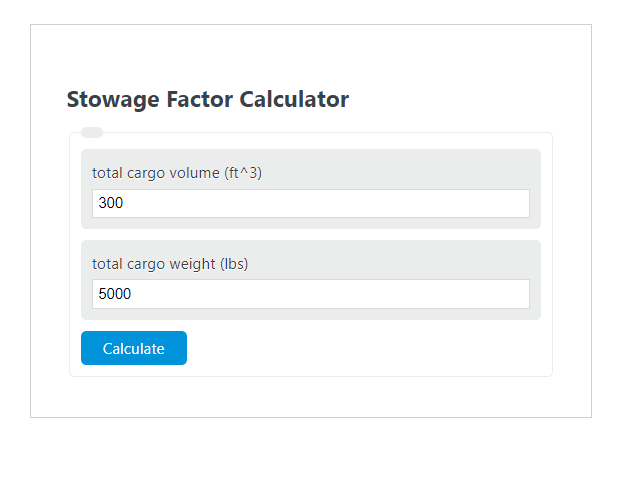
Calculate cargo stowage factor, required hold volume, or cargo weight with metric and imperial unit conversions plus optional broken stowage.
Related Calculators
- Bin Volume Calculator
- CCM to CBM Conversion Calculator
- Brix Density Calculator
- Cords of Wood Calculator
- All Unit Converters
Stowage Factor Formula
The stowage factor tells you how much space a cargo occupies for each unit of weight. It is a core planning metric in shipping, warehousing, and freight loading because it shows whether a cargo is likely to be limited by available space or by allowable weight.
In general, stowage factor is volume divided by weight. The exact numeric result depends on the units you use. In maritime applications, the value is often expressed in cubic feet per long ton, which is why a conversion factor may be needed.
Variables
| Variable | Description | Typical Units |
|---|---|---|
| SF | Stowage factor | ft³/lb, ft³/short ton, ft³/long ton, m³/kg, m³/metric ton |
| V | Total cargo volume | ft³, m³, L |
| W | Total cargo weight | lb, kg, short ton, metric ton |
Common Unit Forms
| Output Unit | Formula | Notes |
|---|---|---|
| ft³/lb | SFft³ / lb = Vft³ / Wlb |
Direct imperial volume-per-pound result |
| ft³/short ton | SFft³ / short ton = Vft³ × 2000 / Wlb |
Uses 1 short ton = 2,000 lb |
| ft³/long ton | SFft³ / long ton = Vft³ × 2240 / Wlb |
Common maritime convention |
| m³/kg | SFm³ / kg = Vm³ / Wkg |
Direct metric volume-per-kilogram result |
| m³/metric ton | SFm³ / metric ton = Vm³ × 1000 / Wkg |
Uses 1 metric ton = 1,000 kg |
How to Calculate Stowage Factor
- Measure or estimate the total cargo volume.
- Determine the total cargo weight using the same shipment basis.
- Select the unit system you want for the answer.
- Apply the matching formula.
- Interpret the result as space required per unit of weight.
A higher stowage factor means the cargo is bulkier for its weight and will consume more space. A lower stowage factor means the cargo is denser and will consume less space per unit of weight.
Example
If a shipment has a total cargo volume of 300 ft³ and a total cargo weight of 5,000 lb, the direct imperial stowage factor in cubic feet per pound is:
If you want the answer in cubic feet per short ton:
If you want the answer in cubic feet per long ton:
Why Stowage Factor Matters
- Load planning: Helps determine how much cargo can fit into a hold, trailer, container, or warehouse bay.
- Space vs. weight limits: Shows whether a shipment will run out of cubic capacity before reaching the maximum allowable weight.
- Cargo comparison: Makes it easier to compare dense and lightweight goods on a consistent basis.
- Freight efficiency: Supports better packing, stacking, and equipment selection.
Practical Notes
- Use consistent units for both the volume and the weight before calculating.
- Include packaging, pallets, dunnage, or handling materials if they materially affect the occupied space.
- For mixed cargo, use total combined volume divided by total combined weight to get the shipment-level stowage factor.
- If cargo settles, compresses, or expands in transit, the effective stowage factor can change.
- Be careful with the word ton; short ton, long ton, and metric ton are different units.
Common Mistakes
- Mixing metric and imperial units without converting first.
- Using net product weight but gross loaded volume.
- Confusing short tons with long tons in maritime calculations.
- Entering a very small weight with a large volume and misreading the result due to unit selection.