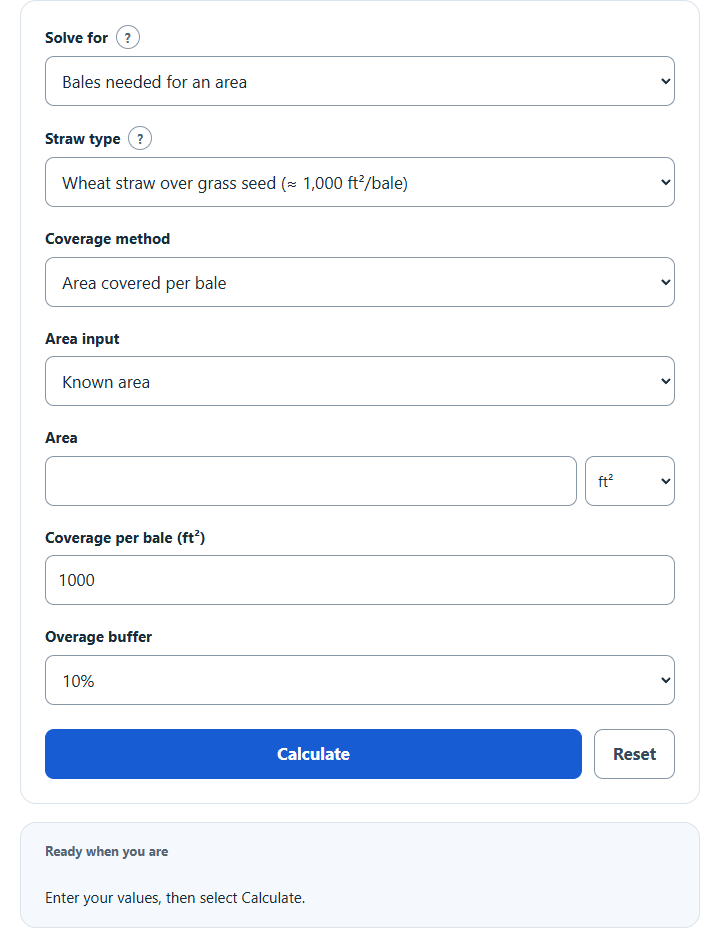
Estimate how many bales of straw you need to cover an area, such as wheat straw over grass seed or pine straw mulch, or the area your bales will cover.
Related Calculators
- Horse Per Acre Calculator
- Acres Per Hour (mowing) Calculator
- Trash Bag Size Calculator
- Ball Pit Calculator
- All Everyday Life and Education Calculators
Straw Coverage Formula
For bale planning, let C be coverage in ft²/bale and p the buffer percentage: bales needed = ceiling[A × (1 + p/100)/C], and area from N available whole bales = N × C/(1 + p/100). With an application rate r in lb per 1,000 ft² and bale weight w in lb, C = 1,000 × w/r. The selected 10% initial buffer is an allowance assumption, not an application recommendation. The separate formula below estimates geometric installed volume from area and depth; it does not determine bales or mass without suitable material/vendor information.
Variables:
- SC is geometric installed volume (cubic yards), not a bale count or mass
- A is the area to be covered (square feet)
- D is the depth of straw (inches)
For this geometric volume, multiply area in ft² by depth in inches, divide by 12 to convert depth to feet, then divide by 27 to convert ft³ to yd³. Thus SC = A × D/324. Loose, baled and installed material can differ in compaction; use vendor coverage at the intended installed depth for a bale estimate.
What is Straw Coverage?
Straw coverage may describe the area covered under a specified application method, or the geometric volume needed for a stated area and installed depth. The calculator estimates bales or area using supplied rates or coverage, not a universal bale size or depth conversion. Material, bale size, compaction and installation affect actual coverage; verify project requirements rather than treating an illustrative preset as an application standard.
How to Calculate Straw Coverage?
The following steps calculate the separate geometric-volume example. For the bale calculator above, pick a straw type for typical coverage, or choose Custom and enter an application rate and bale weight or your vendor’s area per bale.
- First, determine the area to be covered (A) in square feet.
- Next, determine the desired depth of straw (D) in inches.
- Use SC = (A × D)/324 when A is in ft² and D is in inches.
- Finally, calculate the Straw Coverage (SC) in cubic yards.
- Check the ft², inch and yd³ conversions. This volume alone does not give bale count or weight; the calculator above uses a typical or entered coverage per bale.
Example Problem :
Use the following variables as an example problem to test your knowledge.
Area to be covered (A) = 500 square feet
Desired installed depth D = 3 inches = 0.25 ft. For A = 500 ft², geometric volume = 500 × 0.25 = 125 ft³, or 125/27 ≈ 4.62963 yd³. This does not establish a bale count without appropriate material/vendor coverage data.