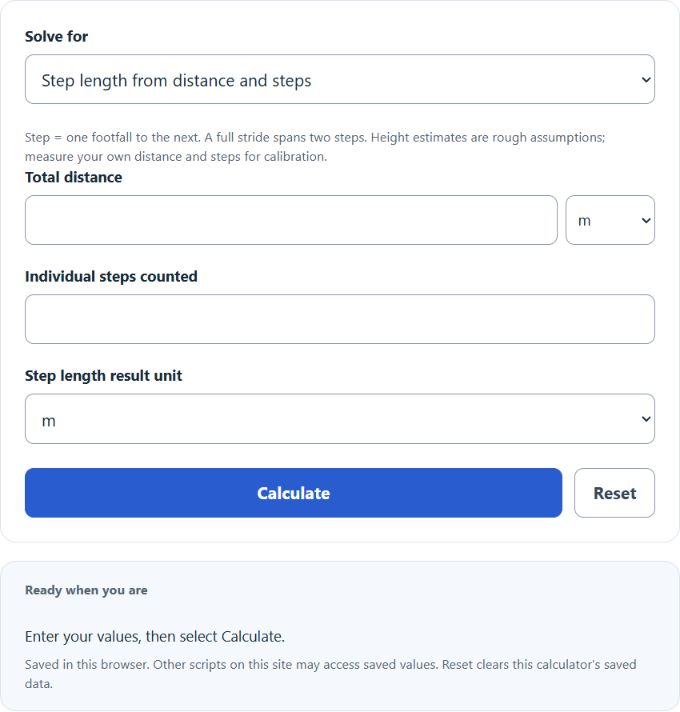
Calculate stride length, steps, distance, pace and speed, or estimate step length from height for walking and running in meters, feet, cm, or inches.
Note on estimates: The “Step length estimate from height” option uses assumed height-based rules of thumb (for walking, a commonly used approximation is step length ≈ height × 0.413). Running step length varies substantially with pace and form, so any height-based running estimate is only a rough starting point. For best accuracy, calibrate by walking/running a known distance and computing your personal distance per step; for clinical gait or rehabilitation decisions, consult a qualified clinician. The retained running factor is 0.65. Neither factor is a validated prediction for an individual. Last reviewed: 2026-10-12.
Stride Length Formula
Step-length and stride-length terms
| Term | Meaning | Useful measurement |
|---|---|---|
| Step length | Distance from one foot contact to the next foot contact | Total distance divided by individual steps |
| Stride length | Distance from one foot contact to the next contact of the same foot | About two step lengths for an even gait |
| Cadence | Individual steps completed per minute | Count steps over a timed interval |
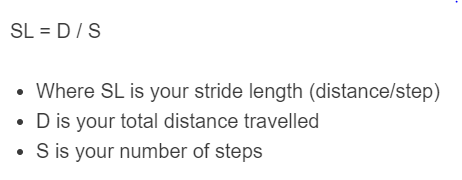
The formulas below show both the distance per step (often called “stride length” in step-counting/pedometer contexts) and the distance per full stride (two steps) used in gait analysis.
- D is your total distance traveled
- S is your total number of steps
- The calculator also shows a two-step stride estimate: twice the mean distance-per-step result. This does not measure left–right asymmetry.
To calculate distance per step, divide the distance traveled by the number of steps.
Stride Length Definition
In step-counting apps and pedometers, “stride length” is often used to mean the distance per step (more formally called step length). In gait analysis, stride length usually means the distance covered in two steps (one full gait cycle, e.g., heel strike to the next heel strike of the same foot). Either way, step/stride length varies from person to person and typically changes with speed.
How to calculate stride length?
- First, determine an accurate distance that you can walk or run that you know the start and finish of. For example, you may know the distance of one lap of a track to be 400 m.
- Next, start walking or running along that distance and measure your total number of steps.
- Finally, using the formula above, calculate your distance per step by dividing the total distance by the number of steps (and multiply by 2 if you need stride length in the two-step/gait-analysis sense).
FAQ
In step-counting, stride length is often used to mean the distance covered per step (step length). In gait analysis, stride length usually means the distance covered in two steps (one full gait cycle).
Yes. As speed increases, you typically take longer steps/strides and/or a higher cadence, so stride length differs between walking and running.
There is no single ideal. For distance running, many runners benefit from avoiding overstriding and using a comfortable stride with an appropriate cadence; sprinting generally uses longer strides and a high cadence.
Usually, yes. Speed increases when stride/step length, cadence (steps per minute), or both increase.
It varies with pace, body proportions and gait. Measure distance and count individual steps at the pace of interest; a full stride combines one left and one right step.
Stride length is important because it helps determine speed (along with cadence). Monitoring stride length and cadence can also help improve efficiency and avoid overstriding.
Sources
Murray MP. Gait as a total pattern of movement. National Institute of Standards and Technology. Guide for the Use of the International System of Units (SI).