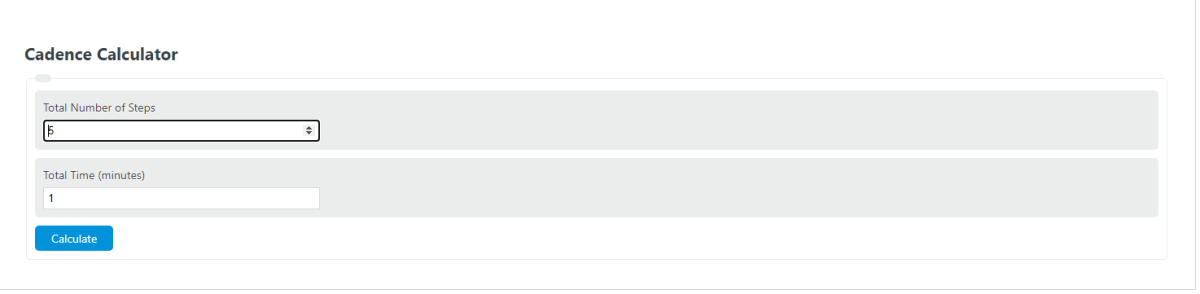
Calculate running cadence, pace, speed, and average step length from a recorded run, or plan pace and total steps from a target cadence in metric or imperial units.
Cadence Formula
The calculator uses cadence in steps per minute. For running, cadence usually means total steps from both feet.
- C = cadence in steps per minute, or spm
- S = steps counted
- T = count time in seconds
If you count one foot only, the result is doubled:
- C = total running cadence in spm
- S = steps counted for one foot
- T = count time in seconds
Use a normal section of your run. Avoid starting, stopping, hills, and sharp turns when counting.
- C = cadence in spm
- v = running speed in meters per second
- L = stride length per step in meters
- L = stride length per step in meters
- v = running speed in meters per second
- C = cadence in spm
- v = running speed in meters per second
- C = cadence in spm
- L = stride length per step in meters
Pace is converted to speed before these formulas are used. Stride length means distance covered per step, not a full left-right cycle.
- E = estimated ideal cadence midpoint in spm
- P = easy run pace in minutes per mile
The ideal cadence mode uses this as a starting estimate. It limits the midpoint to a practical range, then shows about 4 spm below and above that midpoint. If height is entered, a small height adjustment is applied. This is a guide, not a rule.
Running Cadence Reference Tables
Use these ranges to interpret your result. A higher cadence is not always better. Pace, height, terrain, and running style all matter.
| Cadence | Common interpretation | What it may suggest |
|---|---|---|
| Below 150 spm | Lower turnover | You may be using a longer, slower step pattern. |
| 150 to 164 spm | Common easy-run range | Often normal for relaxed running. |
| 165 to 175 spm | Strong everyday range | Common for steady running and many trained runners. |
| 176 to 185 spm | Fast turnover | Often seen at faster paces or with shorter steps. |
| 186 spm and above | Very quick turnover | May be natural at high speed, but can feel rushed at easy pace. |
| How you count | 15 seconds | 30 seconds | 60 seconds |
|---|---|---|---|
| Every step | steps × 4 | steps × 2 | steps × 1 |
| One foot only | steps × 8 | steps × 4 | steps × 2 |
How to Use Your Cadence Result
If your cadence feels comfortable and you are running well, you may not need to change it. If you want to increase cadence, make small changes. Try adding 3 to 5 spm for short parts of a run, then reassess.
Do not force a specific number such as 180 spm. A taller runner, slower pace, trail surface, or hill can all lower cadence naturally. Use the result as a reference point, then match it to comfort, pace, and running form.