Calculate rowing stroke rate, 500m split, watts, meters per stroke, and workout time from strokes, distance, and time, including speed.
Note: This calculator provides training-metric estimates and is not medical advice. If you have a health condition, are new to exercise, or feel pain or dizziness, stop and consult a qualified professional.
How Rowing SPM Is Calculated
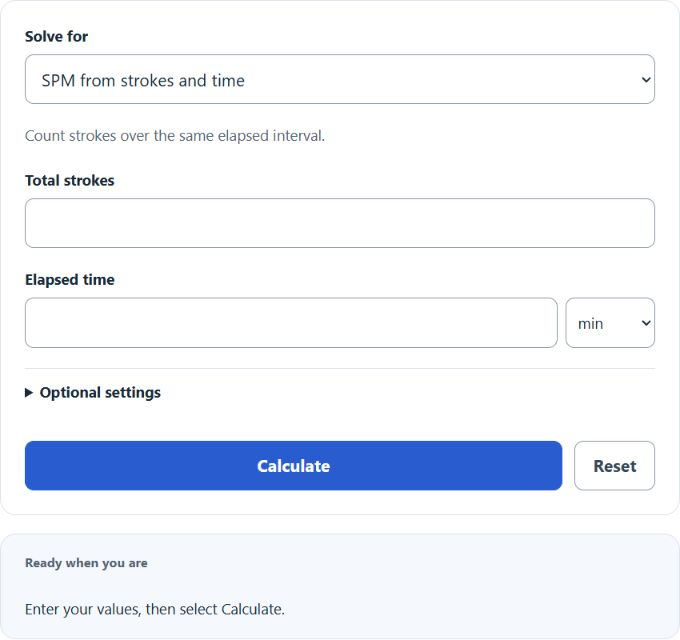
Strokes per minute (SPM) is rowing cadence. The primary equation is SPM = total strokes / elapsed minutes. Choose the value to solve, enter the other two required values, and the calculator also reports time per stroke. If workout distance is supplied, it adds meters per stroke and strokes per 500 meters.
Pace, Power, and Target-Rate Modes
The Pace mode solves distance, cumulative time, or 500-meter split from the other two values and derives Concept2 modeled watts from the 500-meter split; other machines may use different calibration. Target Rate mode connects split, SPM, and meters per stroke so you can see the cadence or efficiency needed for a target pace.
| Question | Required inputs | Primary relationship |
|---|---|---|
| Find SPM | Total strokes and elapsed time | strokes / minutes |
| Find time | Total strokes and SPM | strokes / SPM |
| Find strokes | SPM and elapsed time | SPM × minutes |
| Find 500 m split | Distance and cumulative time | 500 × time / distance |
| Find meters per stroke | Speed and SPM | speed × 60 / SPM |
Reading the Results
SPM describes cadence, not rowing quality by itself. Compare it with split, watts, and meters per stroke. A faster split at the same SPM generally reflects more distance per stroke, while a higher SPM with unchanged split can indicate shorter effective strokes. Use repeatable pieces and similar drag settings when comparing sessions.
Sources
Concept2 Pace Calculator and Watts Calculator. Optional body-weight comparisons use Concept2’s published factor: (body weight in lb / 270)0.222. Adjusted time equals raw time times this factor; adjusted distance equals raw distance divided by it. These are alternative modeled comparisons, not official ranking scores. The same formula applies to women and men, without an age multiplier. Age and category remain context only.