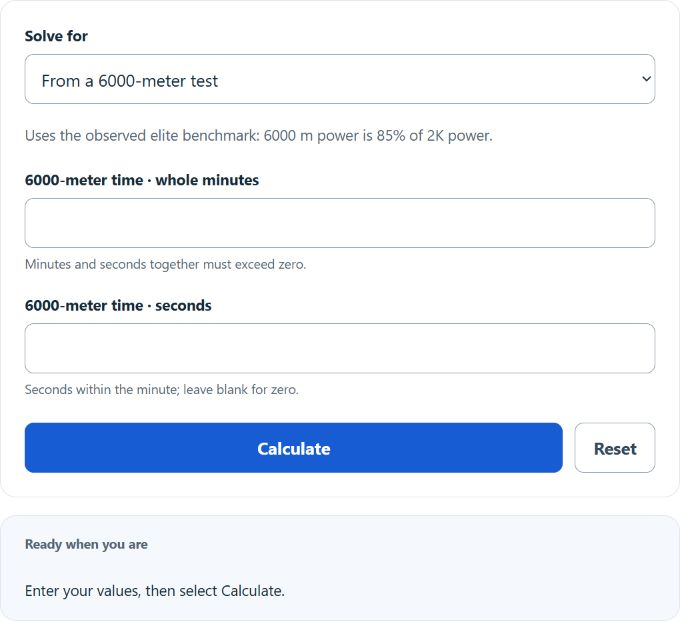
Estimate a 2K erg time from a 6000-meter test, a 60-minute test, or a custom reference result with a transparent power relationship.
How the 2K Erg Projection Works
The calculator converts the reference result to average watts, divides that power by an explicit reference-to-2K power ratio, and converts the resulting 2K watts back to a 500-meter split. Four unrounded splits produce the predicted 2K time. Equivalently, predicted split = reference split × cube root(reference-power percentage ÷ 100). The power relationship applies to comparable Concept2 indoor-rower tests.
| Reference test | Power relationship used | How to interpret it |
|---|---|---|
| 6000 m | Reference watts = 85% of 2K watts | World Rowing-reported elite benchmark |
| 60 minutes | Reference watts = 76% of 2K watts | World Rowing-reported elite benchmark |
| 500 m, 30 minutes, or another test | User-entered percentage | Use personal or team test history |
Why 500 m and 30-minute tests are custom
A short sprint emphasizes anaerobic power, while a 30-minute piece emphasizes sustained aerobic work. There is no single percentage that translates either result accurately for every rower, so the calculator does not invent one.
Entering and reading time
Enter whole minutes for the 6000-meter test and seconds below 60. For custom tests, hours and minutes are whole numbers, minutes run from 0 to 59, and seconds stay below 60. Blank clock components mean zero, but the total test time must exceed zero. Custom reference power supports 10–300% of expected 2K power. Clock results round to one tenth of a second; cumulative pacing uses the unrounded split.
Reading the prediction
The output is most useful as a planning estimate and as a repeatable comparison when the same test and percentage are used. Recent test conditions, pacing, fatigue, and training profile can move the actual 2K result.
Sources
Sources: World Rowing, Using the indoor rower for testing: why do we test different distances? (2019); Concept2 Pace Calculator and formulas. Verified October 12, 2026.