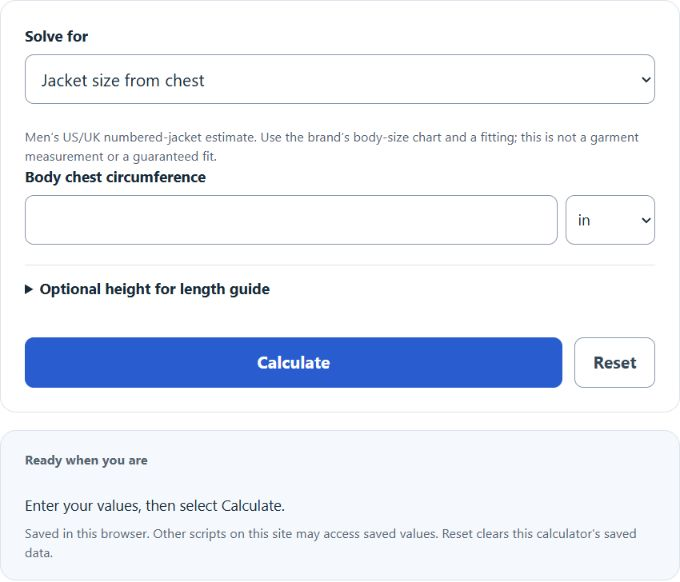
Calculate suit jacket size from chest measurement or estimate chest from US/UK size, with optional height-based short, regular, or long length.
- Every Day Life And Education Calculators
- Dress Length Calculator
- Chest to Waist Ratio Calculator
- Torso Length Calculator
Suit Size Formula
For most men’s US/UK suit jackets, the numeric jacket size is estimated from the chest circumference measured at the fullest part of the chest. This calculator uses the chest measurement in inches rounded to the nearest even number, with exact odd-inch ties rounded up. This is a stated heuristic; some brands also offer odd-numbered sizes. The length letter is then chosen separately based on height and proportions.
- S = estimated jacket size
- C = chest circumference in inches
If your chest measurement is in centimeters, convert it to inches before estimating the size.
If you already know the jacket number and want a quick chest estimate, the tagged size is usually close to the body chest measurement in inches.
This is a sizing guideline, not a tailoring rule. Different brands build more or less room into the chest, waist, shoulder, and sleeve, so the calculator should be used as a strong starting point rather than a guaranteed final fit.
How Suit Sizing Works
A standard suit jacket size has two parts:
- Number: the chest-based size, such as 38, 40, 42, or 44
- Letter: the jacket length, usually S for short, R for regular, and L for long
For example, a 40R is typically intended for someone with an approximately 40-inch chest and average height proportions. The trousers are often sized separately, so jacket size does not automatically tell you the correct pant waist or inseam.
How to Measure Chest Correctly
- Stand naturally with your arms relaxed.
- Wrap a soft measuring tape around the fullest part of your chest.
- Keep the tape level across the back and under the arms.
- Do not pull the tape tight; it should be snug but not compressing the body.
- Measure over a dress shirt or a thin base layer if that reflects how you will usually wear the jacket.
If the measurement falls between sizes, your build and preferred fit matter:
- Closer, slimmer fit: stay at the lower nearby size if the brand runs generous
- More room for comfort or layering: choose the higher nearby size
- Broad shoulders, larger arms, or athletic chest: sizing up is often more comfortable
Typical Jacket Length Guide
Height is commonly used to suggest the jacket length suffix. The table is approximate; this tool uses S below 173 cm, R from 173 through 183 cm, and L above 183 cm. Brand cutoffs and body proportions vary.
| Length Code | Typical Height | General Use |
|---|---|---|
| S | About 5’4" to 5’7" | Shorter jacket body and sleeve proportions |
| R | About 5’8" to 6’0" | Standard proportions for most men |
| L | About 6’1" to 6’3" | Longer sleeves and jacket body |
Some brands also offer extra-short or extra-long lengths, but S, R, and L are the most common categories used for quick estimation.
Common Chest-to-Jacket Size Estimates
| Measured Chest | Estimated Jacket Size | Typical Label |
|---|---|---|
| 36 in | 36 | 36S / 36R / 36L |
| 38 in | 38 | 38S / 38R / 38L |
| 39 in | 40 | Most brands use even-numbered sizing |
| 40 in | 40 | 40S / 40R / 40L |
| 41 in | 42 | Often rounded up to the next even size |
| 42 in | 42 | 42S / 42R / 42L |
| 44 in | 44 | 44S / 44R / 44L |
| 46 in | 46 | 46S / 46R / 46L |
How to Use the Calculator
- Select jacket size from chest, then enter your body chest circumference with its unit. For the reverse estimate, select nominal chest from jacket size.
- Add your height if you want a suggested length category.
- Select Calculate to display the estimate. Blank optional height omits the length guide.
- Use the result as your starting size when shopping online or narrowing down fitting-room options.
If you already know a jacket size, the calculator can also help you estimate the corresponding chest measurement. That is useful when comparing brand charts, resale listings, or secondhand suit jackets where only the tag size is shown.
Important Fit Factors the Calculator Cannot Fully Capture
- Shoulder width: the most important structural fit point in a jacket
- Drop: the difference between chest and waist, which affects how trim the jacket feels
- Fit type: slim, tailored, modern, and classic fits can feel very different at the same tagged size
- Fabric: stiffer fabrics drape differently than stretch blends
- Brand pattern: some labels cut broader in the chest, others narrower in the waist
Because of these factors, two jackets marked with the same size can fit differently. If the shoulder fits correctly, a tailor can usually refine the waist, sleeve length, and trouser details more easily than fixing a jacket that is fundamentally too small across the chest or shoulders.
Quick Fit Checks After You Get a Size
- The jacket should button without pulling hard across the chest.
- The lapels should lie flat rather than bowing outward.
- The shoulders should end near your natural shoulder edge, not beyond it.
- The sleeve should usually allow a small amount of shirt cuff to show.
- The jacket should feel secure when standing, sitting, and moving your arms.
Frequently Asked Questions
Does suit size equal chest size?
Usually, yes for men’s US/UK jacket sizing. A size 40 jacket is generally built for someone with a chest measurement around 40 inches, though the garment itself includes additional ease for movement and comfort.
What if my chest measurement is an odd number?
Many ready-to-wear ranges use even-numbered sizes, while some brands also sell odd numbers. This tool rounds an odd-inch tie up to the next even number. Try both nearby sizes and consult the brand chart before choosing.
Why can two size 42 jackets fit differently?
The size number only gives a chest-based starting point. Shoulder shape, waist suppression, sleeve pitch, fabric, and brand-specific cuts all affect the final fit.
Is this calculator for pants too?
No. Jacket size and trouser size are related only loosely in many suits. Pants are usually chosen using separate waist and inseam measurements.