Calculate exercise sweat rate and a fluid plan. Optionally enter a measured sweat-sodium concentration; the calculator never infers it from sweat rate.
Sweat Rate Formula
The calculator uses the standard weigh-in method recommended in sports medicine. Your sweat rate is the total fluid you lost per hour of exercise:
SR = (Wpre - Wpost + F + Fd - U) / t
Variables:
- SR is your sweat rate in liters per hour (1 kg of body mass change is treated as 1 L of sweat)
- Wpre is your body weight before exercise, in kg
- Wpost is your body weight immediately after exercise, in kg
- F is the fluid you drank during exercise, in L
- Fd is the weight of any food eaten during exercise, in kg (optional, under advanced options)
- U is any urine passed during the session, in L (optional, under advanced options)
- t is the exercise duration in hours
The calculator also reports the percentage of body mass you lost, which is the number used to judge how dehydrated you finished:
PD = (Wpre - Wpost) / Wpre * 100
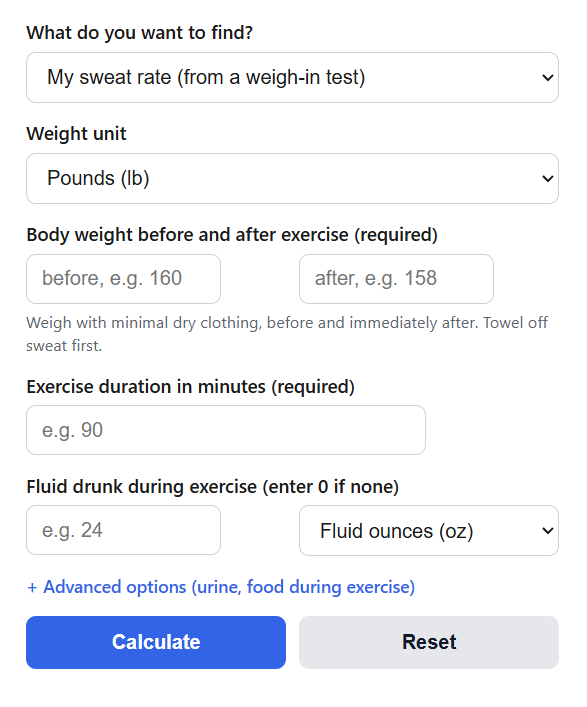
In “My sweat rate” mode you enter your before and after weights, the fluid you drank, and the session length, and the tool returns your sweat rate in L/hr, oz/hr, and mL/hr, your percent of body mass lost with an interpretation, and a rehydration target for the rest of the day. In “Drink plan” mode you enter a sweat rate you already know, your body weight, and a planned session length, and the tool works the formula in reverse to find the drinking rate that keeps your loss at or under 2 percent of body mass:
DR = SR - (0.02 * Wpre) / t
DR is the recommended drinking rate in L/hr, shown per hour and per 15 minutes. The recommendation is capped at 1 L/hr because most people cannot comfortably absorb more than that during exercise.
Typical Sweat Rates and What Your Result Means
Sweat rate is highly individual and depends on body size, intensity, heat, humidity, clothing, and how heat-adapted you are. The ranges below, drawn from published sports science testing, show where most athletes land. Use them to sanity-check your result, not to replace a weigh-in test.
| Activity and conditions | Typical sweat rate |
|---|---|
| Walking or easy hiking | 0.3 to 0.8 L/hr |
| Gym or strength training | 0.4 to 0.9 L/hr |
| Cycling, cool to moderate weather | 0.6 to 1.2 L/hr |
| Running, cool to moderate weather | 0.8 to 1.4 L/hr |
| Team sports in the heat (soccer, basketball) | 1.0 to 2.0 L/hr |
| Running or cycling, hot and humid | 1.2 to 2.5 L/hr |
| American football in pads, summer practice | 1.5 to 2.5+ L/hr |
The second table interprets the percent of body mass lost, the figure the calculator reports after a weigh-in test.
| Body mass change | What it means |
|---|---|
| Gain | You drank more than you sweated. Regular large gains raise hyponatremia risk, so drink less next time. |
| 0 to 1% loss | Well hydrated, minimal effect on performance. |
| 1 to 2% loss | Mild dehydration. Endurance in hot conditions may start to slip near the top of this range. |
| 2 to 3% loss | Measurable drop in endurance performance, higher heart rate and core temperature. |
| 3 to 5% loss | Clear performance and focus decline, elevated risk of cramps and heat exhaustion. |
| Over 5% loss | Health risk. Rehydrate promptly and rework your drinking plan before the next session. |
Example Problems
Example 1: You weigh 160 lb before a 90-minute run and 158 lb after, and you drank 24 oz of sports drink along the way. The 2 lb drop equals 0.91 kg, and 24 oz equals 0.71 L. Total sweat loss is 0.91 + 0.71 = 1.62 L. Dividing by 1.5 hours gives a sweat rate of 1.08 L/hr, or about 36.5 oz/hr. You finished only 1.3 percent down, so your drinking roughly kept pace, and a rehydration target of about 1.1 to 1.4 L covers the rest of the day.
Example 2: You already know your sweat rate is 1.4 L/hr and you weigh 75 kg, and you are planning a 120-minute ride. Projected sweat loss is 1.4 * 2 = 2.8 L, which would be 3.7 percent of body mass with no drinking. A 2 percent loss for you is 1.5 kg, so the calculator recommends drinking (2.8 – 1.5) / 2 = 0.65 L/hr, about 163 mL every 15 minutes. You still finish 1.5 L down, so it also sets a post-ride rehydration target of about 1.9 to 2.3 L.
Sweat Rate Calculator FAQ
How often should you retest your sweat rate?
Retest whenever your conditions change in a meaningful way: the start of summer, a new sport or intensity, altitude, or after a few weeks of heat acclimation, which can raise sweat rate noticeably. Most athletes benefit from a test in cool weather and another in hot weather so they have two reference points. A single 60- to 120-minute session at your normal intensity is enough for each test.
Should you try to replace 100 percent of your sweat while exercising?
No. Drinking at your full sweat rate is usually neither practical nor necessary, and for heavy sweaters it can exceed what the gut can absorb, which is roughly 0.8 to 1 L/hr for most people. The evidence-based target is to finish within about 2 percent of your starting body mass, which is why the drink plan solves for that threshold instead of full replacement. Finishing slightly light and then rehydrating with 1.25 to 1.5 L per kg lost is the standard approach.
How is sodium loss estimated?
Sweat rate alone cannot determine sweat sodium. When a measured concentration is entered, the calculator multiplies it by sweat loss; otherwise no sodium estimate is shown.