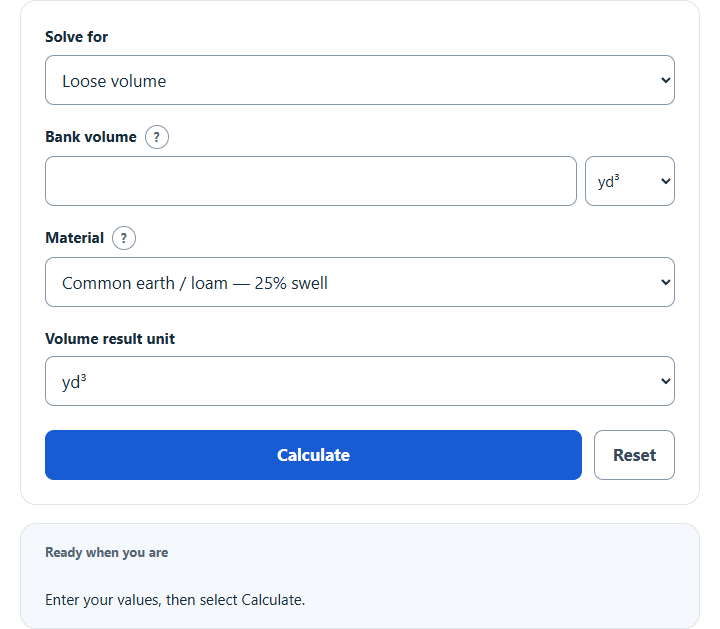
Calculate soil swell: convert bank volume to loose volume using typical material swell factors or your own, find swell %, or estimate truck trips.
Related Calculators
- Expansion Ratio Calculator
- Saturated Unit Weight Of Soil Calculator
- CBR Ratio Calculator
- Slurry Volume Calculator
- All Construction Calculators
Swell Factor Formula
The following formula is used to calculate the loose volume of material after excavation:
Variables:
- BV is the bank volume (cubic yards)
- SF is the swell factor (percentage)
- LV is the loose volume (cubic yards)
Multiply bank volume by 1 + swell percentage / 100. Here 20% swell means a loose/bank multiplier of 1.20. Negative percentages represent contraction. Truck trips are rounded upward from loose volume divided by usable loose-volume capacity; material presets use typical swell values from US Army FM 5-434.
What is a Swell Factor?
The swell factor is a percentage that represents the increase in volume that occurs when material is excavated from its natural state in the ground, known as bank state, to a looser state. This factor is crucial for construction and mining projects to estimate the volume of material that needs to be moved or processed after excavation.
How to Calculate Loose Volume Using Swell Factor?
The following steps outline how to calculate the loose volume using the swell factor:
- First, determine the bank volume (BV) in cubic yards.
- Next, determine the swell factor (SF) as a percentage.
- Use the formula LV = BV * (1 + SF / 100) to calculate the loose volume (LV).
- Finally, calculate the loose volume in cubic yards.
- After inserting the variables and calculating the result, check your answer with the calculator above.
Example Problem:
Use the following variables as an example problem to test your knowledge.
Bank volume (BV) = 50 cubic yards
Swell factor (SF) = 20%. Loose volume = 50 × 1.20 = 60 cubic yards.