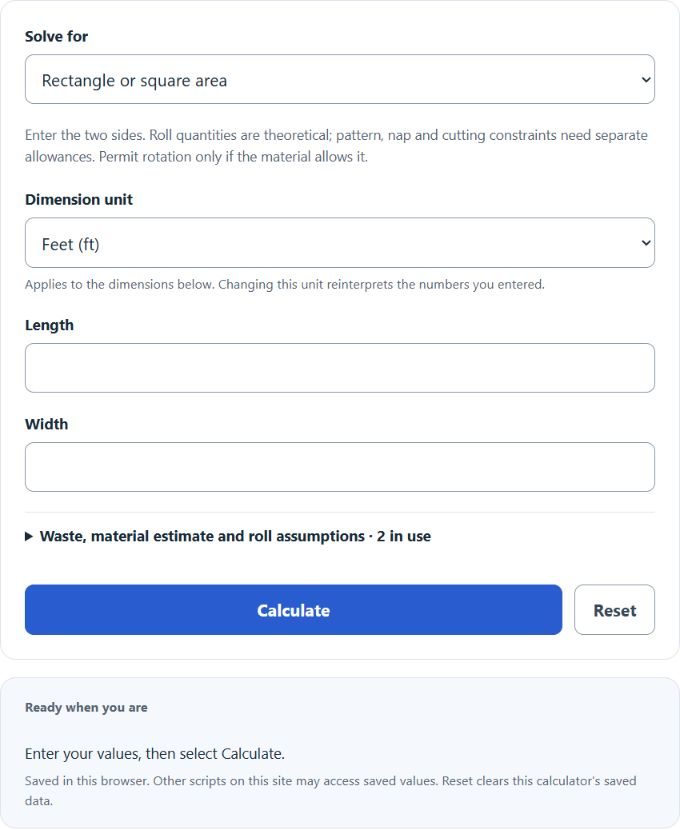
Calculate square yards (SY) for five shapes, convert a known area, or solve a missing rectangular side. Optional allowances, material-price and roll-width settings provide separate area and layout estimates.
- All Unit Converters
- Cost Per Square Foot Calculator
- Floor to Area Ratio Calculator
- Shiplap Calculator
- Inches to Square Inches Calculator
- Cost Per Square Inch Calculator
- Cost Per Square cm Calculator
Square Yards Formula
The following rectangle formula uses length and width in yards. Other shapes and known-area conversion use the selected calculator mode.
- Where SY is the square yards (yd^2)
- L is the length of the area in yards
- W is the width of the area in yards
To calculate the square yards, multiply the length in yards by the width in yards.
Choose a rectangle, two nonoverlapping rectangles, a circle using its diameter, a triangle using its perpendicular height, or a trapezoid using parallel bases and perpendicular height. Add the two rectangle areas only when they do not overlap. The chosen length unit applies to all dimensions; changing it reinterprets the entered numbers. Known-area mode accepts in², ft², m², cm², acres or hectares. Missing-side mode assumes a rectangle.
Blank waste means 0%. Blank price omits cost; an explicit zero price produces a zero-cost estimate. The USD material estimate uses the unrounded waste-adjusted area and the selected price per yd², ft² or m². It does not use the separate whole-square-yard ceiling or strip-layout roll quantity, and excludes tax, installation and supplier billing increments.
Roll settings include 6, 12 and 15 ft, exactly 4 m, or a custom width in feet. Area-equivalent linear yards are an area-based lower bound. For rectangles, the two strip orientations compare theoretical strip counts, seams and total run; use the alternative orientation only when rotation is allowed. These estimates ignore pattern repeat, nap direction, cutting loss and supplier cut increments, and do not establish an order quantity.
What does SY stand for?
SY is most often used to describe square yards which is a unit of measure of area, denoted yd^2.
Example Problem
How to calculate square yards?
- First, determine the length of the area.
In this example, the length of the area is measured to be 50 ft.
- Next, determine the width of the area.
For this problem, the width is measured to be 100 ft.
- Next, multiply the length by the width to get the square area.
The square area is calculated to be 50*100 = 5000 ft^2.
- Finally, convert the area units into square yards.
In this example, we need to convert square feet to square yards. This is done by dividing the result from above by 9.
SY = 5000 / 9
SY ≈ 555.56 square yards (yd^2)