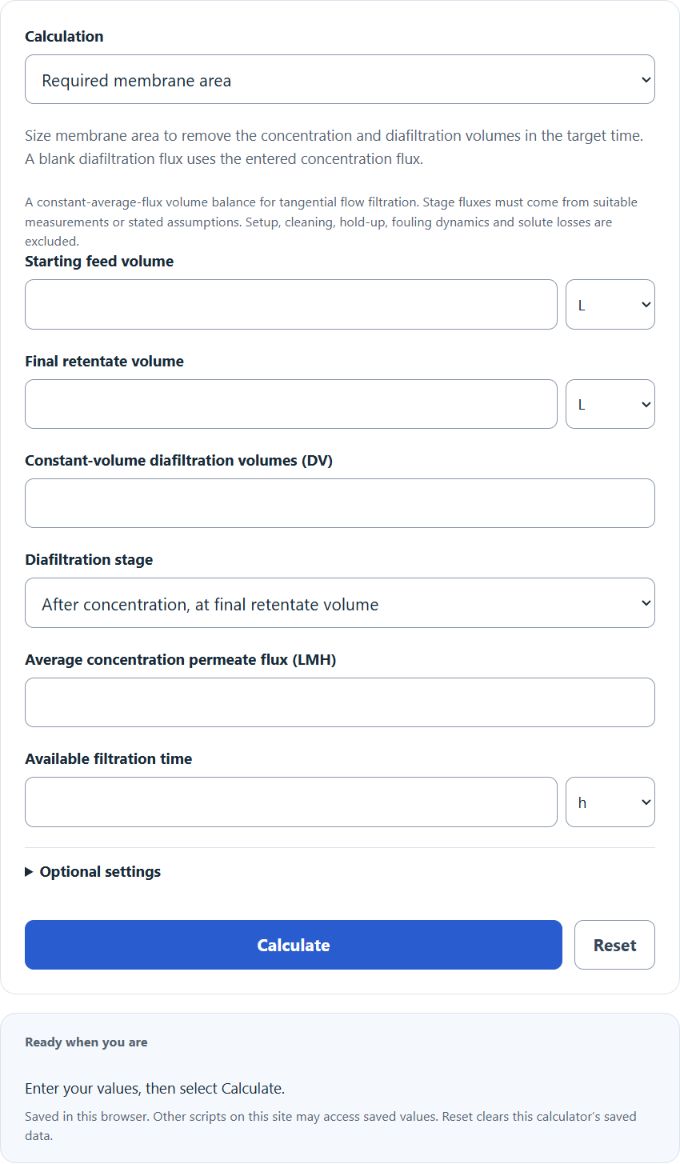
Estimate TFF membrane area, filtration duration or required average permeate flux from a batch volume balance. Include constant-volume diafiltration before or after concentration, then compare a proportional scale-up.
Volume and flux relationships
Concentration permeate Vc = starting feed − final retentate. Diafiltration permeate Vd = diavolumes × the volume present during diafiltration. Concentration factor CF = starting feed / final retentate assumes complete retention of the concentrated solute.
Area = (Vc/Jc + Vd/Jd) / T, where Jc and Jd are average stage fluxes in liters per square meter per hour (LMH), T is filtration time in hours and area is in m². A blank optional diafiltration flux uses Jc for both stages. With available area A, time = (Vc/Jc + Vd/Jd)/A.
For a single common required flux, J = (Vc + Vd)/(AT). For proportional scale-up, new area = original area × new feed / original feed, keeping CF, diavolumes, effective stage fluxes and time unchanged.
Worked example
Concentrate 10 L to 2 L, then perform 3 diavolumes at 2 L. Vc = 8 L and Vd = 6 L. At 50 LMH during concentration and 25 LMH during diafiltration, completing in 2 hours requires (8/50 + 6/25)/2 = 0.2 m². Stage times are 0.8 and 1.2 hours. Increasing the feed tenfold under the same assumptions requires 2 m².
Frequently asked questions
Why does diafiltration order affect area?
Three diavolumes at 10 L require 30 L permeate; at 2 L they require 6 L. The selected stage volume changes the work required.
Does a calculated flux mean it is achievable?
No. Validate average flux for the membrane, feed and operating conditions. Fouling and changing concentration can alter it.
Does the time include cleaning and setup?
No. It covers modeled filtration stages only, excluding hold-up, setup and cleaning.
Reference: Pall: introduction to TFF for laboratory and process development, membrane sizing and diafiltration examples.