Calculate thermal mass (heat capacity) of concrete, brick, water and other materials from size, volume or mass, plus heat stored over a temperature swing.
- All Construction Calculators
- All Mass Calculators
- Percentage Change in Mass Calculator
- Cylinder Mass calculator
- Floor to Area Ratio Calculator
Thermal Mass Formula
The following formula is used to calculate the Thermal Mass.
- Where TM is the Thermal Mass (J/m2-K)
- AE is the sum of the area of all elements (m2)
- HC is the areal heat capacity (J/m2-K)
- TFA is the total floor area (m2)
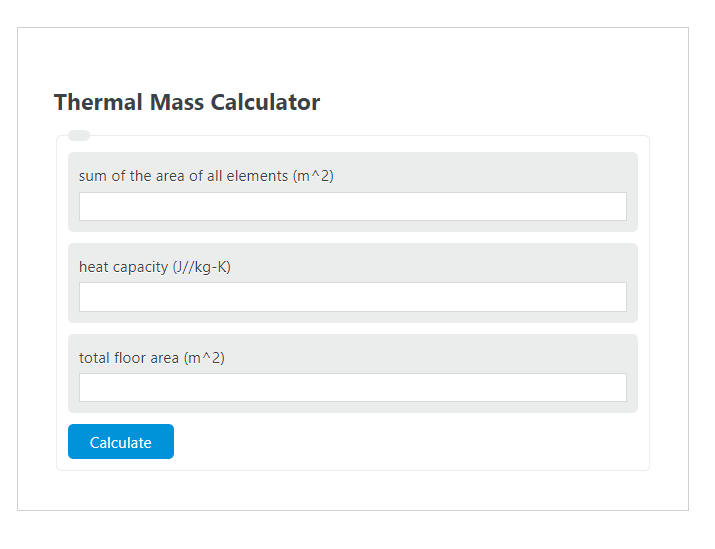
To calculate a thermal mass, multiply the sum of the areas of all elements by the heat capacity, then divide by the floor area.
How to Calculate Thermal Mass?
The following example problems outline how to calculate Thermal Mass.
Example Problem #1
- First, determine the sum of the area of all elements (m2).
- The sum of the area of all elements (m2) is calculated to be 30.
- Next, determine the areal heat capacity (J/m2-K).
- The areal heat capacity (J/m2-K) is measured to be 10.
- Next, determine the total floor area (m2).
- The total floor area (m2) is found to be 50.
- Finally, calculate the Thermal Mass using the formula above:
TM = AE * HC / TFA
The values given above are inserted into the equation below and the solution is calculated:
TM = 30 * 10 / 50 = 6 (J/m2-K)
Example Problem #2
The variables needed for this problem are provided below:
sum of the area of all elements (m2) = 76
areal heat capacity (J/m2-K) = 85
total floor area (m2) = 134
This example problem is a test of your knowledge on the subject. Use the calculator above to check your answer.
TM = AE * HC / TFA = (J/m2-K)