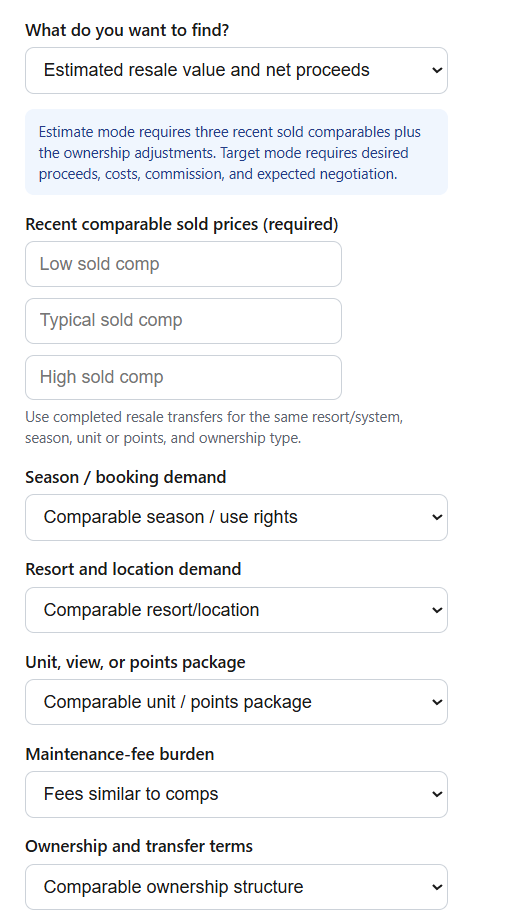
Estimate timeshare resale value, likely net proceeds, or the asking price needed from sold comparables, ownership factors, commissions, and transfer costs.
Timeshare Resale Value Formula
The calculator creates a weighted baseline from a low, typical, and high completed resale. Giving the typical comparable twice the weight reduces the effect of one extreme result:
B = (L + 2M + H) / 4
It then adjusts the baseline for the ownership being valued and for the desired selling speed:
V = B * F1 * F2 * F3 * F4 * F5
 S = V * Q
 N = S * (1 - c) - T
For a target amount of net proceeds, the calculator works backward to a required sale price and asking price:
S = (N + T) / (1 - c)
 Ask = S / (1 - d)
Variables:
- B is the weighted comparable-sale baseline
- L, M, and H are low, typical, and high completed resale prices
- V is adjusted market value
- F1 through F5 are season, location, unit, fee-burden, and contract multipliers
- Q is the quick-sale factor
- S is expected gross sale price
- N is net proceeds
- c is commission as a decimal
- T is transfer and closing cost
- d is expected negotiation discount
Use actual resale transfers or completed listings, not the developer’s original retail price. When the best comparable transactions are nominal or zero-dollar transfers, enter those values honestly; ongoing obligations can make a timeshare economically difficult to sell.
Timeshare Resale Adjustment Reference
Match the comparables as closely as possible before making adjustments. A large multiplier is not a substitute for using the correct resort, points system, ownership type, and season.
| Adjustment | 1.00 benchmark | What can move the factor |
|---|---|---|
| Season / booking demand | Same use period as comps | Prime fixed weeks, school holidays, shoulder season, or weak weeks |
| Resort / location demand | Same resort or market | Brand strength, destination demand, inventory, and resale supply |
| Unit / points package | Comparable size or points | View, room type, annual points, home-resort priority, and restrictions |
| Maintenance-fee burden | Fees similar to comps | Fee per point/night, increases, reserves, and special assessments |
| Ownership terms | Same legal/use structure | Deeded versus right-to-use, term remaining, transfer and booking rules |
Example Problems
Example 1: Comparable resales are $3,000, $4,000, and $5,500.
B = (3000 + 2 * 4000 + 5500) / 4 = $4,125.
The combined ownership adjustments equal 1.08 and the quick-sale factor is 85%, so S = 4125 * 1.08 * 0.85 = $3,786.75. After a 10% commission and $500 closing cost, N = 3786.75 * 0.90 – 500 = $2,908.08.
Example 2: You want $5,000 net after a 10% commission and $500 closing cost, and expect buyers to negotiate 10% below asking.
S = (5000 + 500) / 0.90 = $6,111.11. Ask = 6111.11 / 0.90 = $6,790.12.
Frequently Asked Questions
Why should developer purchase price be ignored?
Developer retail pricing can include sales commissions, incentives, financing, and marketing costs that do not carry into the secondary market. Completed resales better reflect what buyers currently pay for the ownership rights and obligations.
Can a timeshare have negative resale value?
Yes in an economic sense. Some ownerships transfer for a nominal amount, and an owner may pay closing, transfer, or exit costs because the buyer assumes future maintenance fees. The calculator floors net proceeds at zero but explains the cost inputs separately.
What should I verify before using a comparable sale?
Verify the resort or points system, home resort, use year, season, unit or points amount, annual versus biennial use, maintenance fees, special assessments, deeded or right-to-use status, term remaining, and transfer restrictions.