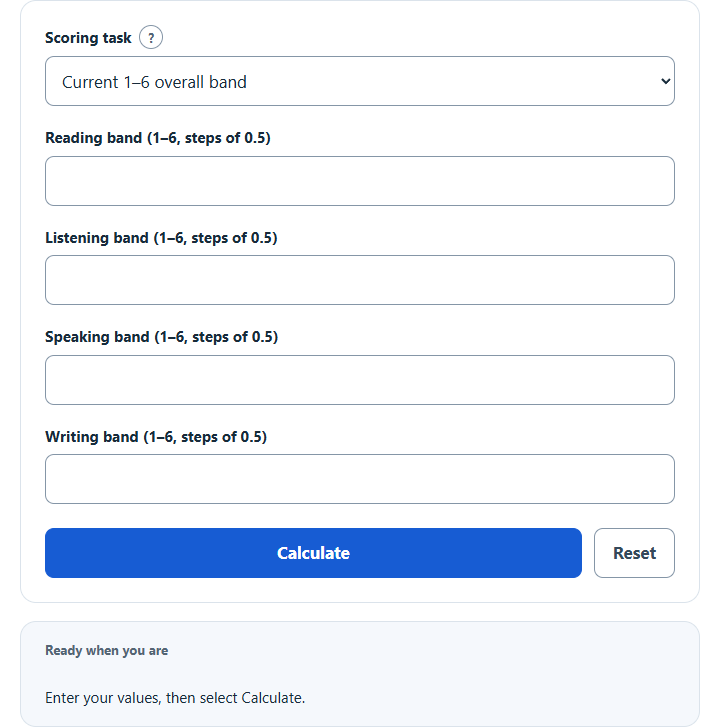
Calculate your overall TOEFL iBT score on the 2026 1–6 band scale from four section bands, or add legacy 0–30 section scores into a 0–120 total.
TOEFL Score Formula
Since January 21, 2026, TOEFL iBT uses four section bands from 1 to 6 in half-point increments. The overall band is their mean rounded to the nearest half band; an exact quarter-band tie rounds up. For example, 5, 5, 5.5 and 5.5 average 5.25 and produce 5.5. Use the current mode for these scores. A rounded overall band cannot uniquely recover a missing section score. ETS explains the current scale.
TOEFL ITP Level 1 total
The ITP task uses three scaled Level 1 scores: Listening and Structure/Written Expression each range from 31 to 68, and Reading ranges from 31 to 67. Add them, multiply by 10, divide by 3, and round to the nearest whole number. The total ranges from 310 to 677. These inputs are already scaled scores, not raw question counts. Level 2 uses a different scale; the separate ITP Speaking score is not part of this total.
ITP total = round((Listening + Structure + Reading) × 10 ÷ 3).
Comparing the iBT scales
The current overall-band result also shows a legacy 0–120 comparison range. The legacy-total task shows the corresponding 1–6 comparison band. These use ETS’s comparison table for tests taken before January 21, 2026. Multiple old-scale totals map to the same band, so this is general guidance rather than an exact prediction of an individual’s result on another test. Use your official report and the receiving institution’s requirements for applications.
Legacy 0–120 scoring
The legacy tasks use the four-section TOEFL scoring model shown below. It can do two useful things: add the four section scores to find the total score, or solve for one missing section score when the total is already known.
If you know the total and three section scores, you can rearrange the equation to find the missing value:
The formulas, table and examples below apply to legacy whole-number 0–30 section scores and their summed 0–120 total, not to the current 1–6 bands.
Score Inputs and Ranges
| Input | Meaning | Valid Range |
|---|---|---|
| Reading | Reading comprehension performance | 0 to 30 |
| Listening | Listening comprehension performance | 0 to 30 |
| Speaking | Oral response performance | 0 to 30 |
| Writing | Written response performance | 0 to 30 |
| Total Score | Combined score across all four sections | 0 to 120 |
How to Use the TOEFL Score Calculator
- Select the scoring task. For the current overall band, enter all four 1–6 section bands.
- If you want your total score, select Legacy 0–120 total and enter all four legacy section scores.
- If you want a missing section score, select the corresponding legacy section task and enter the legacy total plus the other three section scores.
- For an ITP Level 1 total, select its task and enter the three scaled section scores from the report.
- Select Calculate to display the result.
- Check that the result falls inside the valid section range before using it as a study target.
What the Calculator Is Best For
- Practice test planning: add section scores to estimate your overall TOEFL result.
- Target setting: find the section score you still need to reach a desired total.
- Score validation: confirm that your section scores and total score are mathematically consistent.
- Admissions planning: compare both your overall score and your section profile against program requirements.
Important Scoring Checks
- Each section score must remain between 0 and 30.
- The total score must remain between 0 and 120.
- If a calculated missing section is less than 0 or greater than 30, the numbers entered do not fit together.
- A target total may still be insufficient if a school also expects minimum scores in individual sections.
- This calculator adds or solves section scores; it does not convert raw question counts into official scaled scores.
Example Calculations
If your section scores are Reading 25, Listening 22, Speaking 24, and Writing 27, your total score is:
If your target total is 100 and you already have Reading 26, Listening 25, and Speaking 24, the Writing score needed is:
How to Interpret the Result
Your total score gives a quick summary of performance, but the section breakdown matters too. Two students can reach the same total with very different strengths. If you are deciding where to apply or what to study next, review the four subscores individually rather than relying on the total alone.
- Reading highlights academic reading ability.
- Listening reflects comprehension of spoken English.
- Speaking shows how clearly you can respond verbally.
- Writing reflects organization, grammar, and written development.
Common Questions
Can this calculator find a missing section score?
Yes, for the legacy summed scale. Select the legacy missing-section task and enter the total plus the other three section scores. A rounded current 1–6 total does not uniquely determine a missing section.
Why did I get an impossible result?
If the missing section calculates below 0 or above 30, the total score and section scores you entered cannot all be true at the same time.
Can I calculate an official section band from raw answers?
No universal raw-count formula is used here. ETS adjusts Reading and Listening scores for test-form difficulty and adaptive routing; Speaking and Writing also require response scoring and statistical scaling. A count or rubric total alone is insufficient to reproduce an official band. Enter the scaled section results supplied by the test or its practice report. The legacy missing-section tasks only subtract three known scaled scores from a known total.
Should I focus only on the total score?
No. Many users track the total first, but section-level performance is often more useful for study planning and application strategy.