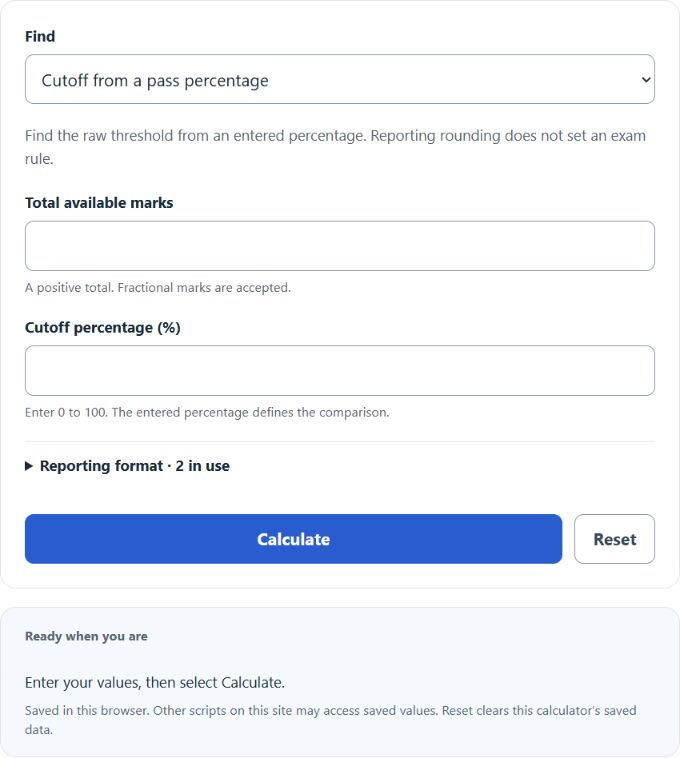
Calculate cutoff scores, pass marks, and percentile thresholds from total marks, your score, mean, and standard deviation for tests.
Related Calculators
- Cumulative Percentage Calculator
- Cutoff Value Calculator
- Passing Score Calculator
- Quiz Grade Calculator
- Overall Grade Calculator
- Marks Percentage Calculator
- All Statistics Calculators
Cutoff Score Formula
The calculator runs three modes. Each mode uses its own formula.
Pass mark mode converts a required cutoff percentage into a raw score:
Check score mode converts your raw score into a percentage and compares it to the cutoff:
Percentile cutoff mode uses the inverse normal distribution to find the score at a given percentile:
- Total: maximum possible marks, points, or questions on the test.
- Percentage: cutoff percentage required to pass or qualify.
- Score: raw marks you obtained.
- Mean: average score in the population or sample.
- SD: standard deviation of the scores.
- z: z-score that corresponds to the chosen percentile under a standard normal curve.
The percentile mode models scores with a normal distribution; it does not calculate an observed group ranking. The NIST normal-distribution reference describes its numerical quantile function, standard deviation and unbounded range. Check the model assumption before applying it to actual scores. Reporting format changes the displayed cutoff; an approximate display of the unrounded threshold is shown separately. Check score compares the declared decimal score with the unrounded percentage threshold, so reporting rounding does not decide that comparison. An institution may apply its own score or rounding rules. The percentile mode treats the input percentile as the share of values below the cutoff, so a 95th percentile cutoff places 5% of test takers above it.
Pass mark mode answers “what raw score equals X%?” Check score mode answers “did I clear the cutoff and by how much?” Percentile cutoff mode answers “what score corresponds to the top N% of a normally distributed group?”
Reference Tables
Illustrative percentages and their raw thresholds on a 100-mark paper. These rows do not establish any exam’s pass or admission policy:
| Cutoff % | Raw marks (out of 100) | Calculation |
|---|---|---|
| 33% | 33 | 100 × 33 / 100 |
| 40% | 40 | 100 × 40 / 100 |
| 50% | 50 | 100 × 50 / 100 |
| 60% | 60 | 100 × 60 / 100 |
| 75% | 75 | 100 × 75 / 100 |
| 90% | 90 | 100 × 90 / 100 |
Z-scores for common percentile cutoffs under a normal distribution:
| Percentile | Z-score | % above cutoff |
|---|---|---|
| 50th | 0.000 | 50% |
| 75th | 0.674 | 25% |
| 90th | 1.282 | 10% |
| 95th | 1.645 | 5% |
| 98th | 2.054 | 2% |
| 99th | 2.326 | 1% |
Worked Examples
Example 1: Pass mark. A test is out of 150 marks and the cutoff is 40%. The required score is 150 × 40 / 100 = 60 marks. If the rule says “round up to a whole mark,” the cutoff stays at 60. If the cutoff were 42%, the exact value is 63 marks, and you can lose up to 87 marks and still qualify.
Example 2: Check score. You scored 72 on a 120-mark exam with a 55% cutoff. Required score = 120 × 55 / 100 = 66. Your achieved percentage is 72 / 120 × 100 = 60%. You clear the cutoff by 6 marks.
Example 3: Percentile cutoff. A normal model has a mean of 500 and a standard deviation of 100. The 95th percentile, also the top-5% model threshold, is approximately 500 + 1.644853627 × 100 = 664.4854. Decimal places reporting with 2 places shows 664.49; round-up reporting shows 665. The modeled share above the unrounded threshold is 5%; rounding changes that percentile, and actual group ranks need observed scores.
FAQ
Should I use the pass mark mode or the percentile mode? Use pass mark mode for an entered percentage, and Check score to compare a score with it. Use the normal percentile mode for a modeled percentile when that distribution assumption is reasonable. An actual top-percent group cutoff requires observed scores and the relevant tie rule.
Why does the percentile mode need a standard deviation? Without spread, you cannot translate a percentile into a score. The mean tells you the center; the SD tells you how far the cutoff sits from that center.
What if scores are not normally distributed? The normal-model value does not establish the actual percentile. Use observed-score methods and the relevant tie policy when the normal assumption is unsuitable; this calculator does not accept a score list.
Can the cutoff be a fraction? Yes, fractional marks are accepted. Reporting format offers upward whole-mark, nearest whole-mark or 0–3 decimal-place display. Check score uses the unrounded entered percentage. For example, 55.6 out of 101 meets a 55% cutoff of 55.55, even if the reported whole-mark cutoff is 56. Use the institution’s actual scoring and rounding rule for a real decision.
What does a negative margin in check score mode mean? Your score is below the entered unrounded percentage threshold by that many marks. The comparison does not establish official qualification or override scoring and rounding policies.