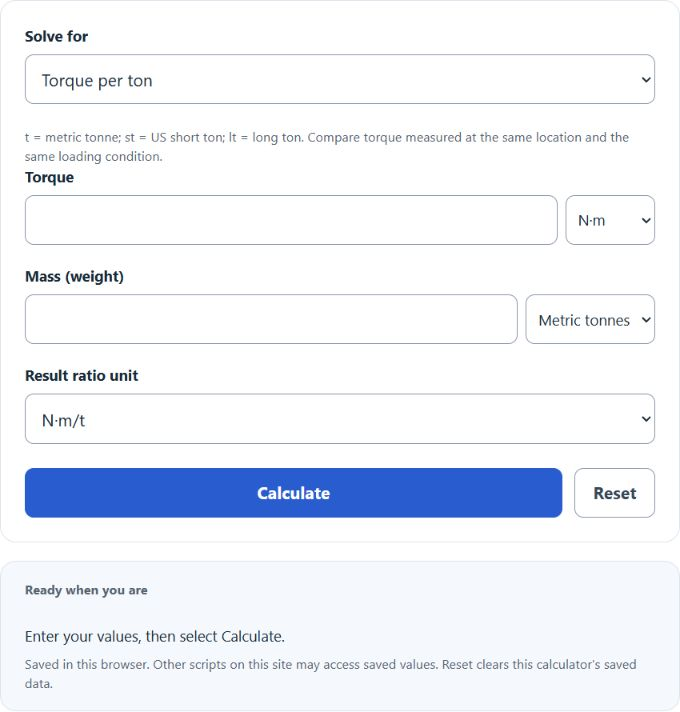
Select torque per ton, total torque, or mass (weight), then enter the two requested values. Torque and ratio outputs support N·m and lbf·ft with metric tonnes, US short tons and long tons.
Related Calculators
- Tractive Force Calculator
- Gradeability Calculator
- Truck Acceleration Calculator
- Drivetrain Loss Calculator
- All Automotive Calculators
Torque Per Ton Formula
Torque per ton expresses how much twisting force is available for each ton of vehicle or machine weight. It is a practical comparison metric because raw torque alone does not show how much mass that torque has to move.
| Symbol | Meaning | Common Unit |
|---|---|---|
| TPT | Torque per ton | Nm/t, lb-ft/st, or lb-ft/lt |
| T | Total torque being evaluated | Newton-meters or pound-feet |
| W | Vehicle or equipment weight | Metric tons, short tons, or long tons |
If you need to solve for a missing torque value or a missing weight value, the relationship can be rearranged:
How to Use the Calculator
- Select the quantity to solve for.
- Enter the two requested values and select their units.
- Select the result unit, then select Calculate.
- Review the result and unit-conversion details. Inputs may use different unit bases.
For comparisons to be meaningful, keep the torque source and weight basis consistent. Engine torque should be compared with engine torque, wheel torque with wheel torque, and metric tons should not be mixed with short or long tons unless you intentionally convert them first.
Example Calculation
If a machine produces 500 newton-meters of torque and weighs 2 metric tons, the ratio is:
This means each ton of weight is backed by 250 newton-meters of torque.
How to Interpret Torque Per Ton
- Higher torque per ton generally indicates stronger low-speed pulling ability relative to weight.
- Lower torque per ton suggests the machine has less twisting force available for each ton it must move.
- The metric is most useful when comparing vehicles, motors, or equipment with similar drivetrains, gearing philosophy, and operating conditions.
Where Torque Per Ton Is Useful
- Comparing trucks, SUVs, tractors, and heavy equipment.
- Evaluating towing, hauling, climbing, or launch-focused performance.
- Screening engine or motor options during early design decisions.
- Comparing loaded versus unloaded operating conditions.
- Benchmarking drivetrain changes after weight reduction or torque upgrades.
Important Comparison Notes
- Use the same weight condition. Curb weight, operating weight, and fully loaded weight can produce very different results.
- Use the same torque location. Crankshaft torque and wheel torque are not directly interchangeable.
- Watch the ton definition. Metric ton, short ton, and long ton ratios are different even when the machine is the same.
- Do not use zero weight. A zero weight input makes the ratio undefined.
- Remember gearing matters. A lower-torque machine with aggressive gearing may feel stronger at the wheels than engine torque alone suggests.
Torque Per Ton vs. Power Per Ton
- Torque per ton is more helpful for launch feel, grade climbing, load-moving ability, and low-speed effort.
- Power per ton is more helpful for sustained acceleration and how quickly speed can continue to build.
- For automotive and machinery analysis, the clearest picture usually comes from looking at both ratios together.
Common Input Mistakes
- Entering pound-feet for torque while interpreting the result as newton-meters per ton.
- Comparing an empty machine to a fully loaded one without noting the weight condition.
- Using brochure torque for one vehicle and wheel torque for another.
- Assuming a higher value guarantees better real-world performance without considering traction, transmission ratios, tire radius, or drivetrain losses.
FAQ
Is a higher torque per ton value better?
A higher value usually means more torque is available for each ton of weight, which is favorable for pulling, launching, and moving loads. It is still only one performance indicator.
Can this be used for electric motors?
Yes. The ratio works for combustion engines, electric motors, hydraulic systems, and other torque-producing machines as long as the torque and weight are expressed consistently.
Should I use curb weight or loaded weight?
Use whichever condition matches the comparison you care about. Curb weight is helpful for base vehicle comparisons, while loaded weight is more realistic for hauling or job-site analysis.
Why can two machines with similar torque per ton feel different?
Because throttle response, gearing, traction, tire size, motor curve, transmission behavior, and power delivery all affect how the available torque reaches the ground or load.