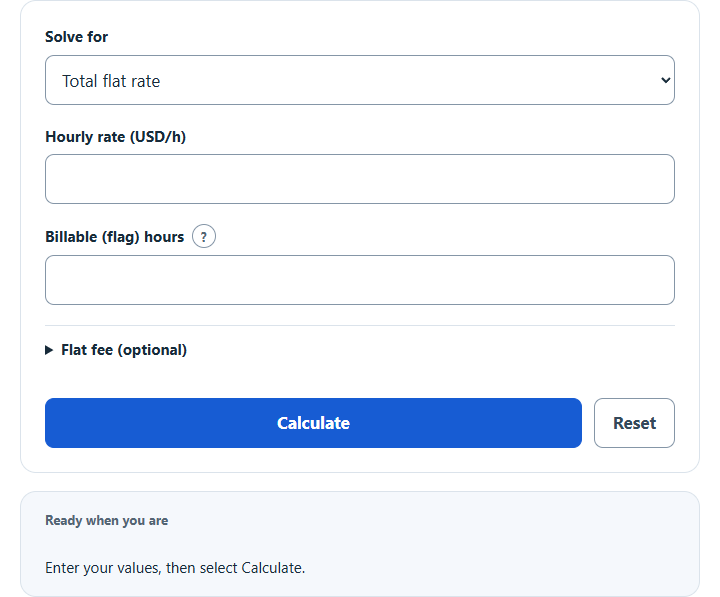
Calculate a mechanic’s or contractor’s total flat rate from flag hours and hourly rate, with an optional flat fee, or solve for the rate, hours or a quote.
Total Flat Rate Formula
The following formula is used to calculate the Total Flat Rate.
- Where TFR is the Total Flat Rate ($)
- R is the flat hourly rate ($/hr)
- T is the total number of hours
To calculate the total flat rate, multiply hourly rate by billable hours. Reverse tasks divide total by hours or by rate. Monetary totals and rates use exact decimal arithmetic and round half up to cents; fractional-cent rates may require more precision for billing.
How to Calculate Total Flat Rate?
For the project-quote task, enter labor cost per hour before profit and your desired margin. Blank materials/expenses and overhead mean zero. Modeled cost = labor cost rate × hours + expenses + allocated overhead. Quote = cost ÷ (1 − margin/100), with margin below100%. This is margin on the quote, not markup on cost. The quote rounds upward to the next whole cent when needed to meet the modeled target; projected profit and achieved margin use that rounded quote. Excluded costs and scope changes can change actual profit. This is a planning model, not a market-price recommendation.
The following example problems outline how to calculate Total Flat Rate.
Example Problem #1:
- First, determine the flat hourly rate ($/hr). The flat hourly rate ($/hr) is given as 35.
- Next, determine the total number of hours. The total number of hours is provided as 20.
- Finally, calculate the Total Flat Rate using the equation above:
TFR = R * T
The values given above are inserted into the equation below:
TFR = 35 * 20 = 700 ($)
Example Problem #2:
The variables needed for this problem are provided below:
flat hourly rate ($/hr) = 80
total number of hours = 20
Entering these values and solving gives:
TFR = R * T = 1600 ($)