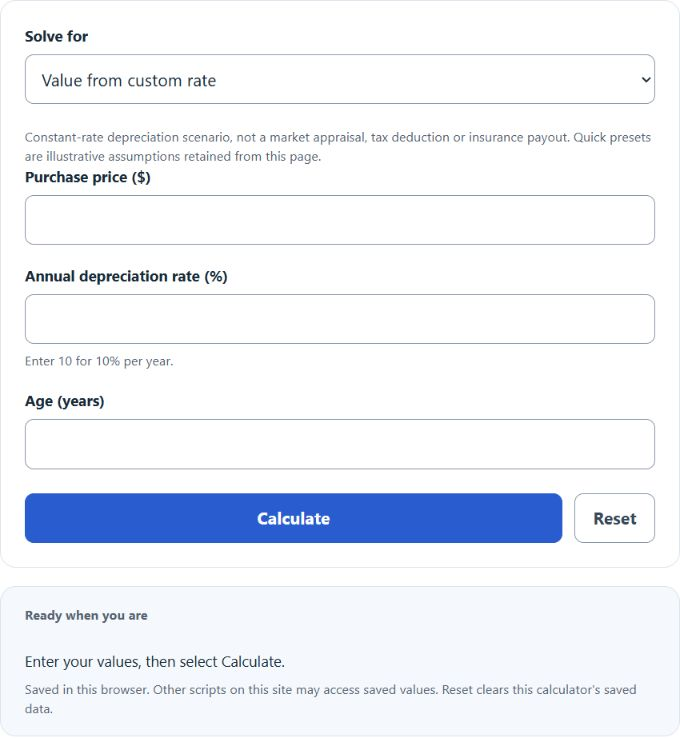
Estimate a trailer’s current value and total depreciation from purchase price, age, type, condition, and annual depreciation rate.
Trailer Value Formula
The calculator uses a constant-rate exponential depreciation scenario. It does not establish market value or outperform other valuation methods. Choose the value to solve for; the core formula is:
Variables:
- TV is the current trailer value ($)
- P is the original purchase price ($)
- D is the annual depreciation rate as a decimal in the formula; enter 10 in the calculator for 10%
- A is the age of the trailer in years
For a $20,000 purchase price and an assumed 10% annual rate, the model gives $20,000 × (1 − 0.10)^5 = $11,809.80 after five years. Each year applies the same percentage to remaining value; this is an assumption, not a validated market curve.
What is Trailer Value?
Trailer value refers to the current fair market price of a trailer based on its original cost, age, condition, type, and the prevailing supply-demand dynamics in the used trailer market. Unlike automobiles, trailers have no standardized odometer or mileage reading, so valuation relies more heavily on age, physical condition, and trailer category. The two primary valuation frameworks used in the industry are the NADA Official Commercial Truck Guide (which began including trailer values in its database) and J.D. Power’s RV valuation system for recreational trailers and campers.
Market sale value and insurance settlement value are different. Policy terms, damage, local comparables and coverage determine actual outcomes; this calculator does not estimate a claim payment.
Depreciation Rates by Trailer Type
The following are illustrative preset assumptions retained from the original calculator, not verified industry averages. Good condition uses a multiplier of 1; excellent uses 0.8, fair 1.2 and poor 1.5. The condition multiplier modifies the annual rate, not the final value.
| Scenario type | Assumed annual base rate | Good-condition value after 5 years | Good-condition value after 10 years |
|---|---|---|---|
| Utility / Cargo | 7% | 69.6% | 48.4% |
| Travel / Camper | 10% | 59.0% | 34.9% |
| Horse / Livestock | 9% | 62.4% | 38.9% |
| Boat | 8% | 65.9% | 43.4% |
| Other (assumption) | 8% | 65.9% | 43.4% |
Use a supported custom rate or current comparable listings for a real trailer. The preset scenarios do not establish which trailer category retains value best.
Year-by-Year Depreciation Schedule
This schedule applies the calculator’s constant base rates with the good-condition multiplier of 1. Percentages are mathematical scenarios, not observed market averages or forecasts.
| Age (Years) | Utility (7%) | Travel (10%) | Horse (9%) | Boat (8%) |
|---|---|---|---|---|
| 0 | 100.0% | 100.0% | 100.0% | 100.0% |
| 1 | 93.0% | 90.0% | 91.0% | 92.0% |
| 2 | 86.5% | 81.0% | 82.8% | 84.6% |
| 3 | 80.4% | 72.9% | 75.4% | 77.9% |
| 5 | 69.6% | 59.0% | 62.4% | 65.9% |
| 7 | 60.2% | 47.8% | 51.7% | 55.8% |
| 10 | 48.4% | 34.9% | 38.9% | 43.4% |
| 15 | 33.7% | 20.6% | 24.3% | 28.6% |
| 20 | 23.4% | 12.2% | 15.2% | 18.9% |
Condition, storage and damage can change actual sale value. The calculator’s condition multipliers are illustrative and do not measure a premium or discount for a particular unit.
Factors That Affect Trailer Value
Beyond age and type, several variables shift a trailer’s market value significantly above or below average depreciation curves:
Condition and Structural Integrity — Inspect frame, floor, axles, bearings, wiring and lights. Structural damage can materially affect value; this calculator supplies no verified percentage discount.
Construction Material — Material, corrosion resistance and build quality may affect condition and buyer demand. No universal aluminum-versus-steel premium is established here.
Brand and Manufacturer — Brand, model, features and local comparables can affect price; this calculator does not apply a brand premium.
Storage Method — Trailers stored indoors or under covered structures retain value notably better than those left exposed to sun, rain, and snow year-round. UV degradation breaks down paint, decals, tires, and rubber seals. For travel trailers, water intrusion from roof seal failure is the most destructive value killer, often reducing the trailer’s worth by thousands of dollars if left unaddressed.
Regional Market Demand — Local supply and buyer demand affect prices. Compare similar trailers in the relevant region rather than applying a universal geographic adjustment.
Tire and Axle Condition — Tire, axle and bearing condition can affect repairs and negotiations. Obtain current repair quotes; no fixed return on tire replacement is assumed.
Upgrades and Modifications — Upgrades may affect buyer interest, but installation cost does not establish resale value or a universal recovery percentage.
Trade-In vs. Private Sale Value
Trade-in, private sale, consignment and auction can produce different proceeds. Reconditioning, fees and negotiation matter; no fixed channel discount is established here.
Private sale and consignment differ in effort, fees and services. Compare actual offers and written commission terms for the particular trailer.
Auction results depend on buyers, venue, fees and condition; auction is not universally the lowest-value channel.
IRS Depreciation for Business-Use Trailers
Business-use trailers may qualify for tax depreciation, depending on classification, use and applicable law. This market-scenario calculator does not apply MACRS or determine a tax deduction.
Section 179 and bonus-depreciation rules depend on tax year, acquisition and placed-in-service dates, and eligibility. Consult current IRS Publication 946; the simple exponential model does not implement those rules.
Tax depreciation and actual sale value are distinct. A fully depreciated tax basis does not establish that a trailer has no market value.
Insurance Valuation Methods
Insurance settlement methods depend on the policy. Actual cash value generally considers depreciation, while agreed-value and replacement-cost coverage have their own terms. No universal annual insurance depreciation rate or payout is modeled here.
Agreed Value policies allow the owner and insurer to set a fixed payout amount at policy inception, which is particularly useful for custom-built trailers, vintage units, or highly modified rigs where standard depreciation would drastically undervalue the trailer. Replacement Cost coverage pays the amount needed to buy a comparable new trailer, regardless of the insured trailer’s age, and carries the highest premiums of the three methods.
Seasonal Pricing Patterns
Seasonal demand may affect local listings and sale prices. There is no verified universal seasonal percentage adjustment in this calculator.
Compare current local offers and the condition of similar units. Timing effects vary; this model applies no seasonal adjustment.