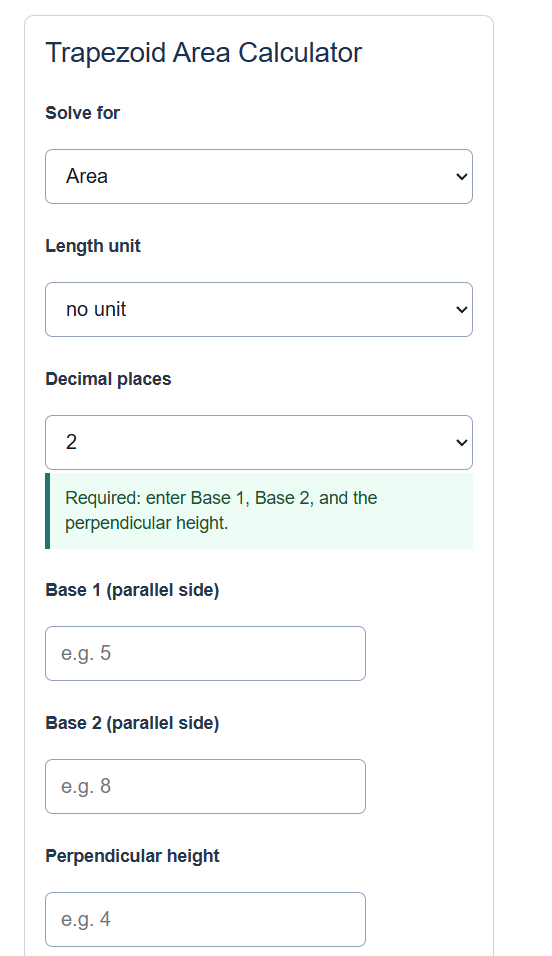
Calculate the area of a trapezoid from its two parallel bases and height, or solve for a missing base, the height, midsegment, and perimeter.
Trapezoid Area Formula
A trapezoid has two parallel sides, called the bases, and a perpendicular height between them. The area depends only on the two bases and the height, so you can rearrange the same formula to solve for the area, the height, or either base.
Area = (b1 + b2) / 2 * h
h = 2 * Area / (b1 + b2)
b1 = 2 * Area / h - b2
m = (b1 + b2) / 2
- Area = area of the trapezoid, given in square units
- b1 = length of the first parallel side (base 1)
- b2 = length of the second parallel side (base 2)
- h = perpendicular height between the two bases
- m = midsegment, the line halfway between the bases
Pick what you want to solve for with the solve-for selector at the top of the calculator. For the area, enter both bases and the height. To work backward, enter the area along with the two known measurements and the calculator returns the missing one. The midsegment is reported on every result because it equals the average of the two bases, which also lets you write the area as midsegment times height. The advanced option adds leg lengths and perimeter for isosceles and right trapezoids.
Inputs and Formula by Solve-For Mode
The calculator uses one of these four arrangements depending on the value you choose to solve for.
| Solve for | Values you enter | Formula used |
|---|---|---|
| Area | b1, b2, h | (b1 + b2) / 2 * h |
| Height | Area, b1, b2 | 2 * Area / (b1 + b2) |
| Base 1 | Area, b2, h | 2 * Area / h - b2 |
| Base 2 | Area, b1, h | 2 * Area / h - b1 |
For isosceles and right trapezoids, the advanced panel also estimates the leg lengths from the height and the difference between the bases.
| Trapezoid type | Leg length |
|---|---|
| Isosceles (equal legs) | leg = square root of ( h^2 + (|b2 - b1| / 2)^2 ) |
| Right (one vertical leg) | leg 1 = h, leg 2 = square root of ( h^2 + (|b2 - b1|)^2 ) |
Examples
Example 1. A trapezoid has bases of 5 and 8 and a height of 4. The area is (5 + 8) / 2 * 4 = 13 / 2 * 4 = 26 square units. The midsegment is (5 + 8) / 2 = 6.5.
Example 2. You know the area is 26 and the bases are 5 and 8, and you want the height. Rearranging gives h = 2 * 26 / (5 + 8) = 52 / 13 = 4. This matches Example 1, which is a good way to check your work.
FAQ
What is the difference between the bases and the legs? The bases are the two parallel sides, and the height is measured straight across between them. The legs are the two slanted, non-parallel sides. Only the bases and the height go into the area formula. The legs affect the perimeter but not the area.
Does it matter which side I call base 1 and which is base 2? No. The area formula adds the two bases together, so the order does not change the result. Just make sure both values are the parallel sides and that the height is the perpendicular distance between them, not the length of a slanted leg.
How do I find the height when I only know the area and the bases? Set the solve-for selector to Height, then enter the area and both bases. The calculator applies h = 2 * Area / (b1 + b2) and returns the perpendicular height.