Calculate a triangle’s missing sides, angles, area, and perimeter from the few measurements you already have.
- All Math and Numbers Calculators
- Law Of Cosines Calculator
- Law Of Sines Calculator
- SOH CAH TOA Calculator – Find Missing Sides & Angles\
- Isosceles Triangle Calculator
Triangle Formula
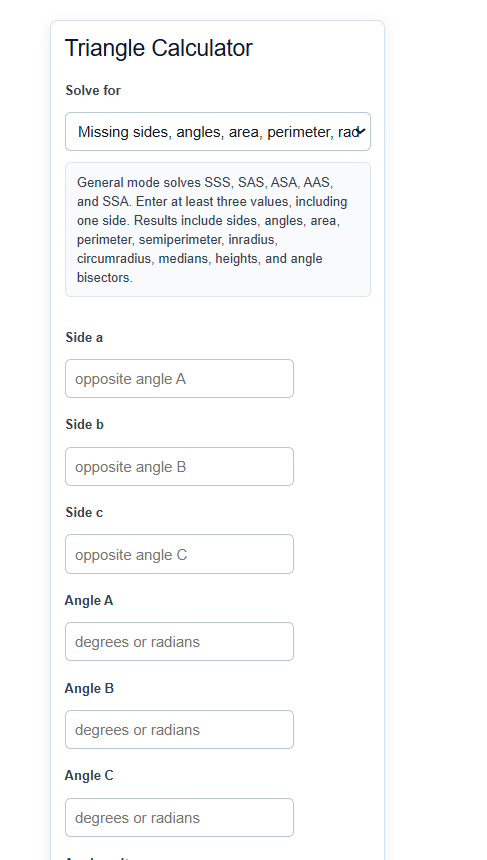
The calculator picks the right method based on what you enter. Give it any valid combination of three values that includes at least one side, and it solves the rest using the law of sines, the law of cosines, and the angle sum rule, then reports the area, perimeter, radii, medians, and heights.
When all three sides are known (SSS) or you have two sides and the included angle (SAS), it uses the law of cosines:
c^2 = a^2 + b^2 - 2*a*b*cos(C)
When you have a side with its opposite angle plus one more angle or side (ASA, AAS, or SSA), it uses the law of sines:
a / sin(A) = b / sin(B) = c / sin(C)
Area is found from whichever inputs are available, using Heron's formula for three sides, the included-angle formula for two sides and an angle, or base times height:
Area = sqrt( s*(s-a)*(s-b)*(s-c) ), s = (a+b+c)/2
Area = (1/2)*a*b*sin(C) = (1/2)*base*height
The remaining properties come from the solved side lengths and the area:
Perimeter = a + b + c
Circumradius R = a / (2*sin(A)); Inradius r = Area / s
Median m_a = sqrt(2*b^2 + 2*c^2 - a^2) / 2
- a, b, c: the three side lengths, where each side is opposite the angle of the matching capital letter.
- A, B, C: the three interior angles, entered in degrees or radians, which always add to 180 degrees.
- s: the semi-perimeter, half of the perimeter.
- Area: the surface enclosed by the three sides.
- R: the circumradius, the radius of the circle passing through all three vertices.
- r: the inradius, the radius of the largest circle that fits inside the triangle.
- m_a: the median from vertex A to the midpoint of side a (medians m_b and m_c follow the same pattern).
The solve-for selector controls which inputs matter. The general mode accepts any sides and angles and runs the law of sines and cosines. The area, base, or height mode rearranges Area = (1/2) times base times height so you can leave one of those three blank. The right triangle mode applies the Pythagorean theorem, and the equilateral mode uses a single side to return area, perimeter, and height. The angle unit selector and decimal-places field control how angles are read and how precisely results are shown.
What You Need to Solve a Triangle
A triangle is fully determined only by certain combinations of three measurements. Use this to know what to enter and which method the calculator applies.
| You know | Case | Method used | Solvable? |
|---|---|---|---|
| 3 sides | SSS | Law of cosines | Yes, one triangle |
| 2 sides + included angle | SAS | Law of cosines | Yes, one triangle |
| 2 angles + any side | ASA / AAS | Law of sines | Yes, one triangle |
| 2 sides + non-included angle | SSA | Law of sines | Ambiguous, 0, 1, or 2 triangles |
| 3 angles only | AAA | None | No, shape only, size unknown |
The triangle inequality must also hold for any set of three sides: the two shorter sides must add up to more than the longest side, or no triangle exists.
| Triangle type | Defining property | Area shortcut |
|---|---|---|
| Equilateral | All sides equal, all angles 60 degrees | (sqrt(3)/4) * side^2 |
| Right | One angle is 90 degrees | (1/2) * leg1 * leg2 |
| Isosceles | Two sides and two angles equal | (1/2) * base * height |
| Scalene | All sides and angles different | Heron's formula |
Examples
Example 1: three sides (SSS). A triangle has sides a = 6, b = 8, and c = 10. Find angle C and the area. Using the law of cosines, cos(C) = (6^2 + 8^2 - 10^2) / (2 times 6 times 8) = (36 + 64 - 100) / 96 = 0, so C = 90 degrees. The semi-perimeter is s = (6 + 8 + 10) / 2 = 12, and Heron's formula gives Area = sqrt(12 times 6 times 4 times 2) = sqrt(576) = 24. The perimeter is 24.
Example 2: two angles and a side (AAS). A triangle has A = 40 degrees, B = 60 degrees, and side a = 8. Then C = 180 - 40 - 60 = 80 degrees. By the law of sines, b = a times sin(B) / sin(A) = 8 times sin(60) / sin(40) = about 10.78, and c = 8 times sin(80) / sin(40) = about 12.26. The perimeter is about 31.04.
Frequently Asked Questions
How many values do I need to enter? You need three values, and at least one of them must be a side. Three angles alone fix the shape but not the size, so the calculator cannot return side lengths from angles only. Valid combinations are three sides, two sides and an angle, or two angles and a side.
Why did I get two different triangles? When you enter two sides and an angle that is not between them (the SSA case), the law of sines can have two valid answers, one with an acute angle and one with an obtuse angle. This is the ambiguous case. The calculator reports each triangle that satisfies the triangle inequality so you can pick the one that matches your problem.
Can I switch between degrees and radians? Yes. Set the angle unit selector to degrees or radians before you calculate, and enter every angle in that same unit. Results are shown in the unit you selected, and you can control the number of decimal places with the precision field.