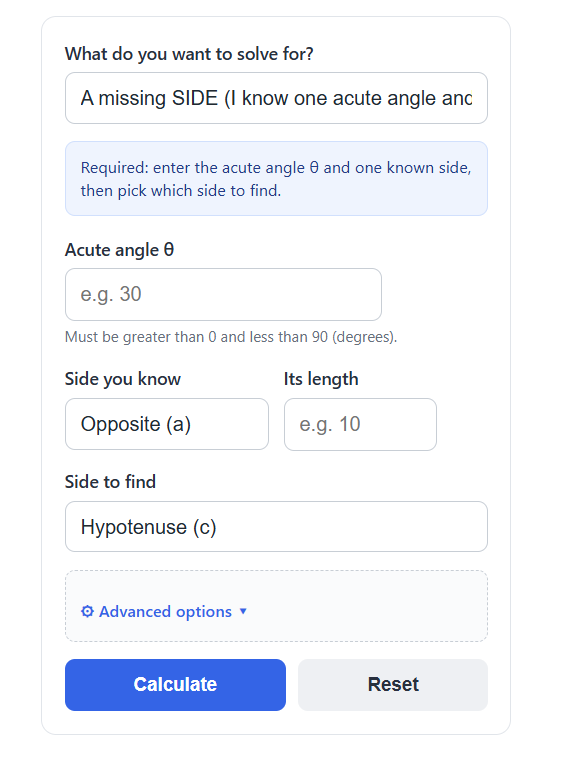
Calculate the missing sides and angles of a right triangle using the SOH CAH TOA method with sine, cosine, and tangent ratios.
- All Math & Numbers Calculators
- Law Of Cosines Calculator
- Law Of Sines Calculator
- Triangle Calculator
- Cosine Calculator: cos, arccos & Right Triangle Solver
- 45 45 90 Triangle Calculator – Sides, Area & Perimeter
- Tangent Calculator
SOH CAH TOA Formula
SOH CAH TOA is a mnemonic for the three main trigonometric ratios of a right triangle. Each ratio links one acute angle to two of the triangle’s sides:
sin(theta) = Opposite / Hypotenuse
cos(theta) = Adjacent / Hypotenuse
tan(theta) = Opposite / Adjacent
The variables in these formulas are:
- theta: the acute angle you are working from (not the 90 degree angle)
- Opposite: the side directly across from theta
- Adjacent: the side next to theta that is not the hypotenuse
- Hypotenuse: the longest side, always across from the right angle
To find a missing side, you pick the ratio that uses the angle you know and the side you know, then solve for the unknown side. For example, if you know theta and the hypotenuse and want the opposite side, you rearrange SOH to get Opposite = Hypotenuse times sin(theta).
To find a missing angle, you use the inverse function of whichever ratio matches the two sides you know. If you know the opposite and the hypotenuse, theta = arcsin(Opposite / Hypotenuse). The same pattern applies with arccos for adjacent and hypotenuse, and arctan for opposite and adjacent. The calculator picks the correct ratio for you based on the sides or angle you enter, and reports the answer in degrees or radians.
Which Ratio to Use
Use this table to choose the right ratio based on which two sides or which side and angle you have:
| Mnemonic | Ratio | Sides Involved | Use When You Know |
|---|---|---|---|
| SOH | sin = O/H | Opposite, Hypotenuse | opposite and hypotenuse |
| CAH | cos = A/H | Adjacent, Hypotenuse | adjacent and hypotenuse |
| TOA | tan = O/A | Opposite, Adjacent | opposite and adjacent |
Common reference values for the three ratios are shown below. These are the angles that appear most often in homework and exams:
| Angle | sin | cos | tan |
|---|---|---|---|
| 0° | 0 | 1 | 0 |
| 30° | 0.500 | 0.866 | 0.577 |
| 45° | 0.707 | 0.707 | 1 |
| 60° | 0.866 | 0.500 | 1.732 |
| 90° | 1 | 0 | undefined |
Example Problems
Example 1: Finding a missing side. A right triangle has an acute angle of 35 degrees, and the hypotenuse measures 10. You want the side opposite the 35 degree angle. The opposite and hypotenuse point to SOH, so Opposite = Hypotenuse times sin(theta) = 10 times sin(35 degrees) = 10 times 0.5736 = 5.74. The opposite side is about 5.74.
Example 2: Finding a missing angle. A right triangle has an opposite side of 6 and an adjacent side of 8. Two sides that are opposite and adjacent point to TOA, so theta = arctan(Opposite / Adjacent) = arctan(6 / 8) = arctan(0.75) = 36.87 degrees. The angle is about 36.87 degrees.
Frequently Asked Questions
How do I know which side is opposite and which is adjacent? Start at the acute angle you are working with. The side that does not touch that angle is the opposite side. The side that touches the angle but is not the hypotenuse is the adjacent side. The hypotenuse is always the longest side and sits across from the right angle, so it never changes no matter which acute angle you pick.
When do I use the inverse functions like arcsin? Use the regular sin, cos, and tan when you know an angle and want a side. Use the inverse functions arcsin, arccos, and arctan when you know two sides and want the angle. The inverse function undoes the ratio, turning a side ratio back into the angle that produced it.
Does SOH CAH TOA work on every triangle? No. These ratios only apply to right triangles, because they depend on one angle being exactly 90 degrees. For triangles without a right angle, you need the law of sines or the law of cosines instead.