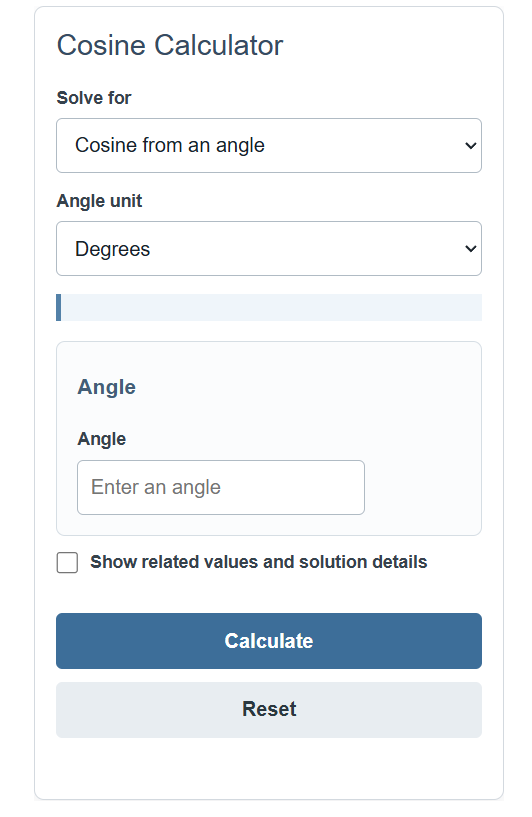
Calculate the cosine of any angle, find an angle from a cosine value, solve right triangles, and get hyperbolic cosine in degrees, radians, or gradians.
- All Math & Numbers Calculators
- Law Of Cosines Calculator
- Law Of Sines Calculator
- SOH CAH TOA Calculator – Find Missing Sides & Angles
- Triangle Calculator
- 45 45 90 Triangle Calculator – Sides, Area & Perimeter
Cosine Formula
This calculator works in four modes, and each mode uses its own formula. Pick what you want to solve for, then enter the values that mode asks for.
Cosine from an angle: cos(theta) = adjacent / hypotenuse
Angle from a cosine value: theta = arccos(x), with 0 deg <= theta <= 180 deg
Right triangle: adjacent = hypotenuse * cos(theta) and hypotenuse = adjacent / cos(theta)
Hyperbolic cosine: cosh(x) = (e^x + e^-x) / 2
- theta = the angle, entered in degrees, radians, or gradians
- cos(theta) = the cosine of the angle, always a value from -1 to 1
- adjacent = the side next to the angle in a right triangle
- hypotenuse = the longest side of a right triangle, opposite the right angle
- x = a plain number, used as the cosine value for arccos or as the input for cosh
- e = Euler's number, about 2.71828
The "Cosine from an angle" mode returns cos(theta) for any angle and can also show the sine, secant, exact value, and reference angle. The "Angle from a cosine value" mode runs the inverse cosine and returns the principal angle between 0 and 180 degrees. The "Right-triangle cosine" mode finds the cosine and the angle from two sides, or finds a missing side from an angle and one known side. The "Hyperbolic cosine" mode computes cosh(x) or its inverse acosh(x), which is a different function from circular cosine.
Common Cosine Values
These are the cosine values for the angles that come up most often. Use them as a quick check against the calculator.
| Angle (degrees) | Angle (radians) | Exact cos | Decimal cos |
|---|---|---|---|
| 0 | 0 | 1 | 1.0000 |
| 30 | pi/6 | sqrt(3)/2 | 0.8660 |
| 45 | pi/4 | sqrt(2)/2 | 0.7071 |
| 60 | pi/3 | 1/2 | 0.5000 |
| 90 | pi/2 | 0 | 0.0000 |
| 120 | 2pi/3 | -1/2 | -0.5000 |
| 135 | 3pi/4 | -sqrt(2)/2 | -0.7071 |
| 150 | 5pi/6 | -sqrt(3)/2 | -0.8660 |
| 180 | pi | -1 | -1.0000 |
Cosine starts at 1 when the angle is 0, falls to 0 at 90 degrees, reaches -1 at 180 degrees, and then repeats every 360 degrees.
Example Problems
Example 1: Cosine from an angle. Find the cosine of 60 degrees. Set the solve-for option to "Cosine from an angle," choose degrees, and enter 60. The cosine of 60 degrees is exactly 1/2, so the result is 0.5.
Example 2: Right triangle. A right triangle has an adjacent side of 6 and a hypotenuse of 10. Using cos(theta) = adjacent / hypotenuse gives cos(theta) = 6 / 10 = 0.6. Taking the inverse cosine, theta = arccos(0.6) = 53.13 degrees, and the opposite side is sqrt(10^2 - 6^2) = 8.
Frequently Asked Questions
What is the cosine of an angle? In a right triangle, the cosine of an angle is the length of the side next to the angle divided by the hypotenuse. On the unit circle it is the x-coordinate of the point at that angle. Cosine always returns a value from -1 to 1.
Why does the inverse cosine only accept values from -1 to 1? Cosine can never be larger than 1 or smaller than -1, so no real angle has a cosine outside that range. If you enter a value beyond -1 to 1, the calculator reports an error because there is no real angle to return.
Is hyperbolic cosine the same as cosine? No. Circular cosine is based on the unit circle and stays between -1 and 1. Hyperbolic cosine, cosh(x), is defined as (e^x + e^-x) / 2, is always at least 1, and grows without bound as x increases.