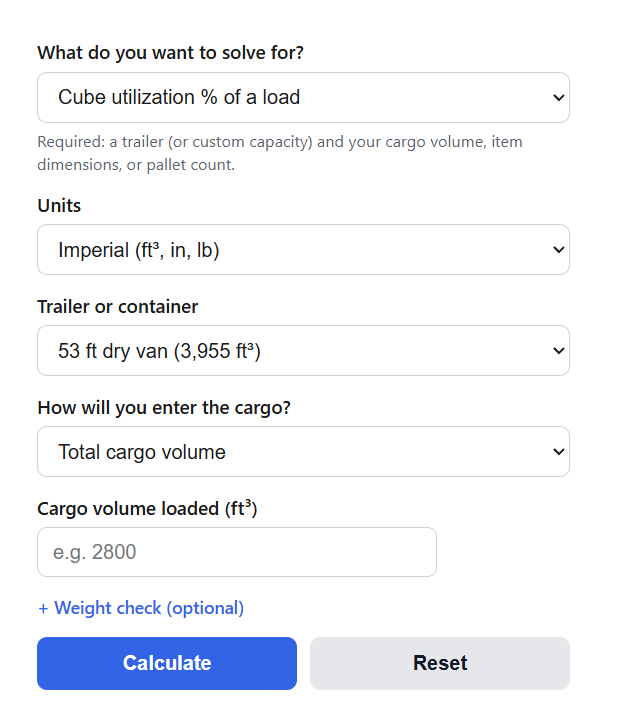
Calculate truck load cube utilization from cargo volume, item dimensions, or pallet counts, plus trucks needed and cube-out vs weigh-out limits.
Truck Load Cube Utilization Formula
CU = (Vc / Vt) * 100
- CU is the cube utilization (%)
- Vc is the cargo volume loaded (ft³ or m³)
- Vt is the usable cubic capacity of the trailer or container (ft³ or m³)
When you need to know how many trucks a shipment requires, the calculator uses a second formula:
N = roundup( Vtotal / (Vt * CUmax / 100) )
- N is the number of trucks needed
- Vtotal is the total cargo volume to ship (ft³ or m³)
- CUmax is the maximum practical utilization you allow per truck (%)
The calculator applies these formulas in three modes. In the utilization mode, it divides your loaded cargo volume by the usable capacity of the trailer you select and returns the percentage of the cube you are using, along with the unused space. You can enter the cargo as a total volume, as item dimensions with a quantity, or as a pallet count with a footprint and loaded height. In the target mode, it reverses the first formula to tell you how much cargo volume corresponds to a chosen utilization percentage. In the trucks mode, it applies the second formula to find how many trailers a total volume requires at a realistic per-truck ceiling. The optional weight check compares weight utilization to cube utilization and reports whether the load cubes out or weighs out first.
Trailer Capacities and Break-Even Densities
The table below lists the usable cube and typical payload for common equipment, along with the break-even density, which is the payload limit divided by the cubic capacity. If your freight is denser than the break-even value, the trailer weighs out before it cubes out, and chasing a higher cube utilization will not help.
| Equipment | Usable cube (ft³) | Typical payload (lb) | Break-even density (lb/ft³) |
|---|---|---|---|
| 53 ft dry van | 3,955 | 45,000 | 11.4 |
| 48 ft dry van | 3,566 | 45,000 | 12.6 |
| 28 ft pup trailer | 2,029 | 22,500 | 11.1 |
| 26 ft box truck | 1,700 | 10,000 | 5.9 |
| 40 ft high cube container | 2,694 | 58,448 | 21.7 |
| 40 ft standard container | 2,389 | 58,863 | 24.6 |
| 20 ft container | 1,172 | 47,772 | 40.8 |
Use this second table to interpret the percentage the calculator returns. Most dry freight networks operate in the 60 to 70 percent range, so anything above 80 percent is strong performance.
| Cube utilization | Rating | What it means |
|---|---|---|
| 85% and up | Excellent | Near the practical ceiling; little room left for load securement and airflow |
| 70–85% | Good | Better than industry average; per-unit freight cost is well controlled |
| 60–70% | Industry average | Typical for mixed dry freight; 30 to 40 percent of the cube rides empty |
| Under 60% | Below average | Look at double-stacking, taller pallet builds, or consolidating shipments |
Truck Load Cube Utilization Example Problems
Example 1: You load 2,800 ft³ of palletized freight into a 53 ft dry van with 3,955 ft³ of usable space. CU = (2,800 / 3,955) * 100 = 70.8%. That sits at the top of the industry average band, and 1,155 ft³ of the trailer rides empty.
Example 2: You need to move 9,500 ft³ of cartons using 53 ft dry vans, planning to a maximum of 85% utilization per truck. Each truck can take 3,955 * 0.85 = 3,361.75 ft³. N = roundup(9,500 / 3,361.75) = roundup(2.83) = 3 trucks. The first two trucks load to 85%, and the last one carries the remaining 2,776.5 ft³ at 70.2% utilization.
Truck Load Cube Utilization FAQs
What is a good cube utilization percentage? Most fleets average 60 to 70 percent, so anything above 70 percent beats the typical dry van network. Loads above 85 percent are excellent and usually require uniform cartons, double-stacked pallets, or floor-loaded freight. Treat 100 percent as theoretical: door clearance, load bars, dunnage, and irregular carton shapes always consume some of the cube.
Why does my trailer run out of weight before it runs out of space? Every trailer has a break-even density equal to its payload limit divided by its cubic capacity, about 11.4 lb/ft³ for a 53 ft dry van. If your freight is denser than that, you hit the legal weight limit while cube space remains, which is called weighing out. Denser freight such as beverages, paper, and tile almost always weighs out, while pillows, furniture, and plastics cube out. The weight check in the calculator tells you which limit binds for your specific load.
How can I raise cube utilization on regular lanes? The biggest gains come from vertical space: build pallets taller where product crush strength allows, double-stack compatible pallets, and switch chronically light lanes to floor loading. Reworking carton sizes so cases fill a 48 x 40 pallet footprint without overhang also helps, since a 2-inch gap around each pallet compounds into hundreds of cubic feet across a full trailer.