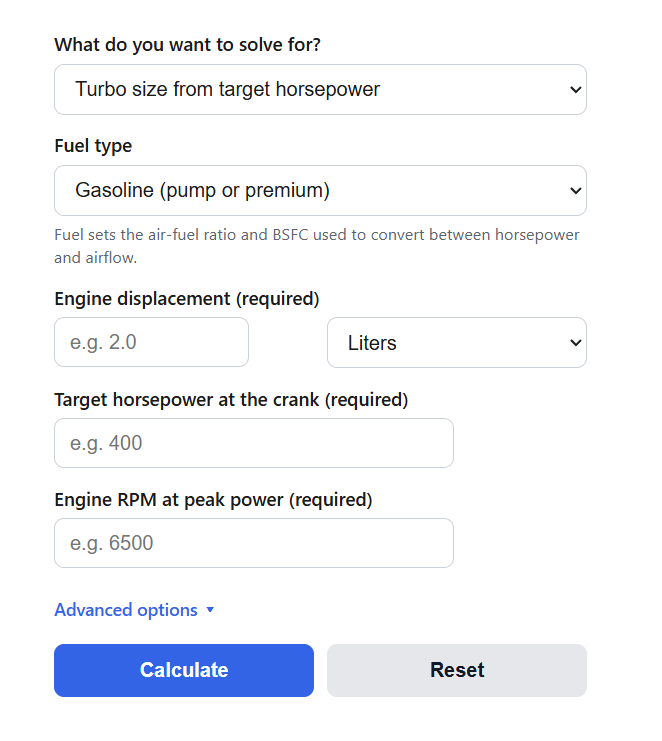
Calculate the right turbo size for your engine from target horsepower, including required airflow (lb/min and CFM), boost pressure, pressure ratio, and compressor inducer diameter in mm.
Turbo Size Formula
The calculator sizes a turbocharger by converting your horsepower target into the airflow the compressor must supply, then matching that airflow to a compressor inducer diameter. The core formula is:
Wa = HP * AFR * BSFC / 60
The required airflow is then converted to a compressor inducer diameter:
D = sqrt(Wa / 0.0224)
For the compressor map mode, the pressure ratio and volume flow are:
PR = (Boost + 14.7) / 14.7
 CFM = (CID * RPM / 2 * VE / 1728) * PR
Variables:
- Wa is the required compressor airflow in pounds of air per minute (lb/min)
- HP is the target horsepower at the crank
- AFR is the air-fuel ratio for the fuel (11.5:1 for boosted gasoline, 7.9:1 for E85, about 20:1 for diesel)
- BSFC is the brake specific fuel consumption in lb/hp-hr (0.50 for gasoline, 0.63 for E85, 0.38 for diesel)
- D is the approximate compressor inducer diameter in millimeters, the standard way turbo sizes are labeled
- PR is the pressure ratio across the compressor
- Boost is the gauge boost pressure in psi, and 14.7 is sea level atmospheric pressure in psia
- CID is engine displacement in cubic inches, RPM is engine speed, and VE is volumetric efficiency as a decimal
The first mode uses the airflow formula to turn a horsepower goal into a required lb/min figure, an estimated boost pressure for your displacement and RPM, and a recommended inducer size. The second mode works like a compressor map helper: it takes displacement, boost, and RPM and returns the pressure ratio and airflow point you can plot on a manufacturer map. The third mode runs the airflow formula in reverse, taking a turbo’s rated flow and telling you how much horsepower it can support on each fuel.
Turbo Inducer Size vs. Horsepower Support
This table maps common compressor inducer diameters to the airflow they typically move and the gasoline horsepower that airflow supports. Use it to sanity check the calculator result or to shortlist turbo families before reading compressor maps.
| Inducer diameter | Typical max airflow | Supported HP (gasoline) | Example turbo class |
|---|---|---|---|
| 38 mm | 32 lb/min | 280 to 340 | GT25 / G25-460 |
| 42 mm | 40 lb/min | 350 to 420 | GT28 / GTX2860 |
| 46 mm | 47 lb/min | 420 to 500 | GTX2867 / G25-550 |
| 49 mm | 54 lb/min | 480 to 560 | GT30 / G25-660 |
| 54 mm | 65 lb/min | 580 to 680 | GTX3071 / G30-770 |
| 58 mm | 75 lb/min | 670 to 780 | GT35 / G30-900 |
| 62 mm | 86 lb/min | 770 to 900 | GTX3582 / G35-900 |
| 67 mm | 100 lb/min | 900 to 1,050 | GT42 / G42-1200 |
| 76 mm | 129 lb/min | 1,150 to 1,350 | GT45 / G45 |
Airflow figures use the same relationship as the calculator (about 0.0224 lb/min per square millimeter of inducer area). Actual flow varies with wheel design and trim, so treat the ranges as a starting shortlist, not a final answer. The second table shows the fuel constants the calculator applies, which explains why the same turbo supports different power on different fuels.
| Fuel | AFR under boost | BSFC (lb/hp-hr) | Airflow per 100 hp |
|---|---|---|---|
| Gasoline | 11.5:1 | 0.50 | 9.6 lb/min |
| E85 | 7.9:1 | 0.63 | 8.3 lb/min |
| Diesel | 20:1 | 0.38 | 12.7 lb/min |
Example Problems
Example 1: sizing a turbo for 400 hp on a 2.0 L gasoline engine. The required airflow is Wa = 400 * 11.5 * 0.50 / 60 = 38.3 lb/min, which is about 501 CFM. The inducer estimate is D = sqrt(38.3 / 0.0224) = 41.4 mm, so a 42 mm turbo in the GT28 or GTX2860 class is the natural shortlist. With peak power at 6,800 RPM and 95 percent volumetric efficiency, the engine needs roughly 19.5 psi of boost to reach that airflow, a pressure ratio of about 2.33.
Example 2: checking what an existing turbo supports. A turbo whose compressor map peaks at 48 lb/min supports about HP = 48 * 60 / (11.5 * 0.50) = 501 hp on gasoline. A typical inducer for that flow is around 46 mm. If the car runs E85 instead, the same 48 lb/min supports about 48 * 60 / (7.9 * 0.63) = 579 hp because E85 needs less air per horsepower.
Frequently Asked Questions
What does the turbo size number like 48 mm actually mean? It is the diameter of the compressor inducer, the smaller opening of the compressor wheel where air enters. Inducer diameter sets how much air the wheel can swallow, which is why it tracks so closely with horsepower capability. The turbine side has its own sizing (wheel diameter and A/R housing ratio), but when a turbo is called a 48 mm unit, the compressor inducer is the number being quoted.
Is it better to size up or size down if I am between sizes? Size up slightly if your goal is peak power and you can accept a little more lag; the larger wheel runs cooler and leaves headroom for future tuning. Size down if you want fast spool and strong midrange on a street car. The worst outcome is a compressor forced to run far outside its efficiency island, which heats the intake charge and invites knock, so always confirm the final choice on the manufacturer compressor map.
Why does the calculator estimate less boost than my friend’s similar build runs? The boost estimate assumes a healthy intercooler (charge air near 90 F) and the volumetric efficiency set in the advanced options. A restrictive intake, hotter charge temperatures, lower VE, or higher elevation all force more boost to reach the same airflow. Boost is only a means to an end; the airflow target in lb/min is the number that actually determines horsepower.