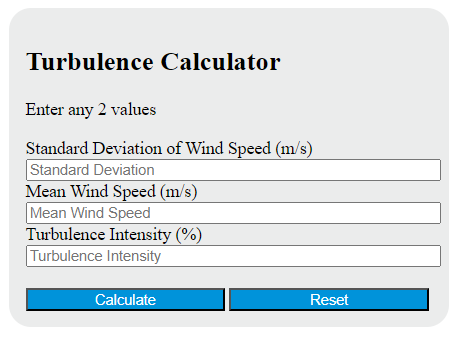
Calculate turbulence intensity, standard deviation of wind speed, or mean wind speed from any 2 values and convert m/s, km/h, or mph.
Related Calculators
- Viscosity to Density Calculator
- Energy Loss From Friction Calculator
- Torricelli’s Law Calculator
- Discharge Calculator
- All Physics Calculators
Turbulence Intensity Formula
Turbulence intensity describes how much wind speed fluctuates around its average value. It is a relative measure of wind variability, expressed as a percentage, and is commonly used when evaluating gustiness, flow quality, and changing wind conditions.
A higher turbulence intensity means the wind speed varies more from moment to moment relative to the mean speed. A lower value indicates steadier flow.
Variable Definitions
- TI — turbulence intensity, expressed as a percentage
- σ — standard deviation of wind speed
- V — mean wind speed
Rearranged Forms
This calculator can also solve for the missing input if the other two values are known.
How to Calculate Turbulence Intensity
- Measure or determine the standard deviation of wind speed over the sampling period.
- Determine the mean wind speed for that same period.
- Divide the standard deviation by the mean wind speed.
- Multiply the result by 100 to convert it to a percentage.
For the result to be valid, the standard deviation and mean wind speed must come from the same dataset, time window, and unit system.
Example
If the standard deviation of wind speed is 2.5 m/s and the mean wind speed is 10 m/s, the turbulence intensity is 25%.
How to Interpret the Result
| Result Pattern | What It Means |
|---|---|
| Lower turbulence intensity | Wind speed is relatively steady, with smaller short-term fluctuations around the mean. |
| Higher turbulence intensity | Wind speed is more irregular or gusty, with larger variation relative to the average speed. |
| Very large percentage at low mean speed | Even modest fluctuations can produce a large value when the mean wind speed is very small. |
Important Notes
- Use matching units. The standard deviation and mean wind speed must both be entered in the same units.
- Turbulence intensity is dimensionless. It is shown as a percentage for easier interpretation.
- The mean wind speed must be greater than zero. If the mean speed is zero, the calculation is undefined.
- Very low mean speeds can exaggerate the result. In calm conditions, the percentage can become misleadingly large.
- This metric summarizes variability only. It does not capture full flow structure, direction changes, or all turbulence scales.
Common Uses of Turbulence Intensity
- Wind resource assessment and turbine siting
- Evaluating gustiness around buildings, poles, and structures
- Comparing wind behavior at different heights or locations
- Reviewing airflow stability in environmental and engineering studies
- Assessing measurement quality in meteorological or sensor datasets
Why Standard Deviation Matters
Standard deviation is the statistical measure that captures how far individual wind speed readings tend to spread from the average. If those readings stay close to the mean, the standard deviation is small and turbulence intensity stays low. If the readings swing widely above and below the mean, the standard deviation increases and the turbulence intensity rises with it.