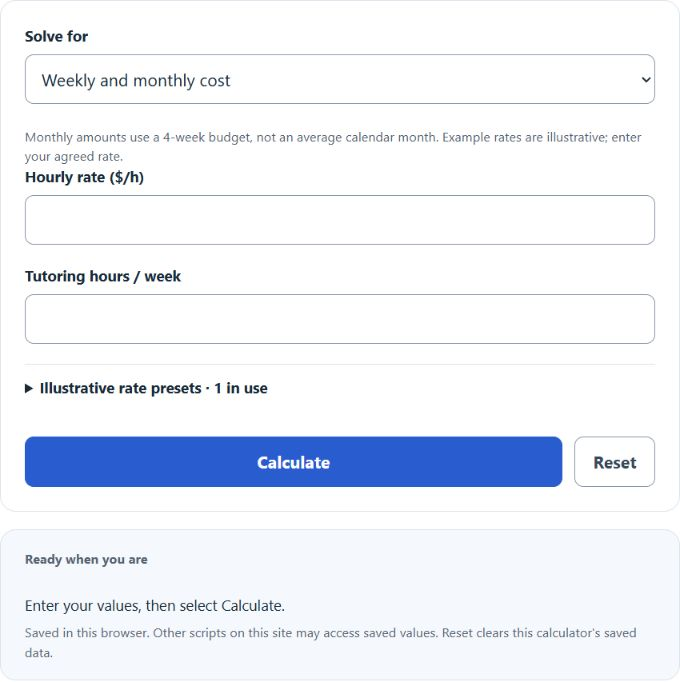
Calculate tutoring cost, hourly rate or weekly hours from the required known inputs. Monthly budgets use four weeks; example expertise presets are illustrative rates.
Tutor Rate Formula
The tutor rate calculator uses your agreed hourly rate to calculate weekly and four-week monthly cost, or works backward from a budget and known hours or rate. Expertise alone does not determine a price. This makes it useful for budgeting one-on-one tutoring, comparing tutors with different backgrounds, and estimating the total cost of an ongoing tutoring plan.
- TR = tutor rate per hour
- Example expertise presets are illustrative hourly rates, not a numeric expertise factor.
- H = hours of tutoring needed per week
- TW = tutoring cost per week
- TM = tutoring cost per month using a 4-week month
What is a tutor rate?
A tutor rate is the amount charged for each hour of academic instruction. In practice, the final price depends on more than just the subject being taught. Tutor credentials, the student’s grade level, session format, and the number of hours booked each week all influence the real cost. One-on-one tutoring usually carries the highest per-student price, while group tutoring often lowers the cost for each student.
Illustrative Tutor Budget Ranges
| Tutor Type | Illustrative Hourly Range | Common Use Case |
|---|---|---|
| Student Tutor | $20–$25 per hour | Basic homework help, peer tutoring, elementary and middle school review |
| Teaching Assistant | $25–$35 per hour | Introductory college courses, structured practice, study support |
| Teacher | $35–$50 per hour | K-12 subject instruction, curriculum-aligned tutoring, intervention support |
| Professor | $50–$100 per hour | Advanced academics, upper-level coursework, specialized writing or analysis |
| Field Expert | $50–$100 per hour | Technical subjects, professional skills, niche exam prep, real-world application |
These are illustrative planning ranges from the original article, not verified typical market prices. Rates often move higher for advanced math and science, AP or IB support, standardized test preparation, urgent scheduling, and highly specialized subjects.
How to Calculate Tutor Cost
- Enter the agreed hourly rate, or select an illustrative example and adjust it.
- Enter the number of tutoring hours needed each week.
- Multiply the hourly rate by hours per week to calculate weekly cost.
- Multiply weekly cost by 4 for the calculator’s four-week monthly budget; actual calendar months vary.
This approach is helpful when comparing several tutoring options. For example, a lower hourly rate may still cost more overall if more tutoring hours are needed each week, while a more experienced tutor may cost more per hour but reduce the total number of sessions required.
Example Tutor Cost Calculation
If a teacher charges $35 per hour and the student needs 4 hours of tutoring each week, the cost can be estimated as follows:
In this case, the tutoring plan costs $140 per week and about $560 per month.
Using the Calculator to Plan Around a Budget
If you already know how much you can spend, you can work backward to estimate how many tutoring hours fit your budget.
This is useful when setting a weekly schedule. For example, if a tutor charges a higher hourly rate, you may decide to reduce session frequency, shorten session length, or reserve that tutor for the most difficult topics only.
What Can Increase or Decrease Tutor Rates?
- Subject difficulty: Algebra, calculus, chemistry, physics, coding, and foreign languages often cost more than general homework support.
- Student level: Elementary tutoring is usually less expensive than high school honors, college, or professional instruction.
- Tutor qualifications: Licensed teachers, professors, and industry experts typically charge more than peer tutors.
- Session format: One-on-one tutoring costs more per student than small-group instruction.
- Delivery method: In-person tutoring may cost more because of travel time or local market pricing, while online tutoring often provides more flexibility.
- Scheduling needs: Intensive test prep, last-minute sessions, and short-term cram sessions often raise the rate.
- Consistency: Recurring weekly tutoring may have a lower effective cost than occasional, on-demand sessions.
When This Calculator Is Most Useful
- Estimating the cost of weekly tutoring before hiring a tutor
- Comparing multiple tutors with different experience levels
- Planning a monthly education budget
- Deciding whether one-on-one tutoring or group tutoring is more cost-effective
- Balancing tutor quality against the number of sessions needed