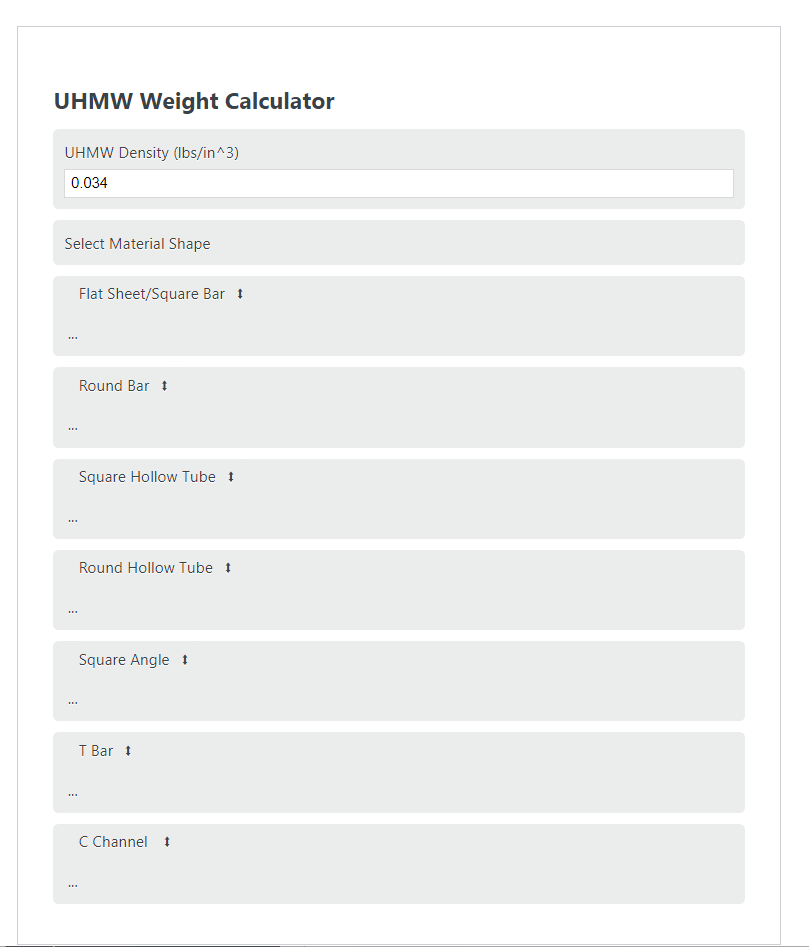
Calculate UHMW sheet, rod, or tube weight from dimensions and density, or solve for required length, with metric and imperial results.
- All Construction Calculators
- All Weight Calculators
- Plastic Weight Calculator
- Acetal Weight Calculator
What is UHMW?
UHMW (ultra-high molecular weight polyethylene) is a thermoplastic with polymer chains ranging from 3.5 to 6 million g/mol in molecular mass, roughly 10 times heavier than standard HDPE chains. This extreme chain length produces a material with the highest abrasion resistance of any thermoplastic, a self-lubricating surface, and impact strength so high that standard Izod test specimens often do not break. UHMW is FDA/USDA compliant in its virgin form, chemically inert against most acids, alkalis, and organic solvents, and absorbs almost no moisture (less than 0.01% over 24 hours).
UHMW Weight Formulas
Every UHMW weight formula follows the same principle: calculate the cross-sectional area of the shape, multiply by the length to get volume, then multiply by density. The formulas below use inches for all dimensions and lb/in³ for density.
Flat Sheet / Square Bar: Weight = L x W x T x d
Round Bar: Weight = π x (D/2)² x L x d
Square Hollow Tube: Weight = [W² – (W – 2T)²] x L x d
Round Hollow Tube: Weight = π x (R² – r²) x L x d
Square Angle: Weight = (2WT – T²) x L x d
T-Bar: Weight = [WT + (H – T)T] x L x d
C-Channel: Weight = (2W x T1 + H x T2) x L x d
Where L = length, W = width or leg length, H = height (inner height for C-channel), T = thickness, D = diameter, R = outer radius, r = inner radius, T1 = flange thickness, T2 = web thickness, and d = density in lb/in³. To use metric inputs, convert all lengths to inches first or use a consistent metric density (kg/m³ with dimensions in meters).
UHMW Density by Grade
UHMW is available in several commercial grades, each with a slightly different density depending on fillers and processing method.
| Grade | Density (lb/in³) | Density (kg/m³) | Specific Gravity |
|---|---|---|---|
| Virgin (natural white) | 0.0335 | 928 – 941 | 0.93 – 0.94 |
| Reprocessed (recycled blend) | 0.0335 – 0.0340 | 928 – 941 | 0.93 – 0.94 |
| Black (carbon-filled) | 0.0340 – 0.0345 | 941 – 955 | 0.94 – 0.96 |
| Oil-filled (bearing grade) | 0.0340 | 941 | 0.94 |
| Glass-filled | 0.0370 – 0.0400 | 1024 – 1108 | 1.02 – 1.11 |
| Metal-detectable | 0.0360 – 0.0380 | 997 – 1052 | 1.00 – 1.05 |
For most calculations, 0.0335 lb/in³ (930 to 940 kg/m³) is the standard reference value. Glass-filled and metal-detectable grades run 7 to 19% heavier due to their inorganic additives.
UHMW Sheet Weight per Square Foot
The following reference table shows the weight of a 12 in x 12 in virgin UHMW sheet at common stock thicknesses, using a density of 0.0335 lb/in³. The rightmost column shows the weight of a full 4×8 ft sheet.
| Thickness (in) | Weight per ft² (lb) | Weight per 4×8 ft sheet (lb) |
|---|---|---|
| 1/16 (0.0625) | 0.30 | 9.65 |
| 1/8 (0.125) | 0.60 | 19.30 |
| 1/4 (0.25) | 1.21 | 38.59 |
| 3/8 (0.375) | 1.81 | 57.89 |
| 1/2 (0.50) | 2.41 | 77.18 |
| 3/4 (0.75) | 3.62 | 115.78 |
| 1.0 | 4.82 | 154.37 |
| 1.5 | 7.24 | 231.55 |
| 2.0 | 9.65 | 308.74 |
These values are useful for estimating shipping weight and freight costs. A standard 4×8 ft sheet at 1/2 in thick weighs roughly 77 lb, which is significantly lighter than an equivalent steel plate (about 490 lb at 1/4 in thick for the same footprint).
UHMW Compared to Other Engineering Plastics
Weight is only one factor when selecting a plastic for wear or structural applications. The table below compares UHMW to four common alternatives across properties that most influence material selection.
| Property | UHMW | HDPE | Nylon 6/6 | Acetal (Delrin) | PTFE (Teflon) |
|---|---|---|---|---|---|
| Density (lb/in³) | 0.034 | 0.035 | 0.041 | 0.051 | 0.078 |
| Tensile Strength (psi) | 5,600 – 7,000 | 3,200 – 4,500 | 11,000 – 12,000 | 9,500 – 10,000 | 2,500 – 5,000 |
| Coefficient of Friction | 0.10 – 0.22 | 0.20 – 0.30 | 0.20 – 0.35 | 0.20 – 0.35 | 0.04 – 0.10 |
| Abrasion Resistance | Highest | Moderate | High | High | Low |
| Max Service Temp (°F) | 180 | 180 | 220 | 180 | 500 |
| Moisture Absorption (%) | <0.01 | <0.01 | 1.2 – 2.8 | 0.20 | <0.01 |
| FDA Compliant | Yes (virgin) | Yes | No (standard) | Yes | Yes |
UHMW stands out as the lightest option with the best abrasion resistance, but it cannot match nylon or acetal for tensile strength or dimensional precision. Where UHMW wins is in sliding-contact, high-impact, and abrasive environments where its combination of low weight, low friction, and extreme toughness is unmatched.
Key UHMW Material Properties
UHMW belongs to the polyethylene family but its molecular chain length (2 to 6 million daltons) gives it properties that diverge sharply from standard PE grades. The chains are so long and entangled that the material cannot be processed by conventional injection molding. Instead, UHMW is compression molded or ram extruded, which produces a highly uniform microstructure.
Tensile yield strength sits between 2,800 and 3,340 psi (19 to 23 MPa), with elongation at break ranging from 350 to 525%. Shore D hardness is 60 to 65, slightly lower than HDPE. The melting point is approximately 267°F (131°C), though the recommended continuous service temperature is 180°F (82°C). Below -300°F (-184°C), UHMW retains impact resistance, making it one of the few plastics suitable for cryogenic applications.
The coefficient of friction ranges from 0.10 to 0.22 depending on surface finish and counterface material. In abrasion testing (ASTM D4060, Taber), UHMW outwears carbon steel by a factor of 10:1 and outperforms every other thermoplastic. It is also self-lubricating, requiring no grease or oil in bushing and bearing applications.
Where UHMW Weight Calculations Matter
Conveyor system design: UHMW wear strips and guide rails line thousands of conveyors in food processing, bottling, and package handling. Engineers need accurate part weights to calculate dead load on the conveyor frame and to size drive motors correctly.
Chute and hopper liners: Mining operations and grain elevators line steel chutes with UHMW to prevent material buildup and reduce wear. Liner panels can be 4×8 ft sheets at 1/2 to 1 in thick, and knowing the panel weight is critical for structural bolt patterns and installation rigging.
Marine fender pads and dock bumpers: UHMW’s near-zero moisture absorption makes it a standard material for dock fenders. Weight calculations determine how many fasteners are needed and whether existing dock framing can support the added load.
Truck bed liners and dump body liners: UHMW sheets bonded to steel truck beds reduce sticking of wet sand, clay, and asphalt. The added weight from the liner affects vehicle payload capacity and must be accounted for in DOT gross weight compliance.
Orthopedic implant components: Medical-grade UHMW (GUR 1020 and 1050 resins) is used for tibial inserts and acetabular cup liners in joint replacements. Component weight affects implant biomechanics and patient comfort, making precise weight control part of the manufacturing specification.
Shipping and freight estimation: UHMW is sold by the pound or by the sheet. Knowing part weight before ordering allows accurate freight quoting and helps avoid overpaying for LTL shipments where weight brackets determine pricing tiers.