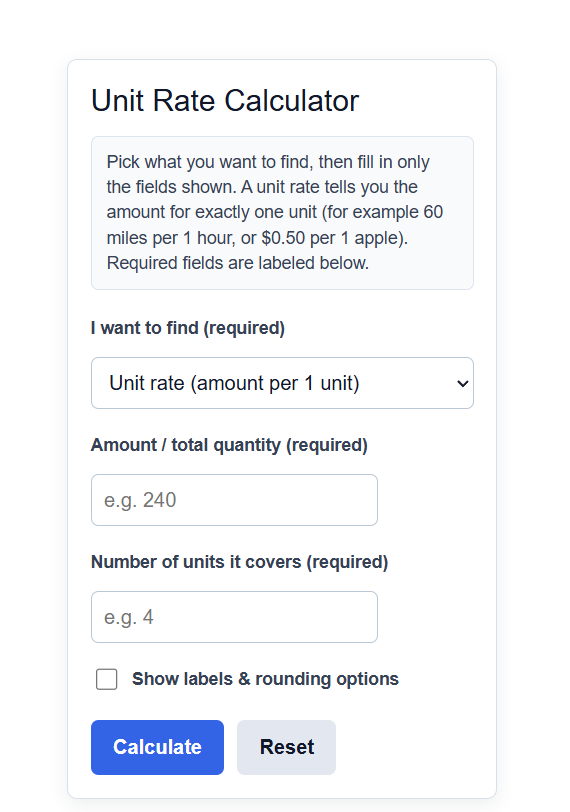
Calculate the unit rate, total amount, or number of units, and compare two items to find the better value per unit.
Unit Rate Formula
A unit rate is a ratio written so the second quantity is exactly 1. The calculator finds it by dividing the total amount by the number of units it covers.
Unit Rate = A / U
When you already know the unit rate, the calculator rearranges the same relationship to find a total or a count.
Total = R * U
Units = T / R
To compare two items, it works out the unit price of each and picks the smaller one as the better value.
Unit Price = Price / Size
- A is the total amount or quantity, such as 240 miles or $6.00.
- U is the number of units that amount covers, such as 4 hours or 12 apples.
- R is the unit rate, the amount per 1 unit.
- T is a known total amount you want to break into units.
- Price and Size are the cost and quantity of an item you want to compare against another.
Pick what you want to find at the top of the calculator. The unit rate mode asks for the amount and the number of units. The total and count modes ask for the unit rate plus one other value. The compare mode asks for the price and size of two items and tells you which costs less per unit. Use the advanced toggle if you want custom labels or a different number of decimal places.
Common Unit Rates and How to Read Them
A unit rate keeps the denominator at 1, which is what makes two situations easy to compare. The table below shows everyday amounts turned into unit rates.
| Situation | Amount ÷ Units | Unit Rate |
|---|---|---|
| Driving 150 miles in 3 hours | 150 ÷ 3 | 50 miles per hour |
| $6.00 for 12 apples | 6 ÷ 12 | $0.50 per apple |
| 450 words in 5 minutes | 450 ÷ 5 | 90 words per minute |
| $3.60 for 3 pounds | 3.6 ÷ 3 | $1.20 per pound |
When you compare two items, the one with the lower price per unit is the better value, even if its sticker price is higher.
| Item | Price / Size | Unit Price | Result |
|---|---|---|---|
| Small bag | $3.00 / 12 oz | $0.25 per oz | Costs more per oz |
| Large bag | $5.00 / 24 oz | $0.208 per oz | Better value |
Example Problems
Example 1. A car travels 240 miles on 8 gallons of gas. To find the fuel economy, divide the amount by the units: 240 / 8 = 30 miles per gallon. Enter 240 as the amount and 8 as the number of units to get the same result.
Example 2. Apples cost $0.50 each and you want 15 of them. This is the total mode, so multiply the unit rate by the count: 0.50 * 15 = $7.50. Enter 0.5 as the unit rate and 15 as the number of units to confirm the total.
Frequently Asked Questions
What is the difference between a ratio and a unit rate? A ratio compares any two quantities, like 150 miles to 3 hours. A unit rate is the special ratio you get when you reduce the second quantity to 1, like 50 miles to 1 hour. You turn a ratio into a unit rate by dividing both parts by the second quantity.
How do I use a unit rate to find a total? Multiply the unit rate by the number of units you want. If something costs $0.50 per unit and you need 20 units, the total is 0.50 * 20 = $10.00. Switch the calculator to total mode and enter the rate and the count.
How does comparing unit prices find the better deal? Divide each item's price by its size to get the cost of one unit, then compare those two numbers. The item with the lower cost per unit is cheaper to buy in equal amounts, which is the better value even when its total price is larger.