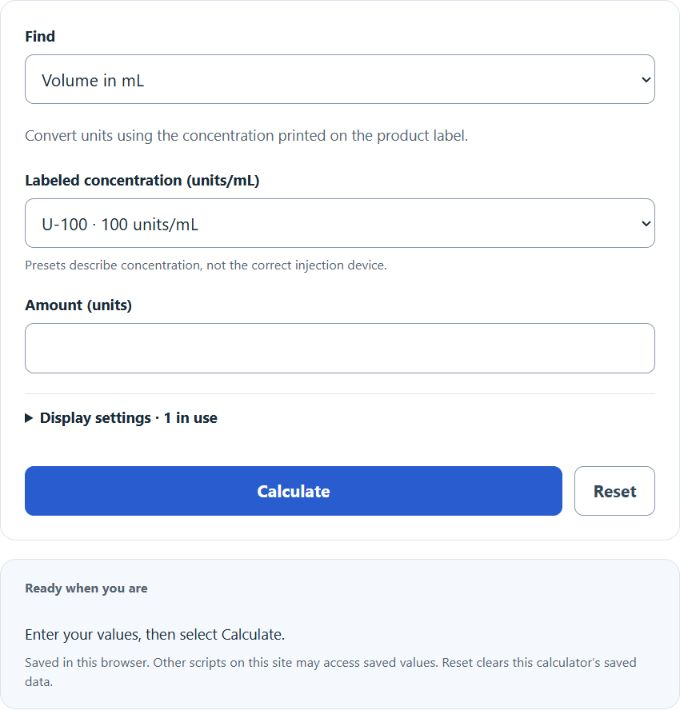
Enter the total units (U) and concentration (U/mL) into the calculator to convert Units to mL. This calculator can also convert mL to Units and calculate units per mL.
- All Health and Medical Calculators
- Heparin Units to mL Calculator
- mL to mg Calculator
- mL to Units Calculator
- Units to CC Converter
- CC to Units Converter
- Units/hr to mL/hr Calculator
Units to mL Formula
The core formula for converting pharmaceutical units to milliliters is:
mL = U / C
Where U is the total units of the substance, and C is the concentration in units per milliliter (U/mL). To reverse the conversion (mL to units), multiply: U = mL x C. To find concentration from known units and volume: C = U / mL.
What Are Pharmaceutical Units?
A pharmaceutical "unit" (U) or International Unit (IU) is a measure of biological activity, not mass. The WHO Expert Committee on Biological Standardization defines each IU relative to a reference preparation of a specific substance. One IU of insulin does not equal one IU of heparin or one IU of vitamin D because each measures a different biological effect. This is why units cannot be converted to milligrams without substance-specific conversion factors, and why the concentration printed on the product label (U/mL) is essential for any volume calculation.
Insulin Concentration Reference
Insulin is manufactured at four standard concentrations. The "U" number on the label tells you how many units of insulin are dissolved in each milliliter of liquid.
| Label | Concentration | mL per 1 Unit | Typical Use |
|---|---|---|---|
| U-40 | 40 U/mL | 0.025 mL | Veterinary medicine (dogs, cats); some countries outside the U.S. |
| U-100 | 100 U/mL | 0.01 mL | Standard human insulin worldwide (most common) |
| U-200 | 200 U/mL | 0.005 mL | Pen-only formulations (e.g., Tresiba, Humalog); not available in vials |
| U-500 | 500 U/mL | 0.002 mL | Severe insulin resistance (typically >200 U/day total requirement) |
U-100 is the global default. When a prescription simply says "insulin" without specifying concentration, it almost always refers to U-100. U-40 remains prevalent in veterinary practice because many animal insulin products are formulated at that strength. U-200 is exclusively dispensed in prefilled pens with dose dials calibrated in units, so the user never needs to manually calculate mL. U-500, five times the concentration of standard insulin, delivers high doses in a small volume but carries a proportionally higher overdose risk per mL of error.
Insulin Syringe Sizes
Insulin syringes are manufactured to match a specific concentration. A U-100 syringe has markings calibrated so that each unit line corresponds to 0.01 mL. Using a U-100 syringe with U-40 insulin (or vice versa) without recalculating will produce a 2.5x dosing error.
| Syringe Size | Total Volume | Graduation | Best For |
|---|---|---|---|
| 30-unit (U-100) | 0.3 mL | 0.5-unit increments | Doses up to 30 U; highest precision for small doses |
| 50-unit (U-100) | 0.5 mL | 1-unit increments | Doses 31 to 50 U |
| 100-unit (U-100) | 1.0 mL | 2-unit increments | Doses 51 to 100 U |
Choosing the smallest syringe that fits the prescribed dose improves accuracy. A 30-unit syringe reads in half-unit marks, while a 100-unit syringe only resolves to 2-unit intervals. For U-500 insulin, a dedicated U-500 syringe (marked in units, holding 2.5 mL total) was introduced to reduce the math errors that occurred when clinicians used U-100 syringes at 1/5 the marked volume.
Heparin Concentration Reference
Unlike insulin, heparin has no single standard concentration. It is manufactured across a wide range of strengths depending on the clinical application, making label verification critical before every dose.
| Concentration | mL for 1,000 U | Clinical Application |
|---|---|---|
| 10 U/mL | 100.0 mL | Catheter lock flush (pediatric/neonatal lines) |
| 100 U/mL | 10.0 mL | Catheter lock flush (adult central lines) |
| 1,000 U/mL | 1.0 mL | Subcutaneous prophylaxis; IV bolus preparation |
| 5,000 U/mL | 0.2 mL | Subcutaneous prophylaxis (5,000 U = 1 mL from this vial) |
| 10,000 U/mL | 0.1 mL | High-dose IV bolus; compounding |
| 20,000 U/mL | 0.05 mL | Compounding for IV infusion bags |
Pre-mixed IV bags (e.g., 25,000 U in 250 mL of D5W = 100 U/mL) are commonly used for continuous infusion and typically dosed at a rate in mL/hr derived from the patient's weight-based protocol (often 18 U/kg/hr after an 80 U/kg bolus for full anticoagulation). The concentration of the bag determines the infusion pump rate: the same 1,000 U/hr dose runs at 10 mL/hr from a 100 U/mL bag but only 4 mL/hr from a 250 U/mL bag.
Other Medications Measured in Units
Insulin and heparin are the most commonly converted, but several other substances use unit-based dosing where the units-to-mL relationship depends entirely on the product's labeled concentration.
| Substance | Unit Type | Common Concentrations |
|---|---|---|
| Penicillin G | Units (U) | Varies by reconstitution volume; 250,000 to 500,000 U/mL typical after mixing |
| Erythropoietin (EPO) | International Units (IU) | 2,000, 4,000, 10,000, or 40,000 IU per vial; volume varies by manufacturer |
| Botulinum Toxin (Botox) | Units (U) | 100 U or 200 U per vial; reconstituted with 1 to 4 mL saline (provider's choice) |
| Vitamin D3 | IU | 400 IU/mL (drops) or 50,000 IU/capsule; 1 IU = 0.025 mcg cholecalciferol |
| Oxytocin (Pitocin) | Units (U) | 10 U/mL (injection); diluted into IV bags for labor induction |
| Vasopressin | Units (U) | 20 U/mL (injection) |
For reconstituted drugs like Penicillin G and Botox, the concentration in U/mL depends on how much diluent is added. This means the same vial can yield different concentrations, and the units-to-mL conversion changes accordingly. Always calculate from the final concentration after reconstitution, not the labeled vial strength alone.
Why Units Are Not Interchangeable Between Drugs
A unit of insulin measures its ability to lower blood glucose. A unit of heparin measures its anticoagulant activity. A unit of penicillin measures its antibacterial potency. These are fundamentally different biological assays measuring different biological effects, which is why the WHO assigns separate reference standards for each substance. 100 units of insulin in 1 mL (U-100) has no mathematical or pharmacological relationship to 100 units of heparin in 1 mL. The only thing they share is the formula structure: mL = Units / (U/mL concentration). The concentration value itself is specific to the product in your hand.
Veterinary vs. Human Insulin
Most veterinary insulin products (Vetsulin/Caninsulin) are formulated at U-40 (40 U/mL), while virtually all human insulin in the United States is U-100. If a veterinarian prescribes a dose in units and the owner uses a U-100 syringe to draw from a U-40 vial, the pet receives only 40% of the intended dose. The reverse scenario, using a U-40 syringe with U-100 insulin, delivers 2.5 times the intended dose. Cross-concentration syringe use is the single most common cause of insulin dosing errors in veterinary patients. To convert between syringe types: multiply the prescribed U-40 units by 0.4 to find the equivalent marking on a U-100 syringe, or divide by 0.4 to go the other direction.