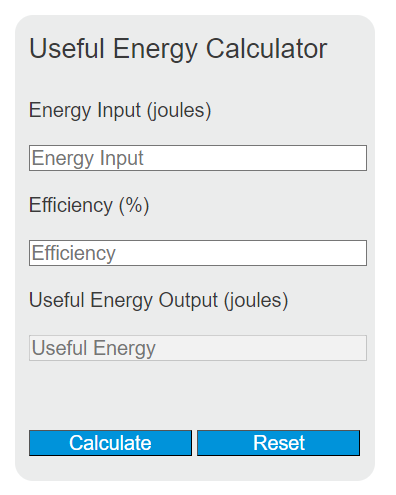
Calculate useful energy output, energy input, or efficiency from any 2 values in joules, kilojoules, or BTU with unit conversions.
Related Calculators
- Annual Energy Production Calculator
- Motor Efficiency Calculator
- Heating Rate Calculator
- Instantaneous Current Calculator
- All Physics Calculators
Useful Energy Formula
Useful energy is the amount of input energy that is converted into the intended output. When efficiency is entered as a percentage, the relationship is:
If efficiency is written as a decimal instead of a percent, the equivalent form is:
Variable Definitions
| Symbol | Meaning | Units | What It Represents |
|---|---|---|---|
| UE | Useful Energy Output | J, kJ, BTU | The energy that actually performs the desired task. |
| EI | Energy Input | J, kJ, BTU | The total energy supplied to the system. |
| η | Efficiency | % or decimal | The fraction of input energy that becomes useful output. |
How to Calculate Useful Energy
- Determine the total energy input.
- Determine the efficiency of the system.
- Convert the efficiency to the correct form for the formula being used.
- Multiply the input energy by the efficiency factor.
- Report the answer in the same energy unit used for the input.
If the calculator accepts efficiency as a percent, enter values such as 60, 75, or 92. If you are calculating by hand with decimal efficiency, use values such as 0.60, 0.75, or 0.92.
Rearranged Forms
If you know the useful energy output and efficiency, you can solve for the required input energy:
If you know the input energy and useful energy output, you can solve for efficiency:
If you want to find wasted energy, subtract useful energy from total input:
You can also write wasted energy directly in terms of efficiency:
Examples
Example 1: A system receives 500 J of energy and operates at 80% efficiency.
The useful output is 400 J, so the remaining 100 J is wasted.
Example 2: A device receives 2.5 kJ of energy and has an efficiency of 64%.
The system delivers 1.6 kJ of useful energy and loses 0.9 kJ.
Quick Interpretation Guide
| Efficiency | Meaning | Useful Portion of Input | Wasted Portion of Input |
|---|---|---|---|
| 25% | Low conversion to intended output | One quarter | Three quarters |
| 50% | Half of the input becomes useful | One half | One half |
| 75% | Most of the input is useful | Three quarters | One quarter |
| 100% | All input is treated as useful in the calculation | All of it | None |
Unit Tips
- Use the same unit for input and output energy.
- If the input is entered in joules, the useful output will also be in joules.
- If the input is entered in kilojoules or BTU, keep the output in that same unit unless you intentionally convert it.
- Efficiency is dimensionless, so it carries no energy unit.
Common Mistakes
- Entering 0.80 when the calculator expects 80 for an 80% efficiency input.
- Mixing units, such as using joules for input and expecting the output in kilojoules without conversion.
- Using an efficiency below 0% or above 100%.
- Confusing useful energy with total energy supplied.
- Forgetting that lower efficiency means a larger share of the input becomes wasted energy.
Why Useful Energy Matters
Useful energy helps you evaluate how effectively a system converts supplied energy into a desired result. This is important when comparing devices, estimating losses, checking process performance, sizing energy inputs, and understanding how much of the supplied energy is actually doing productive work.
Useful Energy vs. Wasted Energy
Every energy input can be divided into a useful portion and a wasted portion. In percentage terms, these two parts add up to the full input energy. A higher efficiency means more of the supplied energy becomes useful output and less is lost.
Frequently Asked Questions
- Is useful energy always less than input energy?
- For any calculation with efficiency below 100%, yes. The useful output is only a fraction of the total input.
- Can I use this calculator with kJ or BTU?
- Yes. The key is to keep the input and output in the same unit system.
- What happens if efficiency is 100%?
- The useful energy output equals the total input energy.
- How do I find the energy that was lost?
- Subtract useful energy from input energy, or use the wasted energy formula shown above.