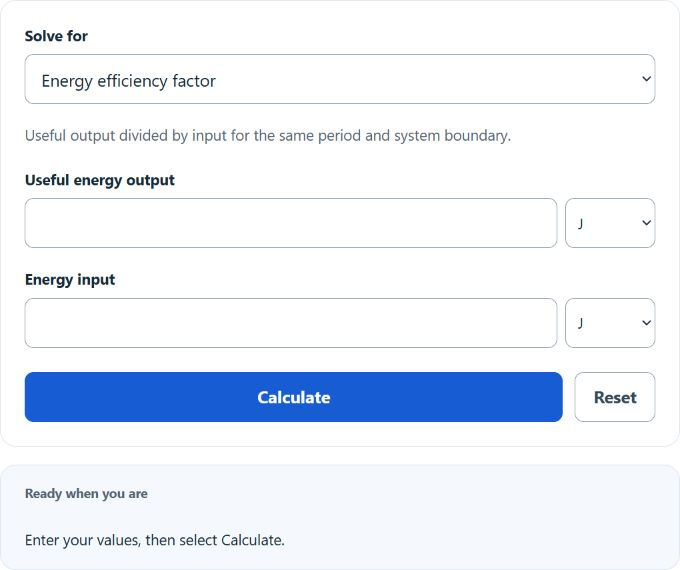
Calculate energy efficiency factor from energy output and input, estimate fuel-based EEF with editable heating values, or convert HVAC ratings to dimensionless energy ratios while preserving their test conditions.
Related Calculators
- Heat Recovery Calculator
- U Value of Ground Floor Calculator
- Louver Free Area Calculator
- Orifice Size Calculator
- All Construction Calculators
Energy Efficiency Factor Formula
Variables:
- EEF is the Energy Efficiency Factor
- EO is the energy output
- EI is the energy input
To calculate Energy Efficiency Factor, divide the energy output by the energy input.
How to Calculate Energy Efficiency Factor?
The following steps outline how to calculate the Energy Efficiency Factor.
- First, determine the energy output.
- Next, determine the energy input.
- Next, gather the formula from above = EEF = EO / EI.
- Finally, calculate the Energy Efficiency Factor.
- After inserting the variables and calculating the result, check your answer with the calculator above.
Example Problem :
Use the following variables as an example problem to test your knowledge.
energy output = 300 J
energy input = 400 J; EEF = 300 / 400 = 0.75 (75%)
Frequently Asked Questions (FAQ)
What is Energy Efficiency Factor (EEF)?
Energy Efficiency Factor (EEF) is a measure of how efficiently a system converts input energy into output energy. It is calculated by dividing the energy output by the energy input.
Why is calculating Energy Efficiency Factor important?
Calculating the Energy Efficiency Factor is important for understanding how well a system is performing. It helps in identifying areas for improvement and can lead to cost savings and reduced environmental impact by optimizing energy use.
Can Energy Efficiency Factor be greater than 1?
Typically, the Energy Efficiency Factor is less than 1, as systems usually lose some energy in the form of heat or other waste. Heat pumps can deliver more heat than their electrical input because they transfer energy from the environment. Their COP can exceed 1 without creating energy; this differs from conversion efficiency with all energy inputs included.
How can one improve the Energy Efficiency Factor of a system?
Improving the Energy Efficiency Factor of a system can be achieved by reducing energy losses, optimizing the system’s operation, using more efficient components, and regular maintenance to ensure the system operates at peak efficiency.