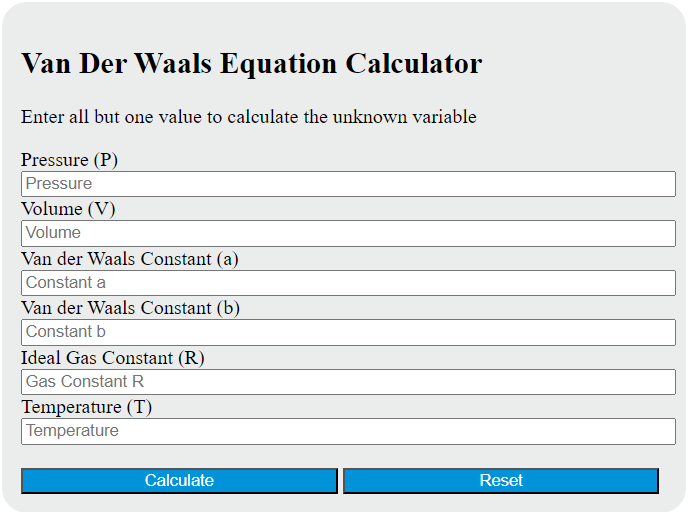
Calculate the missing Van der Waals equation variable from pressure, molar volume, temperature, constants a and b, and gas constant R.
Related Calculators
- Gas Density Calculator
- Moles To Kpa Calculator
- Nitrogen Pressure Calculator
- G/Mol To Density Calculator
- All Chemistry Calculators
Van Der Waals Equation Formula
The van der Waals equation is used to describe the behavior of real gases, taking into account intermolecular forces and the finite size of gas molecules. In molar form (using molar volume v = V/n), the equation is:
Variables:
- P is the pressure of the gas
- v is the molar volume of the gas (v = V/n)
- a is the van der Waals attraction parameter for the gas
- b is the van der Waals co-volume (excluded volume) parameter for the gas
- R is the ideal gas constant
- T is the absolute temperature of the gas
To use the van der Waals equation calculator, substitute the values of pressure (P), molar volume (v), van der Waals constants (a and b), ideal gas constant (R), and temperature (T) into the equation and solve for the unknown variable.
What is a Van Der Waals Equation?
The van der Waals equation is a mathematical expression that describes the behavior of real gases, taking into account the finite size of molecules and the intermolecular forces between them. It is an improvement over the ideal gas law, which assumes that gas molecules have no volume and do not interact with each other. A common form (using total volume V and amount of substance n) is:
Dividing by n and using molar volume v = V/n gives the molar form used by the calculator: (P + a/v²)(v - b) = RT. The term a(n/V)² (or a/v² in molar form) corrects pressure for attractive forces between molecules, and the term nb (or b in molar form) accounts for the finite volume of the molecules by reducing the volume available to the gas.
How to Calculate Van Der Waals Equation?
The following steps outline how to calculate the Van Der Waals Equation:
- First, determine the values of the variables: pressure (P), temperature (T), and the van der Waals constants (a and b). Use the molar volume v (or convert from total volume using v = V/n).
- Next, substitute the values into the van der Waals equation (molar form): (P + a/v²)(v - b) = RT.
- Next, simplify the equation by expanding and rearranging terms.
- Finally, solve for the unknown variable by isolating it on one side of the equation (note: solving for v typically requires solving a cubic equation, so numerical methods are commonly used).
- After obtaining the solution, check your answer by substituting the values back into the original equation.
Example Problem:
Use the following variables as an example problem to test your knowledge (molar form):
Pressure (P) = 3 atm
Molar Volume (v) = 2 L/mol
Temperature (T) = 300 K
Van Der Waals constant (a) = 1.36 L^2 atm/mol^2
Van Der Waals constant (b) = 0.0427 L/mol