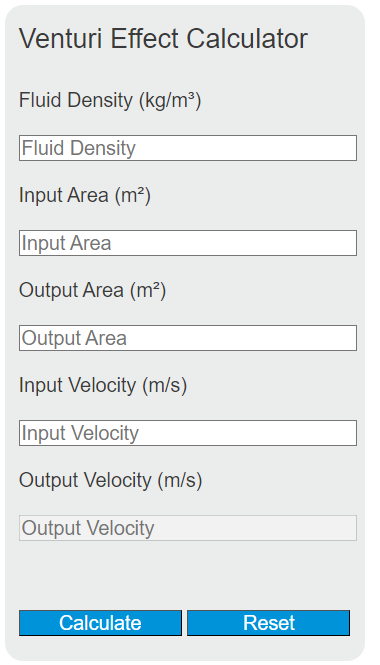
Calculate the missing Venturi effect value from fluid density, input and output areas, and velocities with unit conversions in m/s.
- All Physics Calculators
- Pipe Flow Calculator
- Water Flow Rate Calculator
- Volumetric Flow Rate Calculator
- Flow Rate Pressure Calculator
- Velocity to Pressure Calculator
- Pressure to Velocity Calculator
Venturi Effect Formula
The calculator above uses the continuity relationship for steady, incompressible flow. In a Venturi tube, fluid speeds up as it passes through a smaller cross-sectional area, so the outlet velocity can be found directly from the area ratio.
Where:
- Vout = output velocity
- Ain = input cross-sectional area
- Aout = output cross-sectional area
- Vin = input velocity
This means the flow velocity is inversely related to the flow area. When the outlet area is smaller than the inlet area, the outlet velocity increases. When the outlet area is larger, the outlet velocity decreases.
How the Venturi Effect Works
The Venturi effect occurs when a fluid moves through a constricted section of pipe or channel. As the flow area narrows, the fluid must accelerate to maintain mass flow. In real systems, this rise in velocity is commonly associated with a drop in static pressure through the throat section of the Venturi.
For the calculator on this page, the key idea is simple: same flow rate, different area, different velocity. If the inlet and outlet are on the same streamline and the fluid density remains effectively constant, continuity gives the velocity relationship directly.
How to Use the Calculator
- Enter the input area.
- Enter the output area.
- Enter the input velocity.
- Click calculate to determine the output velocity.
Important input note: area means the cross-sectional flow area, not the outside surface area of the pipe. For circular pipes, the area comes from the inside diameter.
If you are starting with pipe diameters instead of areas, convert diameter to area first, then use the Venturi formula.
Example
If the input area is 0.05 m², the output area is 0.02 m², and the input velocity is 3 m/s, then the outlet velocity is:
Because the outlet area is smaller than the inlet area, the fluid must move faster at the outlet.
When Density Matters
You may notice the calculator includes fluid density. For the simplified velocity calculation above, density does not affect the result. Density becomes important when you want to relate the velocity change to a pressure change using Bernoulli’s principle.
For a horizontal Venturi with negligible energy losses, the pressure drop between inlet and outlet can be written as:
So, if your goal is only to find outlet velocity from inlet velocity and area change, continuity is enough. If your goal is to estimate suction, pressure reduction, or differential pressure, density becomes necessary.
Practical Interpretation
- If Aout is half of Ain, the outlet velocity is twice the inlet velocity.
- If Aout equals Ain, the velocity does not change.
- If Aout is larger than Ain, the outlet velocity is lower.
- A very small outlet area can produce a very large calculated velocity, so input values should reflect a realistic geometry.
Assumptions Behind the Calculation
- Flow is steady.
- The fluid is incompressible or nearly incompressible.
- The flow follows the same stream path through the inlet and outlet sections.
- Cross-sectional areas are measured correctly.
- Losses from friction, turbulence, and fittings are ignored in the simple velocity equation.
These assumptions make the calculator useful for quick engineering estimates, conceptual design, and classroom problems.
Common Applications of the Venturi Effect
- Flow meters
- Aspirators and ejectors
- Carburetion and air-fuel mixing
- Sprayers and atomizers
- HVAC and duct flow analysis
- Water and process piping systems
Common Mistakes
- Using diameter values where area values are required
- Mixing units without converting them properly
- Using outside pipe diameter instead of inside diameter
- Assuming density changes the velocity result in the continuity-only form
- Applying the ideal formula to highly compressible or heavily restricted real-world flow without correction factors
If you need a quick check on your result, remember this rule: smaller flow area should produce higher velocity. If your calculation shows the opposite, one of the inputs is likely reversed or entered in the wrong units.