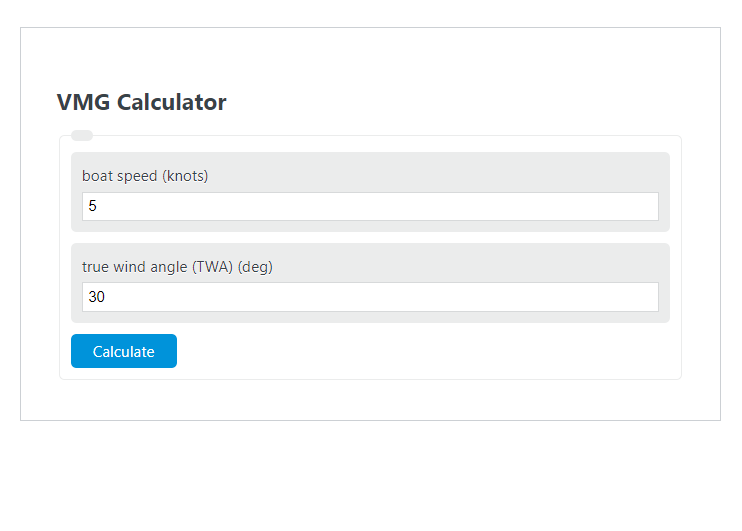
Enter the boat speed and true wind angle (TWA) into the calculator to determine velocity made good (VMG), the component of your sailing speed directed straight upwind or downwind. The VMG to Mark (VMC) tab computes your effective speed toward any waypoint based on boat heading and bearing to the mark.
Related Calculators
- Sail Force Calculator
- Hull Speed Calculator
- Nautical Mile Calculator
- Knots to Distance Calculator
- Boat Travel Time Calculator
- Wind Velocity Calculator
- All Sports and Fitness Calculators
VMG Formula
VMG = BS * cos(TWA)
Where VMG is velocity made good (knots), BS is boat speed through the water (knots), and TWA is the true wind angle in degrees measured from the bow to the true wind direction. The cosine function projects the boat's speed vector onto the wind axis, isolating only the component of motion that is directly upwind or downwind.
At a TWA of 0 degrees (sailing directly into the wind, which is impossible under sail), VMG would equal boat speed. At 90 degrees (beam reach), the cosine is zero and VMG drops to zero because the boat moves entirely perpendicular to the wind. At angles greater than 90 degrees, the cosine becomes negative, indicating downwind VMG. A TWA of 180 degrees (dead run) produces a negative VMG equal to the full boat speed, meaning maximum progress directly downwind.
What Is Velocity Made Good?
Velocity made good is the effective speed of a sailboat measured along the axis of the true wind. Because sailboats cannot travel directly into the wind, they must tack at an angle to make upwind progress. VMG quantifies how much of that angled speed actually translates into direct upwind (or downwind) gain. A boat moving at 7 knots through the water at 40 degrees off the wind has a VMG of approximately 5.4 knots. That 5.4 knots represents the rate at which the boat closes distance to a windward mark.
VMG is the single most important performance metric in windward/leeward racing. The boat with the highest average VMG over a leg wins that leg, regardless of which boat had greater raw speed through the water. This is why a well-sailed 30-foot cruiser pointing at 38 degrees can beat a faster boat that is pinching at 30 degrees or footing off at 55 degrees.
VMG by Point of Sail
The relationship between true wind angle, boat speed, and VMG varies dramatically across points of sail. The following reference values are representative of a typical 35 to 40 foot monohull keelboat in 12 knots of true wind.
Close-hauled (TWA 30 to 45 degrees): This is where upwind VMG is maximized. A typical target is TWA 40 degrees with a boat speed of 6.9 knots, yielding a VMG of about 5.3 knots. Pinching to 30 degrees might reduce boat speed to 5.5 knots and VMG to 4.8 knots. The optimal angle balances pointing ability against speed loss from a stalled sail plan.
Close reach (TWA 45 to 60 degrees): Boat speed increases as the sails are eased, but VMG begins to decline. At 60 degrees and 7.5 knots of boat speed, VMG is only 3.75 knots upwind. This point of sail is fast and comfortable, but inefficient for making ground to windward.
Beam reach (TWA 90 degrees): VMG is zero. The boat moves entirely across the wind with no upwind or downwind component. This is often the fastest point of sail in terms of raw speed, but it contributes nothing to progress along the wind axis.
Broad reach (TWA 120 to 150 degrees): Downwind VMG becomes significant. At 135 degrees with a boat speed of 7.2 knots, downwind VMG is approximately 5.1 knots. Many boats achieve their best downwind VMG here rather than sailing dead downwind, especially when flying an asymmetric spinnaker or Code 0.
Running (TWA 160 to 180 degrees): Boat speed drops significantly, often to 5 to 6 knots, but the cosine of the angle is close to -1, so nearly all speed is directed downwind. At 170 degrees and 5.5 knots, downwind VMG is about 5.4 knots. Whether this beats the broad reach VMG depends on the boat, its rig, and the sea state.
VMG vs. VMC
VMG and VMC (velocity made good on course, also called velocity made good to mark) measure different things. VMG uses the true wind direction as its reference axis. VMC uses the bearing to a specific waypoint or mark. They are equal only when the mark lies exactly upwind or exactly downwind.
VMC is calculated as boat speed multiplied by the cosine of the angle between the boat's heading and the bearing to the mark. This makes VMC useful on any leg of a course, not just windward and leeward legs. However, VMC can be misleading on upwind legs when tacking is required. A boat on port tack heading away from a windward mark may show negative VMC even though the tack is strategically correct for wind shifts or favorable current.
In racing, VMG is the primary metric for pure upwind and downwind performance. VMC is more useful for reaching legs, navigation in current, or when the mark does not lie along the wind axis. Most modern chartplotters display both simultaneously.
Polar Diagrams and Target VMG
A polar diagram is a radial chart that plots a boat's speed at every wind angle for a given true wind speed. Each wind speed produces a different curve. The maximum upwind VMG is found by drawing a horizontal tangent line to the top of the polar curve; the point where it touches indicates the optimal TWA and target boat speed. The same method applied to the bottom of the curve yields the best downwind VMG angle.
For example, a J/105 in 10 knots of wind might show a polar target of 6.4 knots at 42 degrees TWA, producing a target VMG of 4.75 knots. In 15 knots, the same boat's target could shift to 7.1 knots at 39 degrees, yielding a VMG of 5.52 knots. On the downwind side, the optimal angle in 10 knots might be 155 degrees at 6.1 knots of boat speed (downwind VMG of 5.6 knots), widening to 145 degrees at 7.3 knots in 15 knots of wind (downwind VMG of 5.98 knots).
Polar diagrams are generated from velocity prediction programs (VPPs) that model hull resistance, sail aerodynamics, and appendage drag. ORC and IRC rating systems use VPP data to rate boats, and many one-design classes have published polars available. Comparing your real-time VMG to your polar targets is the most direct way to evaluate boat handling, sail trim, and strategic decisions on the racecourse.
Factors That Reduce VMG
Several factors cause actual VMG to fall below polar targets. Sea state is the most significant. Waves slow the boat, force wider tacking angles, and introduce speed variation through the wave cycle. In 2 to 3 foot chop, upwind VMG can drop 10 to 20 percent below flat water targets. Sail trim errors, particularly an over-trimmed jib or twisted mainsail, reduce pointing and speed simultaneously. Leeway (sideways slippage through the water) is not captured by the basic VMG formula but can add 3 to 7 degrees of effective angle loss on older or shallower-keeled boats. Current also shifts the picture: a boat sailing at 5 knots of VMG into 1.5 knots of adverse current has a true ground VMG of only 3.5 knots.
Helmsman technique matters as well. Constantly chasing the VMG number on the instrument display leads to over-steering, which creates drag from excessive rudder angle. Experienced sailors focus on maintaining a smooth, steady VMG average over 30 to 60 second intervals rather than reacting to every gust and wave.
The Downwind VMG Paradox
One counterintuitive result of VMG analysis is that sailing dead downwind is rarely the fastest route to a leeward mark. A boat running at TWA 180 degrees in 12 knots of wind might make only 5.2 knots of boat speed and 5.2 knots of downwind VMG. The same boat broad reaching at 140 degrees under spinnaker might hit 7.8 knots through the water, yielding a downwind VMG of 5.97 knots. The extra distance sailed is more than offset by the higher speed, because sails generate more power at apparent wind angles that keep airflow attached across the leeward surface.
This principle is why competitive offshore racers gybe downwind at wide angles rather than sailing a straight line to the finish. In extreme cases such as foiling multihulls and IMOCA 60s, the optimal downwind VMG angle can be as wide as 120 to 130 degrees true, with the boat traveling at two or three times the wind speed to produce net downwind progress that exceeds the wind speed itself.
Instruments and VMG Display
Modern sailing instruments calculate VMG in real time using data from a speed sensor (paddlewheel or ultrasonic), a wind vane, and an electronic compass. The instrument processor applies the cosine function continuously and can display instantaneous VMG, 10-second rolling average, or a longer damped value. Most racing sailors set their primary display to a 5 to 10 second damped VMG, which smooths out wave-induced noise without lagging too far behind real changes in performance.
Common instrument systems from B&G, Garmin, and Raymarine also display target VMG derived from uploaded polar data. The difference between current VMG and target VMG, sometimes called VMG performance percentage, tells the crew exactly how close they are to theoretical optimum. A performance reading above 95 percent in moderate conditions indicates good trim and helming; dropping below 85 percent signals a need to re-evaluate sail selection, trim, or heading.