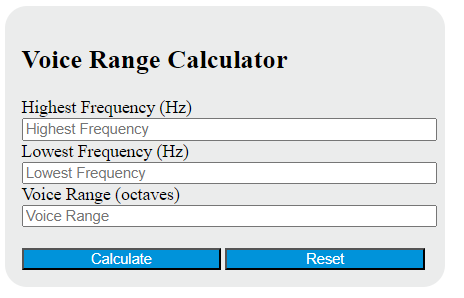
Calculate voice range in octaves or find the missing highest or lowest frequency from any two values using Hz or kHz inputs and a formula.
Related Calculators
- Speech Length Calculator
- Speech Rate Calculator
- Presentation Time Calculator
- Words to Minutes Calculator
- Hz to Note Calculator
- All Everyday Life and Education Calculators
Voice Range Formula
When vocal span is expressed in octaves, it is measured on a logarithmic scale. That matters because pitch does not increase in a straight line with frequency. Every time frequency doubles, the pitch rises by exactly one octave.
Variables:
- VR = voice range in octaves
- Fmax = highest reachable frequency
- Fmin = lowest reachable frequency
Because the formula uses a ratio, the units cancel out. You can use Hz or kHz, but both inputs must use the same unit.
Rearranged Forms
If you know the octave span and one frequency limit, you can solve for the other limit:
These forms are useful when the calculator is solving for the highest or lowest frequency instead of the total span.
What This Calculator Measures
This calculator measures the distance between your lowest and highest phonated pitches. It tells you how wide your range is, not what your voice type is. Two singers can have the same number of octaves and still differ in timbre, tessitura, resonance, and comfort zone.
- Absolute range: the furthest low and high pitches you can produce at all
- Usable range: the notes you can sing consistently with control and acceptable tone
- Performance range: the notes you can reliably use in songs, rehearsals, and live settings
For most practical music decisions, the usable or performance range is more important than the absolute extreme notes.
How to Use the Voice Range Calculator
- Enter your highest frequency.
- Enter your lowest frequency.
- Make sure both values are in the same unit.
- Calculate the result to get your voice range in octaves.
If you are testing your own voice, use repeatable pitches rather than one-time extremes. A note only counts if you can produce it cleanly enough for the purpose you care about.
Manual Calculation Example
If your lowest pitch is 200 Hz and your highest pitch is 1000 Hz, the octave span is:
That means the voice spans a little over 2.32 octaves. In other words, the highest pitch is five times the lowest pitch in frequency.
Quick Interpretation Guide
| Voice Range | Highest vs. Lowest Frequency | If Lowest = 200 Hz |
|---|---|---|
| 1 octave | Highest frequency is twice the lowest | 400 Hz |
| 2 octaves | Highest frequency is four times the lowest | 800 Hz |
| 3 octaves | Highest frequency is eight times the lowest | 1600 Hz |
| 4 octaves | Highest frequency is sixteen times the lowest | 3200 Hz |
This is why octave range is a better musical measurement than simply subtracting frequencies. A change from 100 Hz to 200 Hz is the same octave jump as 500 Hz to 1000 Hz, even though the raw differences are very different.
Using Notes Instead of Frequencies
If you know note names better than frequencies, convert the notes to Hz first. In twelve-tone equal temperament, frequency can be written as:
Here, n is the number of semitones above or below A4. Once the low and high notes are converted to frequencies, use the main voice range formula.
You can also express the same range in semitones:
Since 12 semitones equal 1 octave, a 24-semitone range equals 2 octaves, and a 36-semitone range equals 3 octaves.
Common Input Mistakes
- Using different units for the high and low frequencies
- Entering note numbers, MIDI values, or note names when the calculator expects frequency
- Using a strained top note or fry-based bottom note that is not repeatable
- Confusing total phonated range with comfortable singing range
- Assuming range alone determines whether a voice is soprano, alto, tenor, baritone, or bass
Why Voice Range Matters
Knowing your vocal range can help with song selection, part assignment, arrangement decisions, choir placement, and tracking progress over time. It is also useful when comparing different registers or seeing how warm-ups and training affect your top and bottom notes.
Still, range is only one piece of the picture. Musicians usually care just as much about:
- tone quality across the range
- pitch accuracy
- register transitions
- stamina
- dynamic control
- where the voice feels most natural
Voice Range FAQ
Is a larger voice range automatically better?
No. A wider range can be useful, but control, tuning, consistency, diction, resonance, and endurance usually matter more in real performance.
Can two singers have the same range but different voice types?
Yes. Voice type depends on more than extremes. Tessitura, timbre, passaggio behavior, and where the voice projects best are all important.
Why does the formula use a logarithm?
Musical intervals are based on ratios, not simple differences. The logarithm converts a frequency ratio into a musically meaningful octave measurement.
Can this calculator be used for instruments too?
Yes. The same octave formula works for any sound source with a lowest and highest frequency limit, including instruments and synthesized tones.