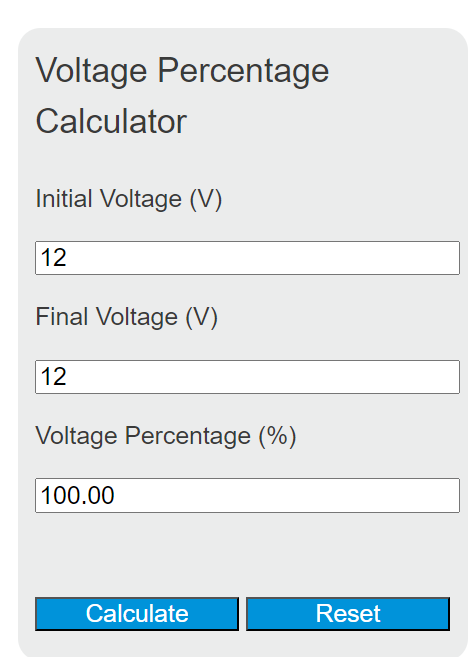
Calculate voltage percentage from a measured and reference voltage, plus percent change, voltage drop percent, battery charge percent, and 3-phase unbalance.
Related Calculators
- Line To Neutral Voltage Calculator
- Step-Down Voltage Calculator
- Voltage Divider Calculator
- DC Link Voltage Calculator
- All Physics Calculators
Voltage Percentage Formula
Voltage percentage expresses the final voltage as a percentage of the initial voltage. It is useful when comparing voltage levels before and after a regulator, transformer, cable run, converter, or loaded electrical circuit.
- VP = voltage percentage
- FV = final voltage
- IV = initial voltage
This result tells you how much of the original voltage remains after the change:
- 100% means no change in voltage
- Greater than 100% means the voltage increased
- Less than 100% means the voltage decreased
How to Calculate Voltage Percentage
- Measure or determine the initial voltage.
- Measure or determine the final voltage.
- Divide the final voltage by the initial voltage.
- Multiply the result by 100 to convert it to a percentage.
Always use the same voltage basis for both measurements. For AC systems, compare RMS to RMS. For DC systems, compare DC to DC. Mixing RMS, peak, or unloaded and loaded values can produce misleading results.
Example
If a circuit starts at 12 V and later measures 9 V, the voltage percentage is:
This means the final voltage is 75% of the initial voltage. In other words, the system retained three-fourths of its original voltage.
Voltage Percentage vs. Percent Change
Many users confuse voltage percentage with percentage change. This calculator returns the final voltage as a percent of the initial voltage. If you need the actual increase or decrease relative to the starting value, use percent change instead.
If you specifically want voltage drop percentage, use:
Using the same 12 V to 9 V example:
- Voltage percentage = 75%
- Percent change = -25%
- Voltage drop percentage = 25%
Interpretation Table
| Voltage Percentage | Meaning | Typical Interpretation |
|---|---|---|
| 0% to less than 100% | Final voltage is lower than initial voltage | Voltage drop, loss, sag, or reduced output |
| 100% | Final voltage equals initial voltage | No net change |
| Greater than 100% | Final voltage is higher than initial voltage | Voltage gain, boost, or amplification |
Common Uses
- Checking how much voltage remains after a load is applied
- Comparing input and output voltages of power supplies or converters
- Evaluating transformer tap or regulator performance
- Estimating voltage retention across long wire runs
- Reviewing circuit behavior during startup, discharge, or peak demand
Practical Notes
- Initial voltage cannot be zero, because division by zero is undefined.
- Use consistent units. Volts should be compared to volts.
- For accurate troubleshooting, measure under the same operating conditions.
- A low voltage percentage does not always mean failure; it may simply reflect normal load behavior.
- If you need to quantify loss rather than retention, use voltage drop percentage instead of voltage percentage alone.
Why This Calculation Matters
Voltage percentage is a fast way to normalize electrical measurements. Instead of only knowing that voltage changed by a certain number of volts, you can see the relative change, which makes it easier to compare batteries, supplies, circuits, and components operating at very different nominal voltages.