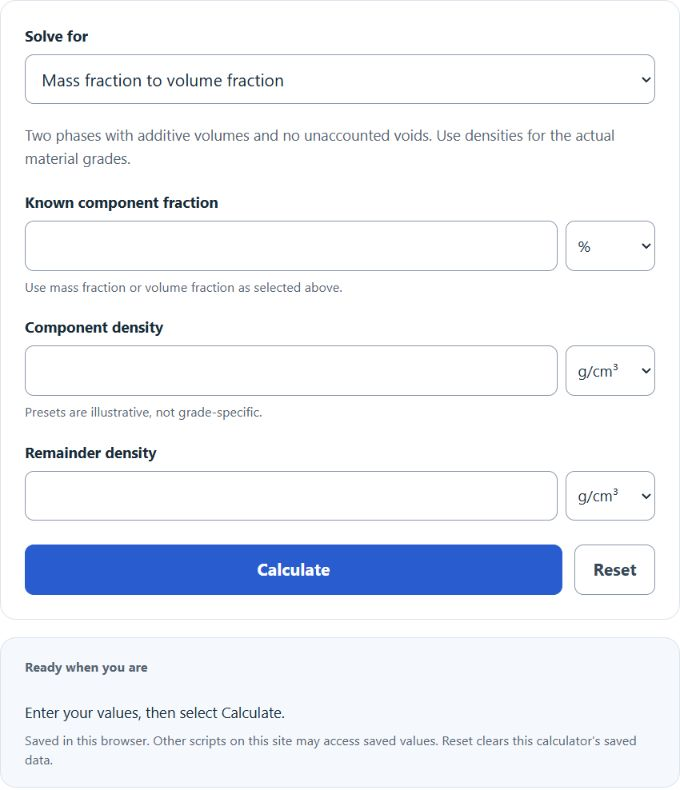
Choose mass-to-volume conversion, a direct fraction, or solid geometry. Density conversion assumes two phases with additive constituent volumes and no unaccounted voids; use densities for the actual material grades.
- All Volume Calculators
- All Chemistry Calculators
- Chemistry Volume Calculator
- Volume Ratio Calculator
Volume Fraction Formula
The following formula is used to calculate the Volume Fraction.
- Where Vf is the dimensionless volume fraction (for example, mL/mL)
- Vs is the volume of the substance (mL)
- Va is the sum of the component volumes on the same basis (mL)
To calculate volume fraction, divide the volume of the individual substance by the volume of all of the substances.
How to Calculate Volume Fraction?
The following example problems outline how to calculate Volume Fraction.
Example Problem #1:
- First, determine the volume of the substance (mL).
- The volume of the substance (mL) is given as 40.
- Next, determine the volume of all substances (mL).
- The volume of all substances (mL) is provided as 100.
- Finally, calculate the Volume Fraction using the equation above:
Vf = Vs / Va
The values given above are inserted into the equation below:
Vf = 40 / 100 = .40 (mL/mL)
Example Problem #2:
The variables needed for this problem are provided below:
volume of the substance (mL) = 90
volume of all substances (mL) = 180
Entering these values and solving gives:
Vf = Vs / Va = .50 (mL/mL)