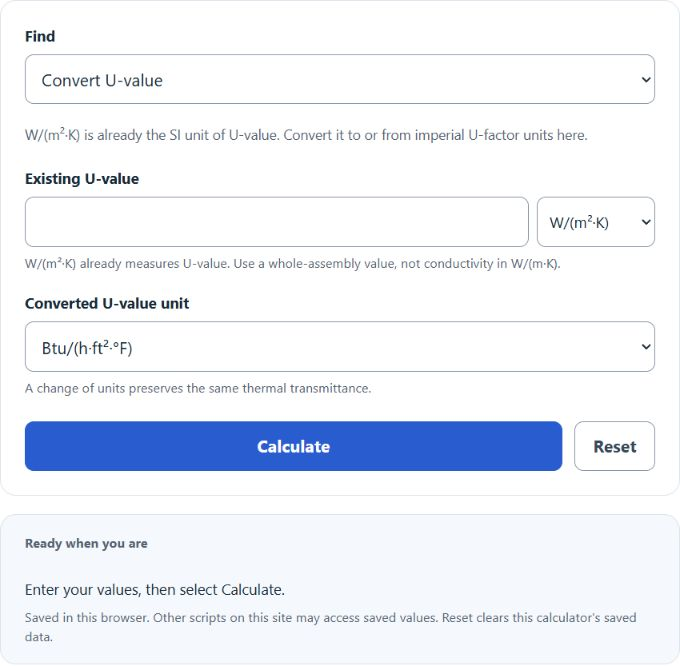
Convert W/m²K U-values and thermal resistance between metric and imperial units, or solve U = 1/R and R = 1/U for whole building assemblies.
- All Construction Calculators
- U Value to RSI Calculator
- U Value of Ground Floor Calculator
- Rockwool R-Value Calculator
Calculator Functions
| Function | What it does | What it requires |
|---|---|---|
| Convert U-value | Converts a U-value between W/(m²·K) and Btu/(h·ft²·°F) | Requires the existing U-value and its unit |
| U-value from R | Finds the U-value from a total thermal resistance | Requires the total R of the whole assembly in m²·K/W or h·ft²·°F/Btu |
| R-value from U | Finds the total thermal resistance from a U-value | Requires the U-value of the whole assembly in W/(m²·K) or Btu/(h·ft²·°F) |
| U-value from conductivity | Estimates the U-value of a flat element built from solid layers | Requires the thickness and thermal conductivity of 1 to 6 layers |
The first three functions list the U-value and the R-value in both metric and imperial units with every result. U-value from conductivity takes each thickness in mm, cm, m or in and each conductivity in W/(m·K). Its optional surface resistances start at 0.13 m²·K/W inside and 0.04 m²·K/W outside, and either can be changed or set to 0.
U-Value Formulas
| U | U-value, or thermal transmittance, in W/(m²·K) |
| R | Total thermal resistance of the element in m²·K/W, surface resistances included |
W/(m²·K), also written W/m²K, is the unit of U-value itself [1]. A wall quoted at 0.25 W/m²K has a U-value of 0.25, and nothing needs converting unless the figure is wanted in imperial units or as an R-value. m²·K/W is the unit of thermal resistance, the reciprocal.
Convert U-value
One Btu/(h·ft²·°F) equals 5.678263 W/(m²·K) [2], so a metric U-value is divided by that factor and an imperial one is multiplied by it. 0.25 W/(m²·K) is 0.0440 Btu/(h·ft²·°F). No reciprocal is taken when only the unit changes.
U-value from R
The main formula applies directly: a total R of 2.5 m²·K/W gives U = 0.4 W/(m²·K). An imperial R-value is converted to metric first:
R-15 in h·ft²·°F/Btu is 2.642 m²·K/W, which gives U = 0.379 W/(m²·K).
| R (m²·K/W) | U (W/(m²·K)) | R (h·ft²·°F/Btu) | U (Btu/(h·ft²·°F)) |
|---|---|---|---|
| 0.1 | 10.000 | 0.57 | 1.761 |
| 0.2 | 5.000 | 1.14 | 0.881 |
| 0.25 | 4.000 | 1.42 | 0.704 |
| 0.5 | 2.000 | 2.84 | 0.352 |
| 1 | 1.000 | 5.68 | 0.176 |
| 1.5 | 0.667 | 8.52 | 0.117 |
| 2 | 0.500 | 11.36 | 0.088 |
| 2.5 | 0.400 | 14.20 | 0.070 |
| 3 | 0.333 | 17.03 | 0.059 |
| 4 | 0.250 | 22.71 | 0.044 |
| 5 | 0.200 | 28.39 | 0.035 |
| 6 | 0.167 | 34.07 | 0.029 |
| 8 | 0.125 | 45.43 | 0.022 |
| 10 | 0.100 | 56.78 | 0.018 |
R-value from U
A U-value of 0.25 W/(m²·K) is a total R of 4 m²·K/W, or 22.71 h·ft²·°F/Btu. This is the resistance of the same whole assembly that the U-value describes.
U-value from conductivity
Each solid layer has a resistance of its thickness d in metres divided by its thermal conductivity λ in W/(m·K). The layers are added together with the inside and outside surface resistances, and U = 1 ÷ R [1]. The starting values of 0.13 and 0.04 m²·K/W are those for a wall, where heat flows horizontally. For a roof the inside value is 0.10, and for a floor it is 0.17 [1].
A single 100 mm layer with λ = 0.04 W/(m·K) has R = 0.1 ÷ 0.04 = 2.5 m²·K/W. With the wall surface resistances the total is 2.67 m²·K/W and U = 0.375 W/(m²·K).
Limits of This Estimate
- A U-value describes a whole assembly. The R-value of one insulation layer is not the total R of a wall, roof or window.
- U-value from conductivity covers flat elements made of uniform solid layers. Layers bridged by studs, joists or metal fixings need the combined method of BS EN ISO 6946, ground floors and basements are covered by BS EN ISO 13370, and windows and doors by BS EN ISO 10077-1 [1].
- An air gap is not a solid layer and should not be entered as one. Thermal conductivity in W/(m·K) is a property of a material, not a U-value.
- The result does not show compliance with a building code.
Sources
- BRE, Conventions for U-value calculations (BR 443), 2019 edition: U = 1 ÷ total resistance, layer resistance from thickness and conductivity, surface resistances and the cases needing other methods
- NIST, Guide for the Use of the International System of Units (SP 811), Appendix B.8: factors between imperial and metric U-value and R-value units