Calculate your water footprint in gallons per day from your diet, home water use, and energy, split into direct and virtual water with yearly totals.
Water Footprint Formula
Your total water footprint is the sum of the water you use directly at home and the “virtual” water used to produce your food, energy and goods:
WF = D + V
The direct part adds up each home use, then applies a factor for typical leaks:
D = (Sh + To + Fa + La + Di + Ba + Ou) * L
The virtual part adds the water behind your diet and your energy and product use:
V = Fd + En
Variables:
- WF is your total water footprint in gallons per day
- D is direct water, the water metered on your home bill
- V is virtual water, the hidden water used to make what you consume
- Sh, To, Fa, La, Di, Ba, Ou are daily gallons for showers, toilet, faucets, laundry, dishwasher, baths and outdoor use
- L is a leak factor, about 1.12 for a typical home that loses close to 12 percent of indoor water to leaks
- Fd is the food water footprint set by your diet, and En is the water behind your energy and household goods
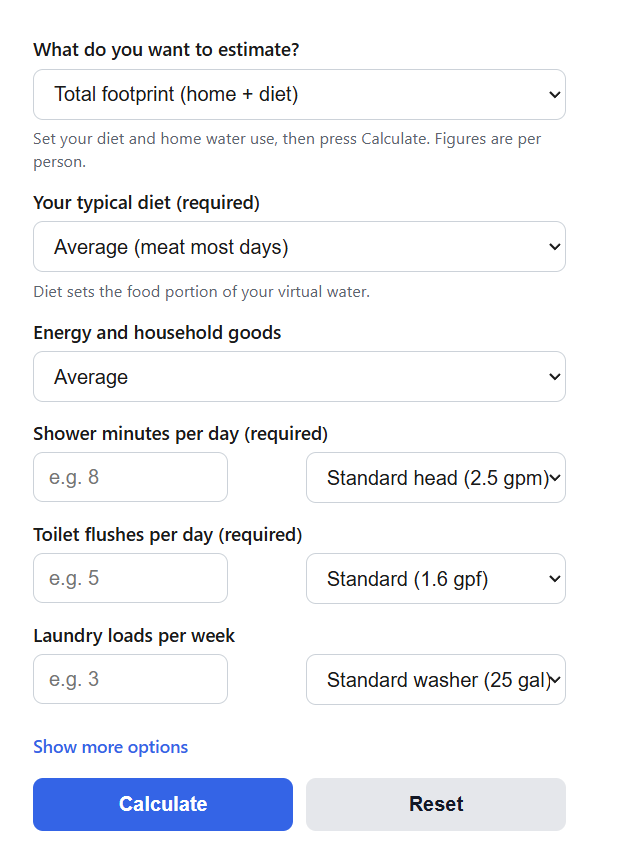
Pick what you want to estimate at the top of the calculator. In “Total footprint” mode you set your diet and your main home uses, and the tool returns gallons per day, gallons per year, the split between direct and virtual water, how you compare with the US average, and the yearly cost of your home water. In “Home water use only” mode you get a fixture by fixture breakdown of your metered use with a yearly dollar cost. In “Diet and goods only” mode you get just the virtual water behind your food and products. Each fixture value comes from the flow rate you pick, so a WaterSense showerhead at 2.0 gallons per minute lowers your shower total against a standard 2.5 head, and a low flush toilet lowers your toilet total.
Food Water Footprint by Diet
Diet is the largest lever on most footprints, so the food portion of your virtual water depends heavily on how much meat you eat. This table shows the food water footprint the calculator assigns to each diet, in gallons per day and gallons per year, so you can see the yearly gap between eating patterns before you add home use.
| Diet pattern | Food water (gal/day) | Food water (gal/year) |
|---|---|---|
| Heavy meat | 3,500 | 1,277,500 |
| Average (meat most days) | 1,500 | 547,500 |
| Low meat / flexitarian | 1,100 | 401,500 |
| Vegetarian | 700 | 255,500 |
| Vegan | 400 | 146,000 |
Moving from a heavy meat diet to an average one saves about 730,000 gallons of food water a year, and moving to a vegan diet saves more than a million. This second table lists typical water use for common home fixtures, which you can use to fill in the home inputs.
| Fixture | Typical use | Efficient option |
|---|---|---|
| Showerhead | 2.5 gal/min | 2.0 gal/min (WaterSense) |
| Toilet | 1.6 gal/flush | 1.28 gal/flush (WaterSense) |
| Bathroom faucet | 2.0 gal/min | 1.5 gal/min |
| Bath | 30 gal/bath | Partial fill |
| Clothes washer | 25 gal/load | 15 gal/load (high-efficiency) |
| Dishwasher | 6 gal/load | 4 gal/load (Energy Star) |
Example Problems
Example 1: Estimate a total water footprint.
You eat an average diet and use average energy and goods. At home you take an 8 minute shower with a standard head, flush a standard toilet 5 times, run 3 laundry loads a week in a standard washer, use the faucet about 4 minutes a day and run 4 dishwasher loads a week, with leaks included. Direct use works out to about 56 gallons a day. Virtual water is 1,500 for food plus 400 for energy and goods, or 1,900 gallons a day. Your footprint is 56 + 1,900 = about 1,956 gallons per day, close to the US average and roughly 714,000 gallons a year.
Example 2: Estimate home water only.
You take a 10 minute shower with a standard 2.5 head, which is 25 gallons, flush a standard toilet 6 times for 9.6 gallons, use the faucet 5 minutes for 10 gallons, run 4 laundry loads a week for about 14 gallons a day and 5 dishwasher loads for about 4 gallons a day. That adds to 63 gallons, and with a 12 percent leak factor your home use is about 71 gallons per day, or roughly 25,900 gallons per year.
Frequently Asked Questions
What is a water footprint?
A water footprint is the total amount of fresh water used to support one person, counting both direct and virtual water. Direct water is what you use at home and see on your bill, such as showers, toilets and laundry. Virtual water is the hidden water used to grow your food, generate your energy and make the products you buy. For most people the virtual part is far larger than the direct part.
What is the average water footprint per person?
In the United States the average water footprint is about 2,000 gallons per person per day. Only around 5 percent of that, near 100 gallons, is direct home use. The other 95 percent is virtual water, and diet alone accounts for more than half of the total because producing meat, dairy and some crops takes large amounts of water.
How can you lower your water footprint?
The biggest single change is usually diet, since cutting back on beef and other high water foods can save hundreds of thousands of gallons a year. At home, shorter showers, WaterSense showerheads and toilets, full laundry and dishwasher loads and fixing leaks all reduce direct use. Because home use is a small share of the total, pairing home savings with diet changes gives the largest overall drop.