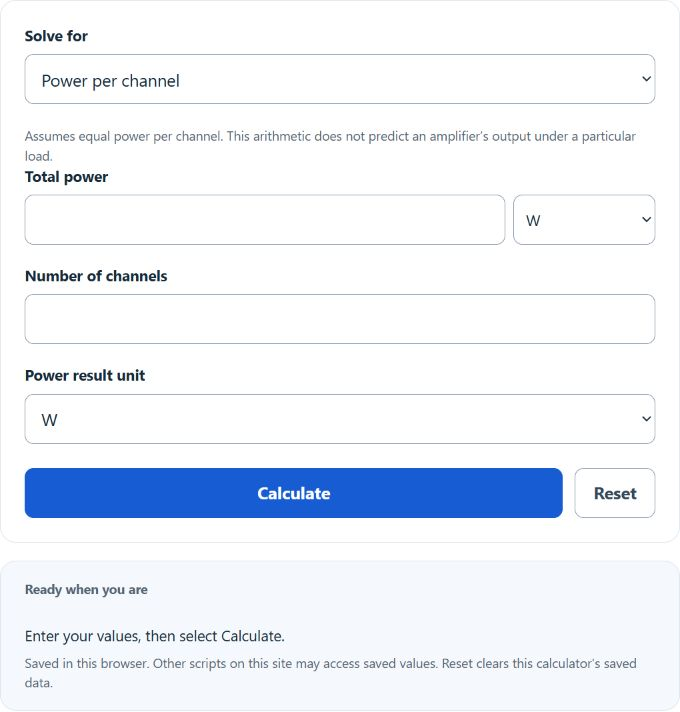
Select power per channel, total power, or equivalent channel count, then enter the two known quantities. The calculation assumes equal power per channel; Btu/hr means International Table Btu/hr and horsepower means mechanical horsepower.
- All Automotive Calculators
- Power Per Square Meter Calculator
- Watts to Voltage Calculator
- Watts to Voltage Calculator
Watts Per Channel Formula
The calculator uses total power, number of channels, and watts per channel. Select the value to solve, then enter the two known quantities.
- WPC = watts per channel
- P = total power, converted to watts before calculation
- C = total number of channels
The calculator first converts power inputs to watts. It then applies the matching formula for the selected value to solve.
- To find watts per channel: divide total power by the number of channels.
- To find total power: multiply watts per channel by the number of channels.
- To find number of channels: divide total power by watts per channel.
Power Unit Conversions Used
All calculations are handled in watts. If you choose another unit, the value is converted before and after the calculation.
| Unit | Equivalent in watts | Common use |
|---|---|---|
| Watt, W | 1 W | Standard amplifier and speaker power ratings |
| Kilowatt, kW | 1,000 W | Large power systems |
| BTU/hr | approximately 0.29307107 W | Heat output or energy rate conversions |
| Horsepower, HP | approximately 745.69987158 W | Motor power comparisons |
Common Audio Channel Counts
| System type | Channels | Example calculation from 500 W total |
|---|---|---|
| Mono | 1 | 500 W per channel |
| Stereo | 2 | 250 W per channel |
| 5-channel system | 5 | 100 W per channel |
| 7-channel system | 7 | 71.43 W per channel |
Example Problems
Example 1: Find watts per channel
You have a total power of 800 W and 4 channels.
The result is 200 watts per channel.
Example 2: Find total power
You have 150 W per channel and 6 channels.
The result is 900 watts total power.
FAQ
What does watts per channel mean?
Watts per channel is the amount of power assigned to each output channel. In a simple calculation, it is total power divided evenly by the number of channels.
Is total power always split evenly between channels?
Not always. This calculator assumes an even split. Real amplifiers may deliver different power depending on impedance, signal level, power supply limits, and how many channels are driven at the same time.
Can the number of channels be a decimal?
Entered channel counts must be positive whole numbers. Solving total power divided by per-channel power can produce a fractional equivalent count, which is not a physical audio-channel count and is not rounded into one.