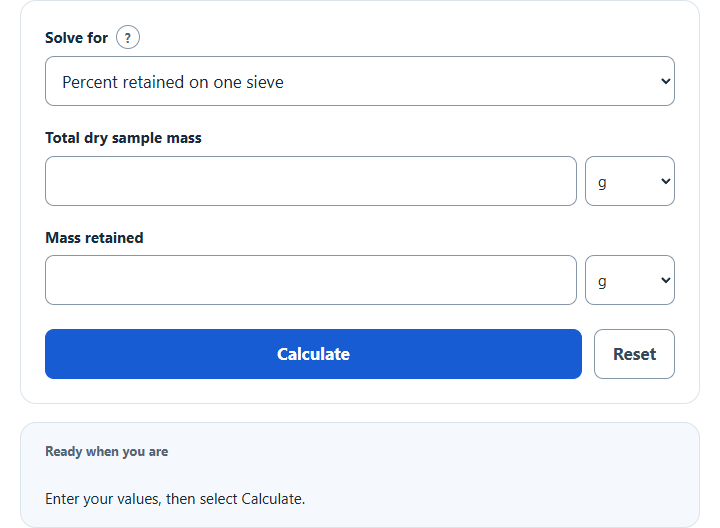
Calculate percent retained on a sieve from the retained and total dry mass, or the cumulative percent retained and passing for a full sieve analysis.
- All Construction Calculators
- Percentage Change in Mass Calculator
- Dry Matter Calculator
- Saturated Unit Weight Of Soil Calculator
Calculator Functions
| Function | What it does | What it requires |
|---|---|---|
| Percent retained on one sieve | Finds the share of the sample held on a sieve | Requires the total dry sample mass and the mass retained |
| Mass retained on one sieve | Finds the mass that a percent retained stands for | Requires the total dry sample mass and the percent retained |
| Total dry sample mass | Finds the sample mass from one sieve’s mass and percentage | Requires the mass retained and the percent retained |
| Cumulative % retained and passing (all sieves) | Finds percent retained, cumulative percent retained and percent passing for a whole stack of sieves | Requires a sieve series and the retained mass on each sieve in grams, largest opening first, with the pan as an optional last entry |
| Gradation from percent passing | Finds the retained and cumulative retained percentages from a percent-passing list | Requires a sieve series and the percent passing each sieve, largest opening first |
Single-sieve masses can be in g, kg or mg. The two gradation functions use the fine aggregate series (9.5, 4.75, 2.36, 1.18, 0.6, 0.3, 0.15 and 0.075 mm), the coarse aggregate series (75, 37.5, 19 and 12.5 mm, then the fine series) or up to 50 custom openings. Both take an optional original dry sample mass and both also report D10, D30, D60, the coefficients of uniformity and curvature, and the fineness modulus.
Percent Retained on a Sieve Formula
| PR | Percent retained on the sieve (%) |
| WS | Mass of material retained on the sieve (g) |
| DM | Original dry mass of the whole sample (g) |
The percent retained on each sieve is the mass held on that sieve divided by the original dry mass of the sample [1]. The divisor is the mass of the whole sample, not the mass that reached that sieve.
Percent retained on one sieve
The main formula applies directly. A sieve holding 125 g from a 500 g sample retains 125 ÷ 500 × 100 = 25%. Entering the combined mass on that sieve and every larger one gives the cumulative percent retained instead.
Mass retained on one sieve
25% of a 500 g sample is 125 g.
Total dry sample mass
If 125 g is 25% of the sample, the sample is 500 g.
Cumulative % retained and passing (all sieves)
The cumulative percent retained on a sieve, CPR, is the percent retained on it plus the percent retained on every larger sieve. Percent passing is what is left, 100 − CPR, found by subtracting down the stack from the first sieve that holds nothing [1]. For a 500 g sample with 0, 10, 60 and 100 g on the 9.5, 4.75, 2.36 and 1.18 mm sieves, the 1.18 mm sieve retains 20%, its cumulative percent retained is 0 + 2 + 12 + 20 = 34% and 66% passes it.
If the original dry mass is left blank, the total is the sum of the masses entered. If it is given and the pan is left blank, the pan mass is taken as the difference.
Gradation from percent passing
The percent retained on a sieve is the percent passing the next larger sieve minus the percent passing this one, and the cumulative percent retained is 100 − P. With 86% passing the 2.36 mm sieve and 66% passing the 1.18 mm sieve, the 1.18 mm sieve retains 20%. Masses are shown only when a dry sample mass is entered.
D10, D30, D60, Cu and Cc
D10, D30 and D60 are the particle sizes at 10%, 30% and 60% passing on the gradation curve [2]. The calculator finds each one between the two sieves that bracket it, on a logarithmic size scale. If the data does not bracket one of them, it is reported as unavailable, and so is any coefficient that needs it.
Fineness Modulus
The fineness modulus adds the cumulative percentages retained on a fixed series of sieves and divides by 100. The series is 0.15, 0.3, 0.6, 1.18, 2.36 and 4.75 mm, then 9.5, 19 and 37.5 mm and larger, each double the last [3]. With cumulative percentages of 2, 14, 34, 58, 80 and 94 on the 4.75 to 0.15 mm sieves and nothing on the 9.5 mm sieve, FM = 282 ÷ 100 = 2.82. A smaller value means a finer material, and fine aggregate commonly falls between 2.00 and 4.00 [3]. The calculator reports it only when all of the sample passes the largest sieve and every sieve of the series up to that size is in the data.
Limits of This Estimate
- Subtracting one sieve’s percent retained from 100 gives the percent passing only for the top sieve. Below it, the percent passing needs the cumulative percent retained.
- All masses must be on the same dry basis. When a sample is washed, the washing loss counts with the pan [1], so it belongs in the pan entry or in the original dry mass.
- D10, D30 and D60 are interpolated, never extended beyond the measured sieves, so the choice of sieves affects them.
- The calculator does the arithmetic of a sieve analysis. It does not check sample size, sieving time, mass recovery or any grading specification.
Sources
- Iowa Department of Transportation, Materials IM 302, Sieve Analysis of Aggregates: percent retained from the original dry mass, percent passing by subtraction, and washing loss
- U.S. Army Corps of Engineers Risk Management Center, Filter Evaluation toolbox manual, Filter Gradation: D10, D30 and D60 and the Cu and Cc equations
- U.S. Army Corps of Engineers, CRD-C 104-80, Method of Calculation of the Fineness Modulus of Aggregate: fineness modulus definition, sieve series and typical range