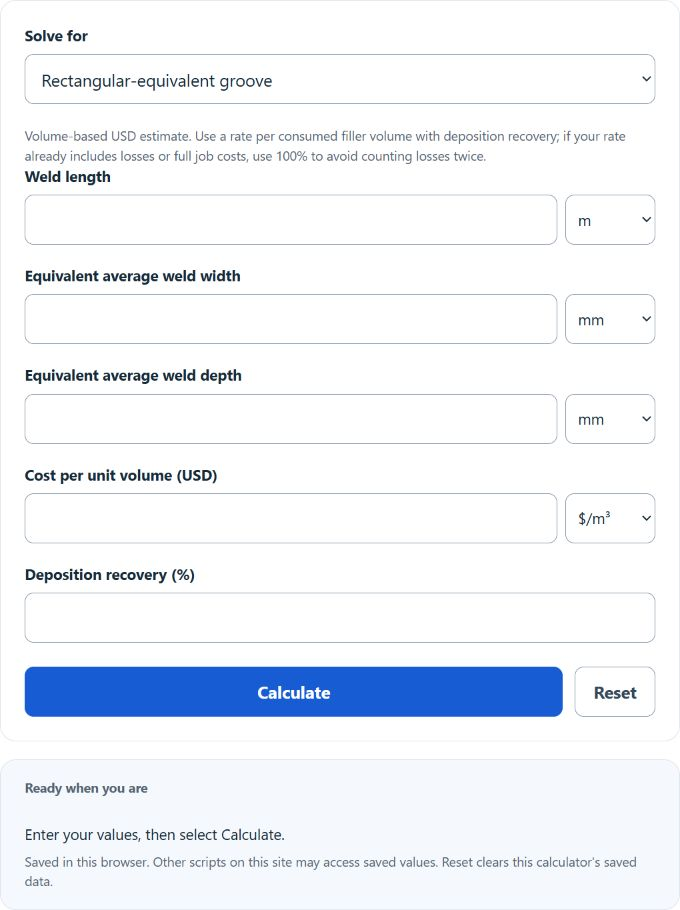
Estimate volume-based welding cost for rectangular-equivalent groove or equal-leg fillet welds from dimensions, USD volume rate and deposition recovery.
Welding Cost Formula
This calculator estimates a volume-based USD cost for a rectangular-equivalent groove or an ideal equal-leg 90° fillet. It does not establish a complete fabrication quote or an acceptable weld design.
- L is effective weld length.
- W and D are equivalent rectangular dimensions whose product equals the weld cross-sectional area.
- a is equal fillet leg size; P is the assumed area multiplier (1 for an ideal straight-face triangular fillet).
- R is the USD cost per consumed filler volume, with units matching V.
- E is deposition recovery in percent: consumed filler retained as deposited weld volume.
A tapered groove should be represented by its actual cross-sectional area, not by arbitrary averages. The legacy convex 1.10 and concave 0.85 area factors are approximate assumptions; profile names do not establish universal volume corrections or acceptable strength.
How to Calculate Welding Cost
- Choose the geometry and enter its measured dimensions.
- Enter a cost rate and select the matching cubic-volume unit.
- Enter deposition recovery above 0% and at most 100%.
- Calculate. The USD result rounds once to the nearest cent, half up.
Use 100% recovery if the rate already includes deposition losses; otherwise the same loss would be charged twice. Recovery is not a labor utilization or arc-on duty-cycle factor.
Example Welding Cost Calculation
A rectangular-equivalent weld is 2 m long, 10 mm wide and 5 mm deep. Its deposited volume is 2 × 0.010 × 0.005 = 0.0001 m³ = 100 cm³. At $2 per cm³ of consumed filler and 80% recovery, equivalent consumption is 100 ÷ 0.80 = 125 cm³. Estimated volume-based cost is 125 × $2 = $250.00.
What Does the Estimate Include?
Only costs represented by the entered volume rate are included. Labor, gas, power, preparation, assembly, inspection, rework, overhead, taxes and profit require additional costing unless already included in that rate. TWI distinguishes weld volume and consumable requirements from deposition time and the wider fabrication costs.
FAQ
Is deposition recovery the same as operator efficiency?
No. Recovery concerns filler retained in the weld. Operator utilization concerns time; this volume model does not calculate labor hours.
Does a lower-volume profile mean the weld is acceptable?
No. Required throat, weld shape, joint strength, tolerances and procedure qualification must be checked separately.