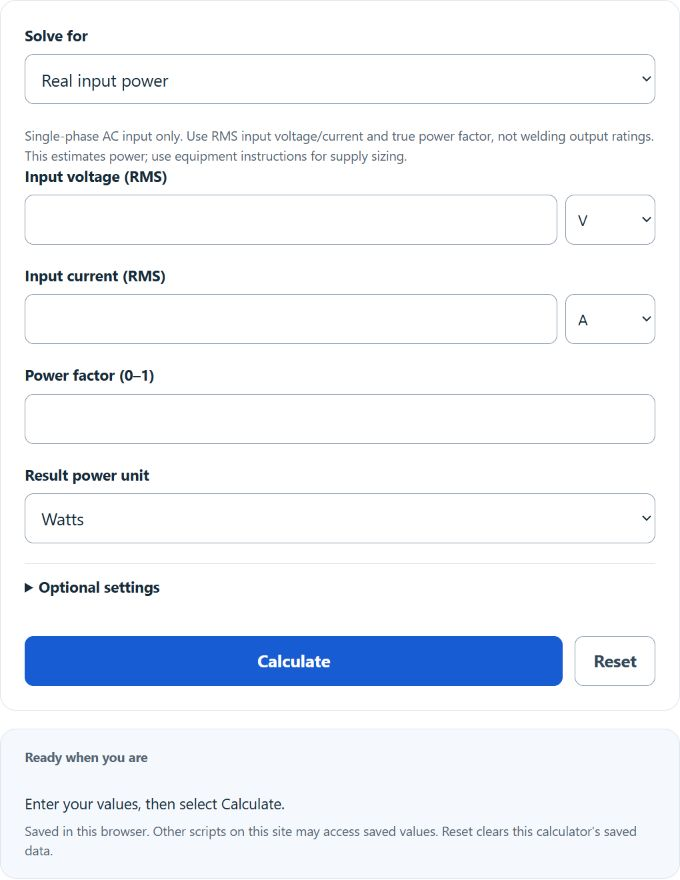
Choose real input power, voltage, current or power factor, then enter the other three values. This calculator uses the single-phase AC input relationship. Optional operating time also gives energy at that input power.
- Heat Input Calculator
- Welding Machine Amperage Calculator
- X-Factor Welding Calculator
- Load Wattage Calculator
- kWh Calculator
- All Construction Calculators
Welding Machine Load Formula
For welding equipment, the term load is commonly used in two ways: the machine’s real electrical input at a specific moment, and the total electrical energy it uses over time. The calculator fields for voltage, current, power factor, and power help you determine the real input power first. From there, you can estimate total energy use in kilowatt-hours.
Real Input Power
For single-phase AC, this equation gives real input power in watts from RMS input voltage, RMS input current and true power factor. It is not the balanced three-phase input equation.
Total Energy Used
These forms give energy in kilowatt-hours during time spent at the stated input power. Add idle and other operating periods separately for total consumption; arc-on time alone omits idle energy.
Rearranged Forms
These relationships are useful when the calculator is solving for a missing input value.
Variable Definitions
| Symbol | Description | Common Unit |
|---|---|---|
| V | Input voltage supplied to the welding machine | V or kV |
| I | Input current drawn by the machine | A or kA |
| PF | Power factor of the electrical input | Unitless |
| P | Real input power | W or kW |
| t | Operating time | hours |
| WML | Total welding machine load as energy consumed | kWh |
How to Calculate Welding Machine Load
- Enter the machine’s input voltage.
- Enter the input current draw.
- Enter the power factor as a decimal value.
- Use the calculator to determine real input power in watts.
- Optionally enter time at this input power to calculate energy. Add any idle or other operating periods separately.
Example
Suppose a welding machine draws 240 V, 30 A, and has a power factor of 0.85. If it runs for 2.5 hours, first calculate the real input power:
The machine’s real electrical load is 6120 W, or 6.12 kW.
Next, calculate the total energy used during operation:
In this case, the welder uses 15.3 kWh of electrical energy over 2.5 hours.
What Affects Welding Machine Load?
- Voltage: Supply voltage changes the relationship between current and power.
- Current draw: Higher current increases the electrical demand on the supply.
- Power factor: Real power is lower than simple volt-amp multiplication when the power factor is below 1.
- Operating time: Longer use increases total energy consumption even when power stays constant.
- Machine setting and duty cycle: Higher output settings and longer active welding periods usually increase overall consumption.
Practical Notes
- Use the welder’s input electrical data, not the welding output rating, when estimating supply load.
- For intermittent use, estimate each operating and idle period using its corresponding input power; a single full-load figure does not describe the whole shift.
- This calculator is best suited to the simple voltage-current-power factor relationship shown above.
- If your welding machine uses a different supply arrangement, confirm that the input values and method match the equipment.
- This estimate does not size circuits, breakers or generators. Follow the equipment instructions and applicable electrical requirements.
Common Questions
- Is welding machine load the same as power?
- Sometimes. Many people use load to mean the machine’s instantaneous input power in watts or kilowatts. Others use it to mean total energy consumption over time in kilowatt-hours.
- What if I already know the power?
- You can skip the voltage and current relationship and calculate energy use directly from power and operating time.
- Why does power factor matter?
- Power factor adjusts the difference between apparent electrical demand and real power actually consumed by the machine.
- Can this help estimate electricity usage?
- Yes. Once real power is known, converting that value into kilowatt-hours provides a practical estimate of energy consumed during operation.