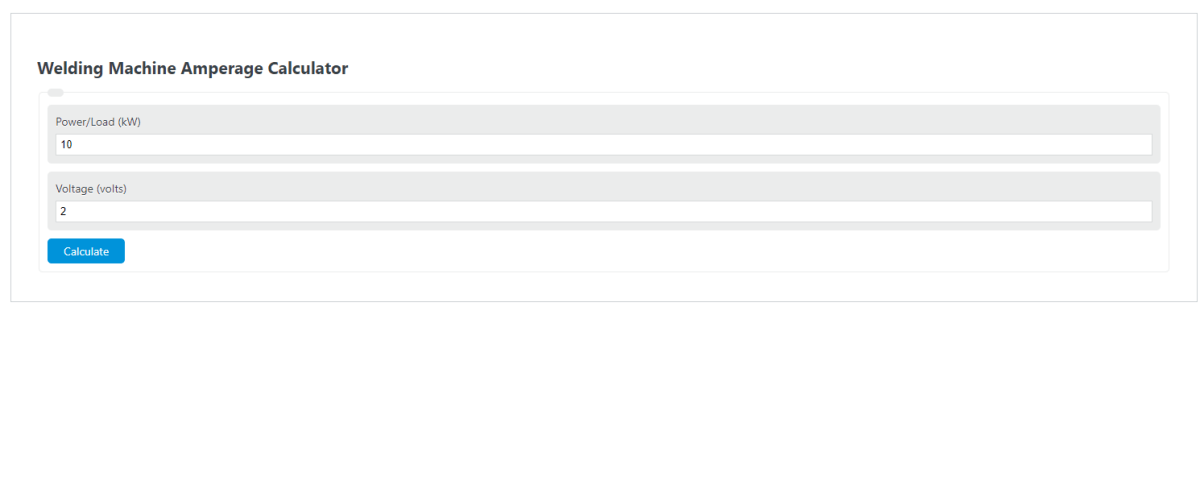
Use this Welding Machine Amperage Calculator to solve input amps, power, or voltage with single- and three-phase formulas, power factor, and kVA headroom.
- All Construction Calculators
- Anodizing Amperage Calculator
- Overload Current Calculator
- Welding Machine Load Calculator
- Amps Draw Calculator
- Watts to Amps Calculator
- Voltage Calculator
- Three Phase Power Calculator
Welding Machine Amperage Formula
The calculator estimates the input current draw of a welding machine from its electrical power and supply voltage. For a simplified estimate, use the relation below:
- A = input amperage in amps
- P = input power in watts
- V = supply voltage in volts
This is the fastest way to estimate current draw when the machine’s real input power is known and the power factor is close to 1. If power is listed in kilowatts, convert it to watts first.
More Complete AC Input Current Formulas
Many welders are AC-powered loads, so actual input current can be somewhat higher than the simple estimate above. When power factor matters, the more complete formulas are:
Single-phase:
Three-phase:
Here, PF is the power factor. Lower power factor means higher input current for the same real power.
What the Calculator Measures
This calculator is for electrical input amperage, meaning the current the welder pulls from the power source. That is different from the welding output current at the electrode, torch, or stinger. A welder may deliver a high welding output current while drawing a lower or different input current because the machine converts voltage and current internally.
| Term | Meaning | Why It Matters |
|---|---|---|
| Input amperage | Current drawn from the wall outlet, generator, or supply panel | Used for circuit sizing, breaker planning, and extension cord selection |
| Output amperage | Current delivered to the welding arc | Used to set weld penetration, heat, and process performance |
| Voltage | Supply voltage available to the machine | Higher supply voltage usually reduces input current for the same power |
| Power | Electrical load required by the welder | Higher power demand increases current draw |
How to Calculate Welding Machine Amperage
- Find the welder’s input power.
- Convert power to watts if needed.
- Identify the supply voltage.
- Divide power by voltage for a quick estimate.
- If power factor is known, use the more complete AC formula instead.
For many practical cases, the current estimate changes mainly with two things:
- More power increases amperage.
- More voltage decreases amperage for the same power.
Examples
Example 1: 4,500 W at 120 V
The estimated input current is 37.5 amps.
Example 2: 7.2 kW at 240 V
The estimated input current is 30 amps.
Example 3: 6,000 W single-phase welder at 230 V with power factor 0.85
The estimated input current is about 30.7 amps.
Quick Reference Table
The table below shows simplified current estimates using the basic formula and assuming the same real power load.
| Input Power | 120 V | 208 V | 240 V |
|---|---|---|---|
| 3,000 W | 25.0 A | 14.4 A | 12.5 A |
| 4,500 W | 37.5 A | 21.6 A | 18.8 A |
| 6,000 W | 50.0 A | 28.8 A | 25.0 A |
| 7,500 W | 62.5 A | 36.1 A | 31.3 A |
Why Actual Welder Current May Differ
The calculator gives a useful estimate, but actual line current may vary because of:
- Power factor below 1.0
- Machine efficiency losses
- Duty cycle and operating load
- Single-phase vs. three-phase input
- Generator quality or voltage drop
If a welder’s nameplate lists rated input current, that value is usually the best reference for installation and circuit planning. The calculator is most helpful for fast estimating, comparing voltage options, and checking whether a machine is in the expected range.
Common Conversions
| Conversion | Relation |
|---|---|
| kilowatts to watts | PW = PkW × 1000 |
| megawatts to watts | PW = PMW × 1000000 |
| horsepower to watts | PW ≈ hp × 745.7 |
Practical Notes
- Use the machine’s input power, not the welding output power setting, when estimating supply current.
- If the welder can operate on multiple voltages, the same machine will usually draw less current at higher supply voltage.
- For shop planning, input amperage helps when evaluating receptacles, branch circuits, and generator capacity.
- If your result seems unusually low, verify that power was entered in watts rather than kilowatts or horsepower.
Frequently Asked Questions
Is welding machine amperage the same as welding output amps?
No. This calculator estimates the current drawn from the power source, not the arc current delivered to the weld.
Why does higher voltage lower current?
For the same power, voltage and current are inversely related in the simplified formula.
Should I use the simple or power-factor formula?
Use the simple formula for quick estimating. Use the power-factor version when you know the welder’s PF and want a more realistic AC input current value.
Can this be used for generators?
Yes, as a first estimate. For generator sizing, leave extra capacity for startup behavior, voltage stability, and real operating conditions.