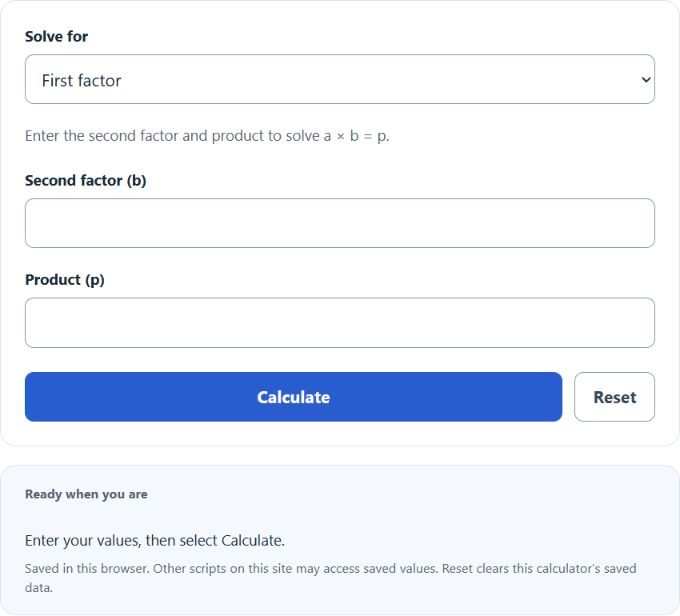
Solve a missing factor or product in a multiplication equation, verify decimal and negative values, and list positive or negative integer factor pairs.
Related Calculators
- Direct Variation Calculator
- Multiplying Percentages Calculator
- Decimal to Ratio Calculator
- Exponent Calculator
- All Math and Numbers Calculators
Factor Pair Counts for Numbers 1 to 100
The number of factor pairs a number has reveals its divisor structure. Prime numbers always have exactly 1 factor pair (1 x p), while highly composite numbers have unusually many. The table below shows the positive factor pair count for key integers up to 100.
| Number | Factor Pairs | Count | Type |
|---|---|---|---|
| 1 | 1 x 1 | 1 | Unit |
| 2 | 1 x 2 | 1 | Prime |
| 6 | 1 x 6, 2 x 3 | 2 | Highly composite |
| 12 | 1 x 12, 2 x 6, 3 x 4 | 3 | Highly composite |
| 24 | 1 x 24, 2 x 12, 3 x 8, 4 x 6 | 4 | Highly composite |
| 36 | 1 x 36, 2 x 18, 3 x 12, 4 x 9, 6 x 6 | 5 | Perfect square, highly composite |
| 48 | 1 x 48, 2 x 24, 3 x 16, 4 x 12, 6 x 8 | 5 | Highly composite |
| 60 | 1 x 60, 2 x 30, 3 x 20, 4 x 15, 5 x 12, 6 x 10 | 6 | Highly composite |
| 72 | 1 x 72, 2 x 36, 3 x 24, 4 x 18, 6 x 12, 8 x 9 | 6 | Composite |
| 96 | 1 x 96, 2 x 48, 3 x 32, 4 x 24, 6 x 16, 8 x 12 | 6 | Composite |
| 100 | 1 x 100, 2 x 50, 4 x 25, 5 x 20, 10 x 10 | 5 | Perfect square |
Key pattern: 60, 72, 84, 90 and 96 share the highest positive factor pair count among integers from 1 to 99: 6 pairs. The divisibility of 60 makes it useful for grouping, but this count alone does not establish why ancient Babylonians chose base-60.
Perfect Squares and Their Unique Factor Structure
Perfect squares always have an odd number of total divisors because one factor pair collapses into a single repeated factor (e.g., 6 x 6 = 36). Every other positive integer has an even divisor count. This means that when you ask “what times what equals 36,” you will find one pair where both factors are identical, while for a non-square like 35 (5 x 7), no such pair exists.
The perfect squares up to 400 and their collapsed factor pairs are: 1 (1×1), 4 (2×2), 9 (3×3), 16 (4×4), 25 (5×5), 36 (6×6), 49 (7×7), 64 (8×8), 81 (9×9), 100 (10×10), 121 (11×11), 144 (12×12), 169 (13×13), 196 (14×14), 225 (15×15), 256 (16×16), 289 (17×17), 324 (18×18), 361 (19×19), and 400 (20×20). The gap between consecutive perfect squares grows linearly: 4-1=3, 9-4=5, 16-9=7, 25-16=9, following the pattern of successive odd numbers.
Properties of Multiplication That Affect Factor Finding
Several algebraic properties govern how factor pairs behave and why the calculator handles certain inputs in specific ways.
Commutative property: a x b = b x a. This means 3 x 8 and 8 x 3 both equal 24. The calculator counts these as one pair rather than two, since order does not change the product.
Zero property: a x 0 = 0 for all values of a. A zero product and a known zero factor leave the missing real factor undetermined: any finite real number satisfies the equation. Integer factor pairs mode accepts positive products only; zero is outside that mode.
Identity property: a x 1 = a. Every positive integer n has the trivial factor pair (1, n). A prime number is defined as a number greater than 1 whose only factor pair is this trivial one.
Sign rules: positive x positive = positive, negative x negative = positive, and positive x negative = negative. For a positive whole-number product, the Include negative factor pairs option also lists the corresponding pairs with both factors negative.
The Divisor Function: Counting Factor Pairs at Scale
In number theory, the divisor function d(n) counts the total number of positive divisors of n. The number of distinct positive factor pairs equals d(n)/2 when n is not a perfect square, and (d(n)+1)/2 when it is. The first 20 values of d(n) are:
| n | 1 | 2 | 3 | 4 | 5 | 6 | 7 | 8 | 9 | 10 | 11 | 12 | 13 | 14 | 15 | 16 | 17 | 18 | 19 | 20 |
|---|---|---|---|---|---|---|---|---|---|---|---|---|---|---|---|---|---|---|---|---|
| d(n) | 1 | 2 | 2 | 3 | 2 | 4 | 2 | 4 | 3 | 4 | 2 | 6 | 2 | 4 | 4 | 5 | 2 | 6 | 2 | 6 |
| Pairs | 1 | 1 | 1 | 2 | 1 | 2 | 1 | 2 | 2 | 2 | 1 | 3 | 1 | 2 | 2 | 3 | 1 | 3 | 1 | 3 |
Notice that d(n) = 2 exactly when n is prime (divisors are only 1 and itself). The largest d(n) in this range is 6, which belongs to 12, 18, and 20. For very large numbers, the divisor function grows slowly: the average value of d(n) for numbers near N is approximately ln(N).
Common What Times What Equals Quick Reference
Below are the complete positive integer factor pairs for the most commonly searched target numbers. Use the calculator above for any number not listed here.
| Target | All Positive Factor Pairs | Prime? |
|---|---|---|
| 5 | 1 x 5 | Yes |
| 8 | 1 x 8, 2 x 4 | No |
| 10 | 1 x 10, 2 x 5 | No |
| 12 | 1 x 12, 2 x 6, 3 x 4 | No |
| 16 | 1 x 16, 2 x 8, 4 x 4 | No |
| 18 | 1 x 18, 2 x 9, 3 x 6 | No |
| 20 | 1 x 20, 2 x 10, 4 x 5 | No |
| 24 | 1 x 24, 2 x 12, 3 x 8, 4 x 6 | No |
| 25 | 1 x 25, 5 x 5 | No |
| 30 | 1 x 30, 2 x 15, 3 x 10, 5 x 6 | No |
| 36 | 1 x 36, 2 x 18, 3 x 12, 4 x 9, 6 x 6 | No |
| 42 | 1 x 42, 2 x 21, 3 x 14, 6 x 7 | No |
| 48 | 1 x 48, 2 x 24, 3 x 16, 4 x 12, 6 x 8 | No |
| 50 | 1 x 50, 2 x 25, 5 x 10 | No |
| 60 | 1 x 60, 2 x 30, 3 x 20, 4 x 15, 5 x 12, 6 x 10 | No |
| 72 | 1 x 72, 2 x 36, 3 x 24, 4 x 18, 6 x 12, 8 x 9 | No |
| 100 | 1 x 100, 2 x 50, 4 x 25, 5 x 20, 10 x 10 | No |
| 144 | 1 x 144, 2 x 72, 3 x 48, 4 x 36, 6 x 24, 8 x 18, 9 x 16, 12 x 12 | No |
Primes, Composites, and Why Factoring Matters
A prime number has exactly one positive factor pair: 1 times itself. Every other integer greater than 1 is composite, meaning it can be broken into at least two distinct factor pairs. The fundamental theorem of arithmetic guarantees that every integer greater than 1 has a unique prime factorization, and from that factorization, you can calculate the exact number of factor pairs without testing every possible divisor.
For a number with prime factorization p1^a1 x p2^a2 x … x pk^ak, the total divisor count is (a1+1)(a2+1)…(ak+1). For example, 360 = 2^3 x 3^2 x 5^1, so d(360) = 4 x 3 x 2 = 24 divisors, which yields 12 factor pairs. This formula explains why numbers with many small prime factors (like 2, 3, and 5) tend to have the most factor pairs relative to their size.
The 25 primes under 100 are: 2, 3, 5, 7, 11, 13, 17, 19, 23, 29, 31, 37, 41, 43, 47, 53, 59, 61, 67, 71, 73, 79, 83, 89, and 97. For any of these, asking what times what equals that prime has only one whole-number answer: 1 times the prime itself.
Where Factor Pairs Appear Outside Mathematics
Factor pairs show up whenever something needs to be divided evenly into rows and columns or groups of equal size. Arranging 24 chairs in a room gives 4 layout options: 1 row of 24, 2 rows of 12, 3 rows of 8, or 4 rows of 6. Packaging 60 items into equally filled boxes permits 12 box sizes: the 12 positive divisors of 60. Screen resolution choices (1920 x 1080, 1280 x 720) are factor pairs of the total pixel count. Musical time signatures rely on how beats subdivide: 4/4 time divides a measure into 4 groups of 1, 2 groups of 2, or 1 group of 4.
In cryptography, the security of RSA encryption depends on the difficulty of finding the two prime factors of a very large composite number. An RSA modulus is constructed from large primes. Its factorization difficulty depends on the number’s structure and the available algorithms and resources; digit count alone does not determine a universal runtime. This calculator lists factor pairs only for positive products up to 10 billion.
FAQ
What does what times what equals mean?
It asks for two numbers (factors) whose product is a given target. For example, what times what equals 36 asks for all pairs like 4 x 9, 6 x 6, 2 x 18, and so on. Integer factor pairs mode lists every unique positive integer pair for a positive product up to 10 billion, with optional pairs of negative factors.
How do the missing-factor and product modes work?
Select First factor, Second factor or Product, then enter the two values requested. Missing factors are found by division when the known factor is nonzero. A zero product and a known zero factor allow any finite real missing factor; a nonzero product with a zero factor has no solution.
Why do perfect squares have an odd number of divisors?
Divisors normally come in pairs (d, n/d). For perfect squares, the square root pairs with itself, adding one unpaired divisor to the total. For example, 36 has divisors 1, 2, 3, 4, 6, 9, 12, 18, 36 (nine divisors), where 6 is the unpaired middle divisor because 6 x 6 = 36.
Can this calculator handle decimals and negative numbers?
First factor, Second factor and Product modes support finite decimal and negative values. Integer factor pairs mode requires a positive whole-number product. Select Yes under Include negative factor pairs to list both-negative pairs as well.
What is the largest number the calculator supports?
Integer factor pairs mode accepts positive whole-number products from 1 through 10 billion (10,000,000,000). Other modes use finite binary floating-point values and display up to 15 significant digits; calculations that overflow or round a nonzero result to zero are rejected.