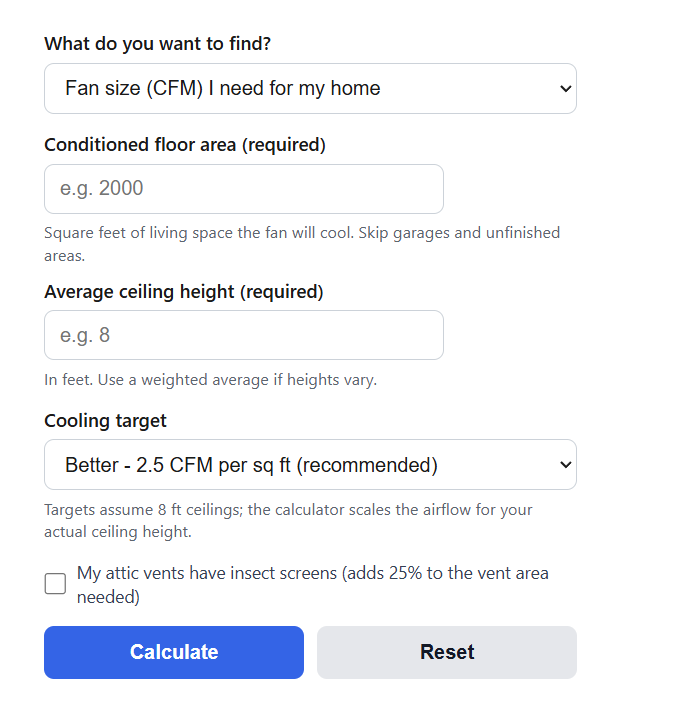
Calculate the whole house fan CFM you need from square footage, ceiling height, and cooling target, plus the attic vent area and window opening to support it.
Whole House Fan CFM Formula
The standard sizing rule multiplies your conditioned floor area by a cooling target of 2 to 3 CFM per square foot, then scales the result for ceiling height:
CFM = A * T * (H / 8)
The same requirement can be written as a volume calculation using air changes per hour:
CFM = (A * H * ACH) / 60
Variables:
- CFM is the required fan airflow in cubic feet per minute
- A is the conditioned floor area in square feet (living space only, not garages or unfinished areas)
- T is the cooling target in CFM per square foot: 2.0 for a good system, 2.5 for most homes, 3.0 for hot climates
- H is the average ceiling height in feet; dividing by 8 adjusts the target for ceilings taller than the standard 8 ft
- ACH is air changes per hour. Whole house fans typically deliver 15 to 23 ACH, which is the same as 2 to 3 CFM per square foot under 8 ft ceilings
The calculator’s first mode applies these formulas directly: enter your floor area, ceiling height, and a cooling target (or a custom ACH), and it returns the required fan size along with the venting that size demands. Those venting requirements come from two more rules:
NFA = CFM / 750
 Window area = CFM / 250
NFA is the net free vent area your attic needs in square feet, based on the rule of 1 square foot per 750 CFM. If your vents have insect screens, the calculator increases this by 25 percent to offset the blocked airflow. Window area is the total open window space in square feet you should provide while the fan runs, based on 4 square feet per 1,000 CFM. Skipping either check is the most common cause of a fan that underperforms its rating.
The second mode works in reverse. Enter the rated CFM of a fan you own or were quoted, and the calculator solves for the air changes per hour it actually delivers in your home:
ACH = (CFM * 60) / (A * H)
It then grades that number against the 15 to 23 ACH range and shows how many minutes the fan needs to exchange all the air in the house once.
Sizing Chart with Attic Vent and Window Requirements
This chart shows required fan sizes for common home sizes with 8 ft ceilings, plus the attic net free vent area and open window area that go with the recommended 2.5 CFM per square foot size. Most sizing charts stop at the CFM number, but the venting columns are what determine whether that airflow actually happens.
| Home size | Good (2.0) | Better (2.5) | Best (3.0) | Attic vent area at 2.5 | Window opening at 2.5 |
|---|---|---|---|---|---|
| 1,000 sq ft | 2,000 CFM | 2,500 CFM | 3,000 CFM | 3.3 sq ft | 10 sq ft |
| 1,500 sq ft | 3,000 CFM | 3,750 CFM | 4,500 CFM | 5.0 sq ft | 15 sq ft |
| 2,000 sq ft | 4,000 CFM | 5,000 CFM | 6,000 CFM | 6.7 sq ft | 20 sq ft |
| 2,500 sq ft | 5,000 CFM | 6,250 CFM | 7,500 CFM | 8.3 sq ft | 25 sq ft |
| 3,000 sq ft | 6,000 CFM | 7,500 CFM | 9,000 CFM | 10.0 sq ft | 30 sq ft |
| 3,500 sq ft | 7,000 CFM | 8,750 CFM | 10,500 CFM | 11.7 sq ft | 35 sq ft |
| 4,000 sq ft | 8,000 CFM | 10,000 CFM | 12,000 CFM | 13.3 sq ft | 40 sq ft |
For ceilings taller than 8 ft, multiply the CFM values by your ceiling height divided by 8. The second table translates each cooling target into what it feels like in practice. The air change time is the number of minutes the fan needs to replace every cubic foot of air in the house.
| Target | Air changes per hour | One air change every | Best for |
|---|---|---|---|
| Under 1.5 CFM/sq ft | Below 11 | Over 5.3 min | Undersized for whole house cooling; closer to attic fan duty |
| 2.0 CFM/sq ft | 15.0 | 4.0 min | Mild climates, cool nights, lowest noise and cost |
| 2.5 CFM/sq ft | 18.8 | 3.2 min | Recommended balance of speed and sound for most homes |
| 3.0 CFM/sq ft | 22.5 | 2.7 min | Hot inland climates, fast evening purge of trapped heat |
The 15 to 23 ACH band matches the Department of Energy’s guidance for whole house fans. Sizing inside it cools the house in minutes while drawing a few hundred watts, a small fraction of what central air conditioning uses.
Whole House Fan CFM Example Problems
Example 1: A 1,800 sq ft single story home has standard 8 ft ceilings, and you want the recommended 2.5 CFM per square foot. The required airflow is 1,800 * 2.5 * (8 / 8) = 4,500 CFM. That fan needs 4,500 / 750 = 6.0 sq ft of attic net free vent area and 4,500 / 250 = 18 sq ft of open window while it runs. It delivers 18.8 air changes per hour, one full air change every 3.2 minutes.
Example 2: You were quoted a 4,500 CFM fan for a 2,200 sq ft home with 9 ft ceilings. The house volume is 2,200 * 9 = 19,800 cu ft, so the fan delivers (4,500 * 60) / 19,800 = 13.6 air changes per hour, about 2.0 CFM per square foot of floor but below the 15 ACH mark once the taller ceilings are counted. It exchanges the air every 4.4 minutes. That is workable for mild evenings, but stepping up one fan size would bring the home into the recommended range.
Frequently Asked Questions
How many CFM do I need for a 2,000 square foot house?
With 8 ft ceilings, plan on 4,000 to 6,000 CFM, with 5,000 CFM as the recommended middle target. A fan in that range changes the air in the house every 3 to 4 minutes. To support it, the attic needs about 6.7 sq ft of net free vent area and you should open around 20 sq ft of windows while the fan runs. If your ceilings average 9 ft, scale the airflow up by 9/8, which moves the recommendation to about 5,600 CFM.
Can a whole house fan be too big?
Yes. Above roughly 3 CFM per square foot the extra airflow adds noise and cost without much added cooling, and an oversized fan can outrun the attic’s venting. When exhaust air cannot escape fast enough, static pressure builds, airflow drops below the rating, and in homes with gas water heaters or furnaces the fan can pull combustion gases back down the flue if windows are not open. If your calculated size exceeds your attic’s net free vent area, either add roof or gable venting or choose a multi-speed fan and run it lower.
Is a whole house fan the same as an attic fan?
No. A whole house fan mounts in the ceiling between the living space and the attic, pulls air through open windows, and exhausts it out the attic vents, cooling the whole home. An attic fan only ventilates the attic itself and is sized far smaller, at roughly 0.7 CFM per square foot of attic floor area. The two are sized with different rules, and an attic fan cannot substitute for the airflow this calculator recommends.