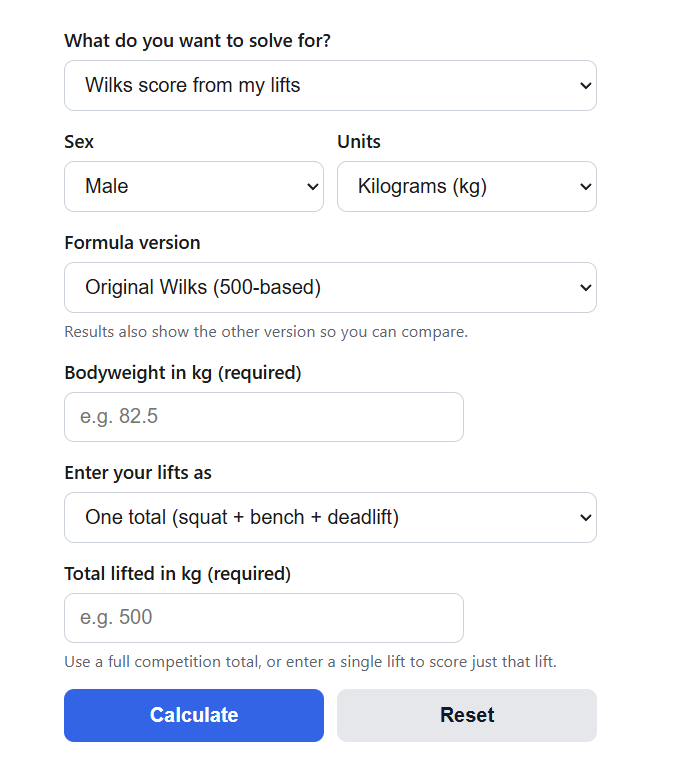
Calculate your Wilks score from bodyweight and powerlifting total in kg or lb, using the original or 2020 formula, or find the total needed for a target score.
Wilks Score Formula
Wilks Score = W * 500 / (a + b*x + c*x^2 + d*x^3 + e*x^4 + f*x^5)
- W is the total weight lifted in kilograms, usually your best squat, bench press, and deadlift added together
- x is your bodyweight in kilograms
- a, b, c, d, e, and f are fixed coefficients that differ for men and women
The fraction 500 / (a + b*x + … + f*x^5) is called the Wilks coefficient. It shrinks as bodyweight rises, which is how the formula levels the playing field between light and heavy lifters. Multiplying your total by the coefficient converts it into a bodyweight-adjusted score that can be compared across weight classes and between men and women.
For men, the original coefficients are a = -216.0475144, b = 16.2606339, c = -0.002388645, d = -0.00113732, e = 7.01863E-06, and f = -1.291E-08. For women, they are a = 594.31747775582, b = -27.23842536447, c = 0.82112226871, d = -0.00930733913, e = 4.731582E-05, and f = -9.054E-08.
In March 2020, Powerlifting Australia released a rebalanced version of the formula, often called Wilks-2 or the 2020 Wilks. It uses new coefficient sets for men and women and a 600 multiplier instead of 500:
Wilks-2 Score = W * 600 / (a + b*x + c*x^2 + d*x^3 + e*x^4 + f*x^5)
The calculator supports both versions and always displays the other version alongside your chosen one so you can compare. In score mode, it multiplies your total by the coefficient for your sex and bodyweight. You can enter one combined total or separate squat, bench, and deadlift numbers, and pound inputs are converted to kilograms (divided by 2.20462) before the polynomial is applied. In target mode, the calculation runs in reverse to tell you the total you need for a chosen score:
Required Total = Target Score / Wilks Coefficient
Wilks Score Benchmarks and Required Totals
Wilks scores are most useful when you know what a given number means in practice. The benchmarks below reflect commonly used interpretation ranges for raw lifters on the original 500-based scale. Scores from the 2020 formula run roughly 15 to 20 percent higher, so do not judge a 2020 score against this table.
| Level | Men (original Wilks) | Women (original Wilks) |
|---|---|---|
| Beginner to recreational | Under 300 | Under 200 |
| Competitive at local meets | 300 to 350 | 200 to 250 |
| Strong intermediate | 350 to 400 | 250 to 300 |
| Advanced, national level | 400 to 450 | 300 to 350 |
| Elite, international level | 450 and up | 350 and up |
The next table turns the formula around and shows the total you would need to lift at different bodyweights to reach three common Wilks milestones, using the original formula. It is a quick way to set a training target without running the calculator repeatedly.
| Sex | Bodyweight | Total for Wilks 300 | Total for Wilks 400 | Total for Wilks 500 |
|---|---|---|---|---|
| Male | 60 kg | 351.8 kg | 469.0 kg | 586.3 kg |
| Male | 75 kg | 421.0 kg | 561.4 kg | 701.7 kg |
| Male | 90 kg | 469.9 kg | 626.6 kg | 783.2 kg |
| Male | 105 kg | 502.0 kg | 669.4 kg | 836.7 kg |
| Male | 120 kg | 521.8 kg | 695.7 kg | 869.7 kg |
| Female | 50 kg | 233.5 kg | 311.4 kg | 389.2 kg |
| Female | 60 kg | 269.1 kg | 358.8 kg | 448.5 kg |
| Female | 75 kg | 315.6 kg | 420.8 kg | 526.0 kg |
| Female | 90 kg | 347.2 kg | 462.9 kg | 578.7 kg |
Example Problems
Example 1: A male lifter weighs 100 kg and totals 600 kg (for instance a 220 kg squat, 150 kg bench, and 230 kg deadlift). Evaluating the original men’s polynomial at x = 100 gives a denominator of about 821.57, so the coefficient is 500 / 821.57 = 0.6086. His Wilks score is 600 kg * 0.6086 = 365.15, a strong intermediate result. Under the 2020 formula the same lifts score 437.62, which shows why the two versions should never be compared directly.
Example 2: A female lifter weighs 60 kg and wants to know what total she needs for a 400 Wilks. Her original-formula coefficient at 60 kg bodyweight is 1.1149. Rearranging the formula, Required Total = 400 / 1.1149 = 358.8 kg. If her current total is 300 kg, her score today is 300 * 1.1149 = 334.47, so she needs about 59 more kilograms across her three lifts to reach the target.
Frequently Asked Questions
What is a good Wilks score?
On the original scale, 300 is a solid recreational benchmark for men, 350 is competitive at local meets, 400 is roughly national level, and 450 to 500 or more is elite. For women, the equivalent milestones sit about 100 points lower, so 250 to 300 is strong and 350 or more is elite. These are informal guidelines for raw lifters rather than official standards, and equipped lifting shifts them upward.
Why are my original and 2020 Wilks scores so different?
The 2020 update changed both the coefficients and the multiplier, moving from 500 to 600, so scores from the new version run roughly 15 to 20 percent higher for the same lifts. The rebalance also aligned men’s and women’s scoring more closely and fixed distortions at very light and very heavy bodyweights. Always check which version a leaderboard or meet uses before comparing numbers. Note that many federations now use other systems entirely, such as DOTS or IPF GL points, but Wilks remains the most widely recognized gym benchmark.
Can I enter my lifts in pounds?
Yes. The formula itself is defined in kilograms, so the calculator divides pound inputs by 2.20462 to convert bodyweight and total to kilograms before applying the polynomial. The resulting score is the same either way because the Wilks score is a normalized number, not a weight. Results are shown with both kilogram and pound equivalents of your total.