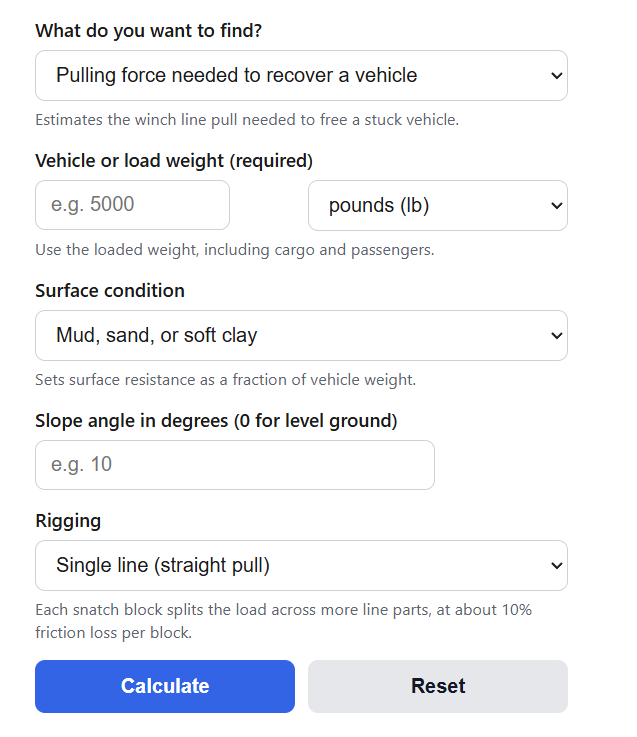
Calculate the winch pulling force needed to free a stuck vehicle, winch force from motor torque, and the pull available at each rope layer on the drum.
Winch Pulling Force Formula
F = W*fs + W*sin(a)
Fw = F / (n * 0.9^(n-1))
- F is the total resistance at the load (lb)
- W is the vehicle or load weight (lb)
- fs is the surface resistance factor (see table below)
- a is the slope angle in degrees
- Fw is the line pull required at the winch (lb)
- n is the number of line parts (1 for a single line, 2 for a double line, 3 for a triple line)
The recovery mode of the calculator uses these two equations. Surface resistance is the weight multiplied by a factor that depends on how badly the vehicle is stuck, and grade resistance adds the weight component acting down the slope. Rigging a snatch block splits the total resistance across more line parts, with roughly a 10 percent friction loss per block, which is why a double line needs about 55 percent of the single line pull rather than exactly half.
F = T*G*e / r
- F is the winch pulling force (N or lb)
- T is the motor torque (N*m or lb*ft)
- G is the gear ratio between the motor and drum
- e is the gear train efficiency as a decimal
- r is the drum radius (m or ft)
The torque mode uses this equation to find the force a winch can generate at the drum. If you already know the torque delivered at the drum, leave the gear ratio and efficiency at their defaults.
Pn = P1 * (D + d) / (D + (2n - 1)*d)
- Pn is the pulling force available on rope layer n
- P1 is the rated line pull on the bare drum (layer 1)
- D is the bare drum diameter
- d is the rope diameter
The layer mode uses this equation to show how the rated capacity falls as rope stacks up on the drum. Each layer increases the effective radius the winch must pull against, so the same torque produces less force.
Surface Resistance Factors and Layer Derating
The first table lists the surface resistance factors used by the calculator, along with the resulting resistance for a typical 5,000 lb vehicle on level ground. These factors come from standard vehicle recovery practice.
| Surface condition | Factor (fs) | Resistance, 5,000 lb vehicle |
|---|---|---|
| Hard road (rolling freely) | 0.04 | 200 lb |
| Gravel | 0.20 | 1,000 lb |
| Grass | 0.25 | 1,250 lb |
| Shingle / loose rock | 0.33 | 1,650 lb |
| Mud, sand, or soft clay | 0.50 | 2,500 lb |
| Bogged to the axles | 1.00 | 5,000 lb |
| Bogged to the top of the wheels | 2.00 | 10,000 lb |
| Bogged to the hood | 3.00 | 15,000 lb |
The second table shows something most winch guides leave out: the pull printed on a winch only applies to the first layer of rope on the drum. This example uses a 9,500 lb winch with a 2.5 inch drum and 3/8 inch rope. By the fourth layer, the winch delivers barely more than half its rated pull, which is why you should spool out as much rope as possible before a hard pull.
| Rope layer | Available pull | Percent of rating |
|---|---|---|
| Layer 1 (bare drum) | 9,500 lb | 100% |
| Layer 2 | 7,534 lb | 79.3% |
| Layer 3 | 6,243 lb | 65.7% |
| Layer 4 (full drum) | 5,329 lb | 56.1% |
Example Problems
Example 1: recovering a stuck truck. A 5,200 lb truck is bogged to its axles in mud (fs = 1.00) on a 10 degree uphill slope, and you rig a double line through one snatch block. Surface resistance is 5,200 * 1.00 = 5,200 lb. Grade resistance is 5,200 * sin(10) = 903 lb. Total resistance is 6,103 lb. With two line parts and one snatch block, the required winch line pull is 6,103 / (2 * 0.9) = 3,391 lb. After the standard 1.5 safety margin is applied, a winch rated around 5,500 lb or more handles this pull comfortably.
Example 2: pulling force from torque. A winch delivers 180 lb-ft of torque at a drum with a 5-inch diameter, so the drum radius is 2.5 inches. Converting torque to pound-inches gives 180 * 12 = 2,160 lb-in. The pulling force is 2,160 / 2.5 = 864 lb on the first rope layer.
Winch Pulling Force FAQ
What size winch do I need for my vehicle? The common rule of thumb is a rated line pull of at least 1.5 times the loaded weight of your vehicle. A 5,000 lb truck calls for a winch rated at 7,500 lb or more. The rule builds in margin for slopes, suction in mud, and the capacity you lose as rope layers build on the drum. If you regularly sink to the axles or deeper, size from the calculator result instead, since a badly bogged vehicle can need more than its own weight in pull.
Does a snatch block double my winch’s pulling power? Not quite. Rigging a double line splits the load across two line parts, so in theory the winch only needs to supply half the total resistance. In practice the block adds roughly 10 percent friction loss, so a double line delivers about 1.8 times the effective capacity, not 2.0. A second block for a triple line gives about 2.4 times. The trade-off is speed: each added line part slows the recovery proportionally.
Why does my winch feel weaker when the drum is full of rope? A winch produces torque, and pulling force equals torque divided by the working radius. Every layer of rope wound onto the drum increases that radius by one rope diameter, so the force drops layer by layer. A typical winch loses 10 to 12 percent of its pull with each added layer and delivers only 50 to 60 percent of its rating on a full drum. Before a maximum-effort pull, spool out rope until only one layer remains, anchoring farther away if needed.